
Visual iteration of musically induced frissons
Research title? Perhaps. Feedback from Michael is very positive. It does roll off the tongue nicely.
Consider the ecology of social relations within cultural and creative hubs.
Quantifying feelings
"Feel is being human." — Butch Vig (Grohl 2013, 01:24:00 )
My MoP capstone project was born of frustration to quantify musical emotion. Musicians speak of music (feeling, emotion, energy, rhythm) in a heartfelt, honest and raw manner, which, as I understand it, is not acceptable in an academic context.
Subsequently, I sought ways to contextualise the language used by non-academics to describe their connection with music (including my own) in an academic framework.
I have been watching a wide range of music documentaries, researching philosophers including Foucault [1] and Kant, and expanding on my study of music culture, phenomenology and brain sciences.
The song 'Guided by Angels' by Melbourne punk four-piece Amyl and the Sniffers (2021) reflects the significance of energy with emotional states. In the chorus, Amyl and the Sniffers frontwoman Amy Taylor declares, "Energy, good energy and bad energy. I've got plenty of energy. It's my currency. I spend, protect my energy, currency."
Perfect.
Footnotes
I am particularly interested in Foucault’s theories on power and knowledge (Heroux 2001).
Bibliography
Amyl and the Sniffers. "Guided by Angels". Directed by John Angus Stewart. July 8, 2021. Music video. 04:00. https://youtu.be/Z--D1flPLnk.
Cahoon, Lawrence. 2014. “Postmodernism, Truth, and Power. The Great Courses.” Online lecture, 00:32:00. https://rmit.kanopy.com/video/postmodernism-truth-and-power.
Cahoon, Lawrence. 2014. “Kant's Ethics of Duty and Natural Rights. The Great Courses.” Online lecture, 00:31:00. https://rmit.kanopy.com/video/kants-ethics-duty-and-natural-rights.
Grohl, Dave. 2013. Sound City. Film, 01:48:00. United States: Gravitas Ventures. https://rmit.kanopy.com/video/sound-city.
Hardy Jr, Don. 2015. Theory of Obscurity. United States: Film Movement. https://rmit.kanopy.com/video/theory-obscurity.
Heroux, Erick. 2001. "Power. Vol. 3 Of The Essential Works Of Foucault, 1954-1984". Substance 30 (3): 143-150. doi:10.1353/sub.2001.0025.
Jarmusch, Jim. 2016. Gimme Danger. Film. United States: Low Mind Films and New Element Media. https://rmit.kanopy.com/video/gimme-danger-0.
Visual art and soundscapes
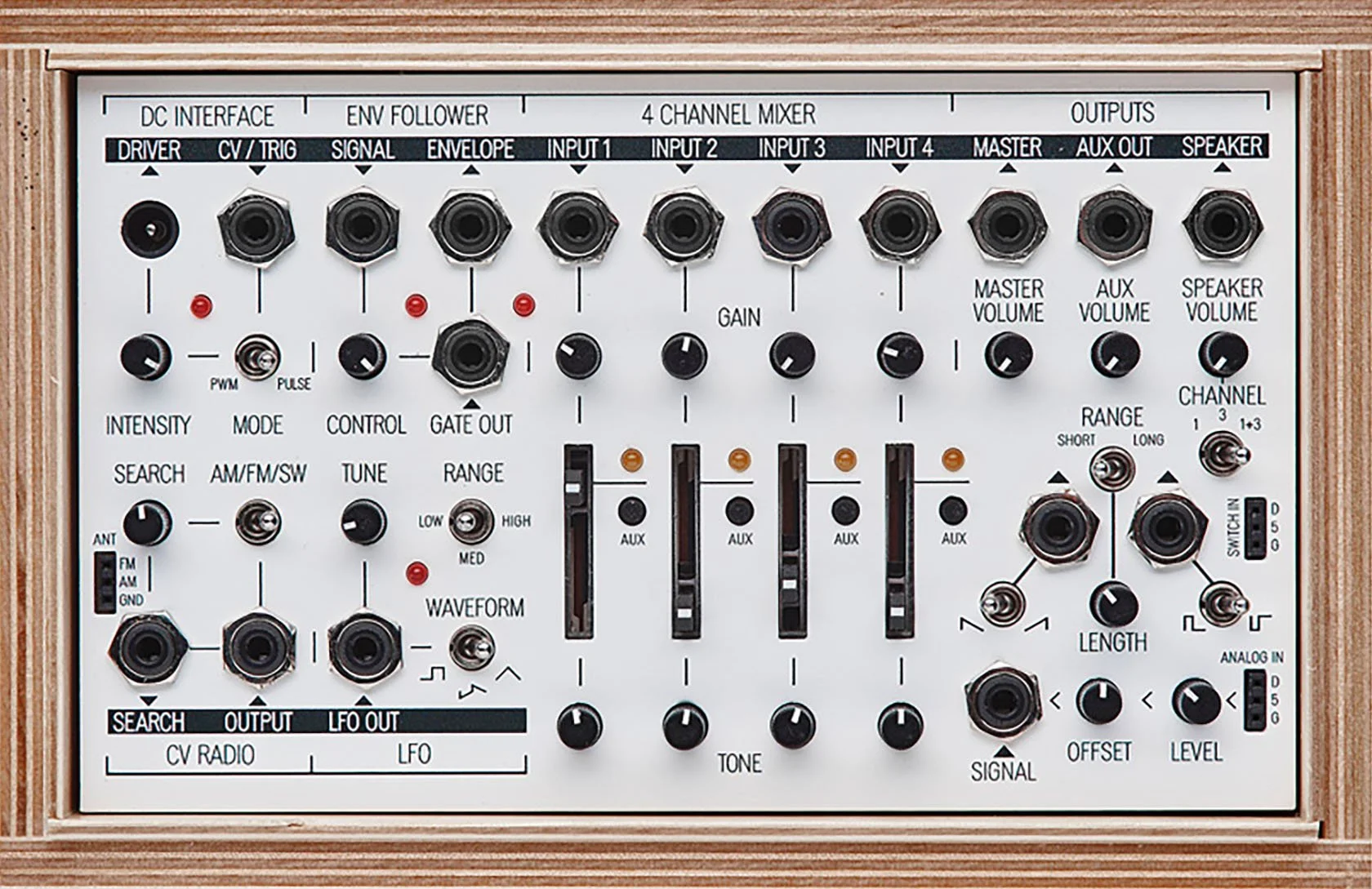
Koma Elektronik, Field Kit – Electro Acoustic Workstation, 2017
Raul Sanchez is an Australian musician. Although best known as the lead guitarist in Magic Dirt, Raul also plays in several other (less known) bands. Additionally, Raul's taste in music is expansive and eclectic, as can be heard in his soundtracks (written for short films), solo projects, and Avant Garde soundscapes (which he refers to as "sound sculptures").
This resonates strongly (see Master of Photography capstone project “Frisson”) which aimed to visualise mental and bodily sensations experienced when listening to music (or musically induced frisson) in a series of abstracted portraits of Melbourne musicians created using alternative analogue photography and printmaking. The involvement and participation of musicians informed the project from the perspective of the live music creative sectors and contributed to my artwork, 'speaking back' to my study of neuroscience, phenomenology and live music culture that underpinned the creative-based research.
Raul and I are discussing numerous collaborative projects, whereby I create 2D works based on soundscapes he has composed, and he creates soundscapes to accompany my visual art (2D).
Musicians and academic theories inform visual art series. My photographic and creative practices used to create series are recorded, sampled and used to compose a soundscape by a working musician. Thus the visual works, informed by live music creative sectors and academic study, come 'full circle' to inspire the music and musician. Full circle.
This week, we are meeting to build on my concept of recording my photographic (analogue) and printmaking processes as samples to create a soundscape or sound sculpture to accompany a visual installation of works.
The equipment Raul will use includes The Koma Field Kit and Koma Field Kit FX, both made in Germany for creating sound art and electro-acoustic music. He has provided links to the equipment, which I have yet to research. Raul referenced Curtis Roads and David Toop (academics who specialise in the field of Avant-Guard music), who I have also begun to investigate.
Keywords
Avant-Garde, Music, Soundscapes, Sound sculpture, 2D art, Curtis Roads, David Toop, Koma Field Kit
Bibliography
Collins, Nick. 2016. "Composing Electronic Music: A New Aesthetic. By Curtis Roads". Music And Letters 97 (4): 675-677. doi:10.1093/ml/gcw092.
Roads, Curtis. Composing Electronic Music: A New Aesthetic. New York: Oxford University Press, 2015. Oxford Scholarship Online, 2015. doi: 10.1093/acprof:oso/9780195373233.001.0001.
Toop, David. 2012. "Sounding The Object: A Timebase Archive". Journal Of Conservation And Museum Studies 10 (1). doi:10.5334/jcms.1011203.
Arvidsson, Alf. 2017. "David Toop. 2016. Into The Maelstrom: Music, Improvisation And The Dream Of Freedom: Before 1970." New York and London: Bloomsbury. ISBN 978-1-5013-1451-3 (Hbk), 978-1-6289-2769-6 (Pbk). 330 Pp.". Perfect Beat 18 (2): 170-172. doi:10.1558/prbt.33480.
Koma Elektronik GmbH. 2016. "FIELD KIT - Electroacoustic Workstation". Kickstarter. https://www.kickstarter.com/projects/komaelektronik/field-kit-electroacoustic-workstation.
Koma Elektronik. 2017. Field Kit – Electro Acoustic Workstation. Image. https://koma-elektronik.com/?product=field-kit.
Soundscapes
Record photographic processes used to create a series (such as agitation of darkroom trays, film developing canisters, timer, winding of film loading film), to sample and create a soundscape that accompanies the visual art. The process brings the work that visually iterates (in 2D imagery) mental and physical sensations induced by listening to music (musically induced frissons and musical emotion) full circle, whereby the processes used to create the art are then used to transform back into music. The intention is that the soundscape then presents an audial iteration of musically induced frissons and musical emotion. Although this soundscape is intended to be part of the final installation, I am keen to produce a limited edition vinyl release. I am currently discussing with a friend who is an established touring and recording musician on the ‘rock scene’ and a talented sound engineer, solo artist and composer who reaches into the ambient noise and the avant garde.
Keywords
Soundscapes, Musical emotion, Frissons
Montage
Inspired by Robert Rauschenberg (Granlund 1997, 03:35), I am keen to explore the artist’s technique of printing my own photographs with vegetable dye and transferring the images to paper. I have also been further researching Modernist artists such as Laszlo Moholy-Nagy, Alexander Rodchenko and Roman Ciezlewitz, along with photographers who primarily work with photograms, including Adam Fuss, Florris Neusüss, Man Ray and Laszlo Moholy-Nagy (again and always) for inspiration in applying assemblage to my work and am intrigued to see the creative direction these previously uncharted processes will lead. Assemblage will relate well in speaking back to and visualising my theoretical study of neuroscience, phenomenology and music culture about (a) musically induced ‘frissons’ and musical emotion, and (b) to how the multilayered nuances of the live music for performers and participants (including rhythm, energy and emotion) interconnect to create a synthesised personal experience. Although the topics of frissons and musical emotions may appear distant to that of analysing the interplays of the live music experience, there is a direct relationship, as frissons (in this instance, musically induced frisson) and the live music experience unfold in real-time as unrepeatable events, not unlike the real-time occurrence of ‘emotional states’. It is worth noting that significant variables contribute to any given mental and physical response to such events and that such responses often vary.
Additional references to come.
Figures to come.
Keywords
Robert Rauschenberg, Montage, Image transfer, Photography, Painting
Bibliography
“Robert Rauschenberg: Man at work”. Directed by Chris Granlund. Arthaus Musik, 1997. https://rmit.kanopy.com/video/robert-rauschenberg-man-work. [Accessed 29 January 2022]
Power: Essential Works of Foucault 1954–84
In “Truth and Juridical Forms” (Foucault 2020, 52-58), contemporary philosopher Michelle Foucault discusses nineteenth-century penal law, stating that (western civilization) penal systems were transformed in the early 1800s.
The question that arises in this domain is why Foucault does not consider imprisonment to encompass a) the provocation of shame and humiliation, b) retaliation (particularly in considering the death penalty and incarceration in itself), and c) forced labour?
Poststructuralism
Several poststructuralists of the 1960s and 1970s, including Michel Foucault (1926-84) and Jean-François Lyotard (1924-98), politicised and radically challenged 'structuralism'. These poststructuralists claimed that everything we do is semiotic (mediated by cultural signs). "All we see, think and know is mediated by signs, language (hence culture)" (Cahoone 2014).
Semiotic constructions that 'suppress or ignore differences and complexities'.
Further research
The distinction between reality and appearance.
Foucaultian definitions of eighteenth-century penal ‘theories and systems’, the four types of 'punishment', and the transformation of codes and systems from the 1820s to 1860s.
"The Postmodern Condition: A Report on Knowledge" (Lyotard 1979).
In Lyotard, "language games" refer to "any social context in which language is used". Note that Foucault discusses "language games" as power plays in which knowledge is used as a political weapon and is utilised or leveraged, not as a tool of learning or attainment of higher understanding for cultural, community or social benefit, but as a tool to assert power (1994, 1–16).
Keywords
Poststructuralism, Power, Politics, Lyotard, Philosophy, Power, Michel Foucault, Knowledge, Weapon, Weaponising knowledge
Bibliography
Cahoone, Lawrence. 2014. "Postmodernism, Truth, And Power". The Great Courses. Video of lecture, 32:00. https://rmit.kanopy.com/video/postmodernism-truth-and-power.
Foucault, Michel. Power: Essential Works of Foucault 1954–84: Volume Three. 3rd ed. Edited by James D. Faubion. Translated by Robert Hurley and others. Great Britain: Penguin Books, 2020.
Heroux, Erick. 2001. "Power. Vol. 3 Of The Essential Works of Foucault, 1954-1984". SubStance 30 (3): 143-150. doi:10.1353/sub.2001.0025.
Music culture and frissons research overlap
There is a crossover in the two fields of research in (a) the study of mental and bodily sensations experienced when listening to music (or musically induced ‘frissons’); and (b) the ongoing sustainability and cohesiveness of live music creative sectors in a post-pandemic era.
The crossover is particularly relevant when considering the dynamics of a traditional face-to-face live music experience compared to that of digital real-time delivery of live music performances, evident on an in-depth examination of the interplays that define the ‘face-to-face’ occurrence as a synthesised ‘real-time’ personal experience that impacts and influences sensory intake and mental and physical states of performers and attendees.
Cultural significance.
Visualising energy and emotion.
Tropes
I embrace the new in my art through experimentation and the urge to investigate breaking down the tropes and boundaries of the photographic image. In this I am fearless.
In 1971, John Baldessari declared, “I will not make any more boring art”. The artist filmed himself writing the statement until the reel ran out.
A commitment that is worth noting.
Keywords
John Baldessari, Anti-trope, Tropes, Fearlessness, Experimentation, Photography
Bibliography
Baldessari, John. 1995. "Interview: I Will Not make any More Boring Art." By Liam Gillick. Art Monthly (Archive : 1976-2005) (187) (1 June 1995): 3-4, 6-7. https://login.ezproxy.lib.rmit.edu.au/login?url=https://www.proquest.com/scholarly-journals/interview-i-will-not-make-any-more-boring-art/docview/1366938379/se-2?accountid=13552. [Acc 23 Jan 2022]
Physics of sound
What is the physics of sound?
How does sound move?
How does the body register ‘sound’?
How does the ear differentiate between ‘noise’ and ‘music’?
Further research
Barad, Robin Fox, Joel Stern
Keywords
Psychophysics, Physics, Sound, Materiality
Recommended reading 1
Check the bibliography and citations (2020–2022 spreadsheets) for more reading material. Additional resources are below (also in bib spreadsheets).
Keywords
Live music, Music culture, History, Venues, Performance, Reading, Research
Bibliography
Beilharz, Peter. 2012. "Rock Lobster: Lobby Loyde And The History Of Rock Music In Australia". Thesis Eleven 109 (1): 64-70. doi:10.1177/0725513611434136.
Crabtree, Deb. “Most People I Know ...” Bookseller + Publisher 89, no. 4 (2009): 45. https://search.informit.org/doi/10.3316/informit.682644202819570.
Homan, Shane, Martin Cloonan, and Jennifer Cattermole. 2015. Popular Music Industries and the State : Policy Notes. London: Taylor & Francis Group. https://ebookcentral.proquest.com/lib/rmit/detail.action?docID=4185755.
Homan, Shane. 2008. “A Portrait of the Politician as a Young Pub Rocker: Live Music Venue Reform in Australia.” Popular music 27, no. 2: 243–256.https://rmit.primo.exlibrisgroup.com/permalink/61RMIT_INST/4t5l5f/cdi_jstor_primary_40212377
Homan, Shane. 2011. “I Tote And I Vote”: Australian Live Music And Cultural Policy”. Arts Marketing: An International Journal 1 (2): 96-107. doi:10.1108/20442081111180322.
Homan, Shane. 2013. "Music And Politics. By John Street. Cambridge And Malden, UK: Polity Press, 2012. ISBN 978-0-7456-3544-6". Popular Music 32 (1): 141-143. doi:10.1017/s0261143012000694.Homan, Shane. 2016. “SLAM: The Music City and Cultural Activism.” Law, social justice & global development 20. https://rmit.primo.exlibrisgroup.com/permalink/61RMIT_INST/4t5l5f/cdi_gale_infotracacademiconefile_A466413302.
Oldham, Paul. 2013. "'Suck More Piss': How the Confluence of Key Melbourne-Based Audiences, Musicians, and Iconic Scene Spaces Informed the Oz Rock Identity." Perfect Beat 14 (2): 120-139. http://ezproxy.lib.rmit.edu.au/login?url=https://www-proquest-com.ezproxy.lib.rmit.edu.au/scholarly-journals/suck-more-piss-how-confluence-key-melbourne-based/docview/1503663412/se-2?accountid=13552.
Connect like a musician
I connect with photography musically, aiming to iterate musical emotion in the viewer. Despite playing in bands in the 1980s, I struggled to connect with music when performing. In short, I was terrified of getting it ‘wrong’. This was also heightened by the pressure of being part of a ‘team’. Although I am my own worst critic (which is fine as it is a great motivator), experience has taught me that I am a lone wolf and work most efficiently when I have myself to answer for.
Post-musician, I found the connection to music and with music through photography. Applying an apparatus based approach to my practice whereby my instruments are the equipment, processes are the notes and artworks the songs.
To advance, I need to learn how to “touch” sound and have asked an established sound engineer for an internship.
A conversation with my daughter …
“Why don’t you play anymore?”
“I do.”
“No, why don’t you play an instrument?”
“The camera is my instrument.”
“No, like play guitar?
“Because it frightens me. I am scared of getting it ‘wrong’ and letting the ‘team’ down. Photography is my freedom. I have no fear in the camera. I embrace and explore every nuance, anomaly, mishap and accident to break down barriers. The possibilities are endless.”
Waste nothing
[TOPIC] I have experienced issues with one of my large format cameras which resulted in approximately a quarter of the negative being exposed (Figure 1).
Figure 1
Although the problem was resolved by reading over the manufacturer manual and disassembling some of the camera parts, I was still left with eight sheets of 4x5 film that held a partial image. As such, I have scanned the negatives and created a polyptych (Figure 2) with the exposed segments from each of the eight negatives.
Figure 2
Fragments
Ballarat Botanical Gardens 2021
4x5LF
[EXPLAINATION]
[ANALYSIS]
Keywords
4x5, Large format, Ballarat