
Adams, Kandinsky and Barth on rhythm
Many artists practice, like my own, is significantly shaped or influenced by music. Ansel Adams used musical terms for these processes, characterising 'image management as 'the score' and value management as 'the performance'[1] (Latour 1998, 147). Visualisation is primary to my image making in all fields. It is inherent and, in contrast to Adams’, an intuitive process relying on instinct and “feeling”. As with Adams, Kandinsky applies musical terminology to his art practice, as evident in the ‘Composition’ series. Kandinsky writes:
“Every work of art comes into being in the same way as the cosmos by means of catastrophes, which ultimately create out of the cacophony of the various instruments that symphony we call the music of the spheres […] The very word composition called forth in me an inner vibration. Subsequently, I made it my aim in life to paint a ‘composition’” (Dabrowski 1995, 10).
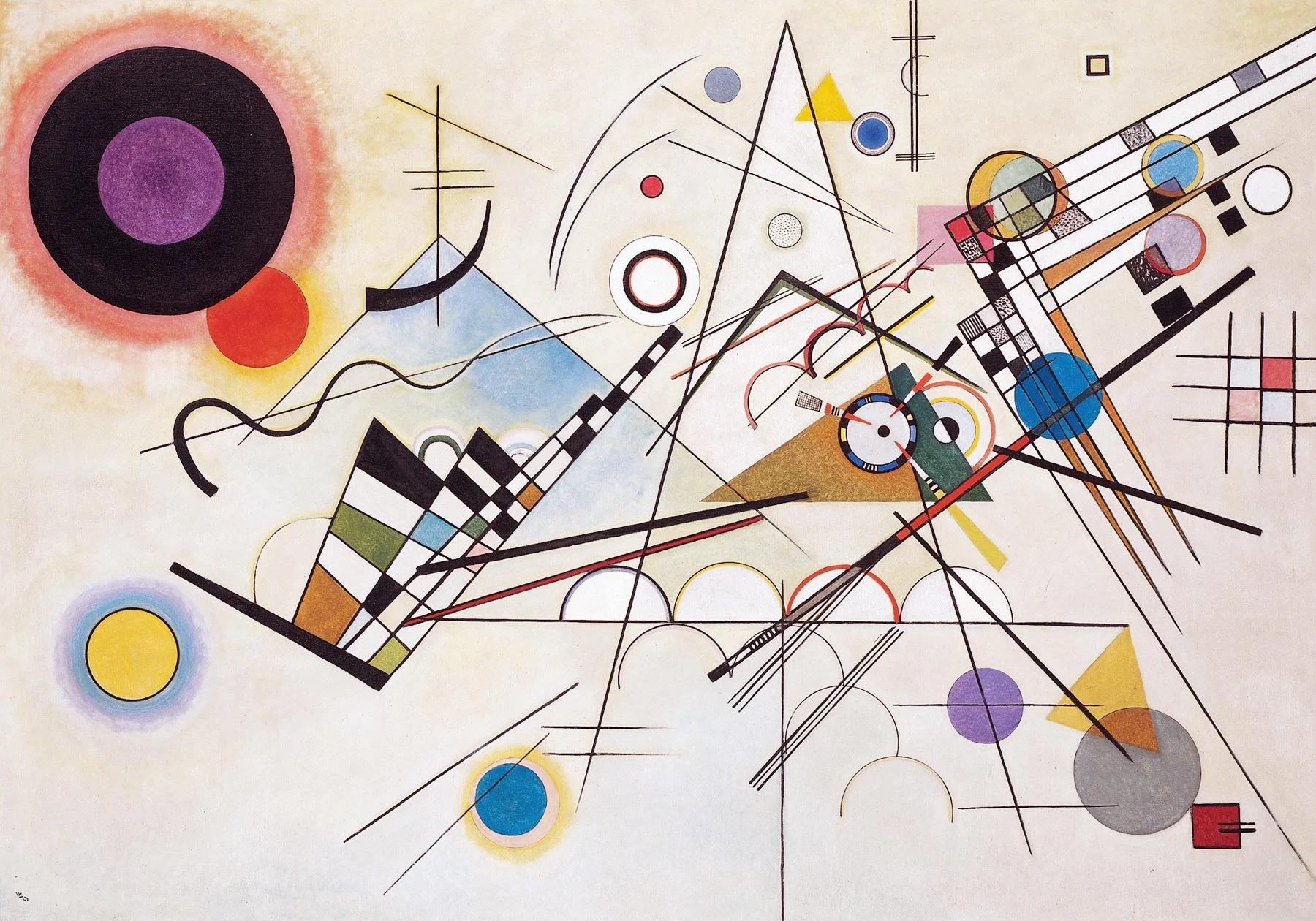
Wassily Kandinsky, Composition VIII, 1923, oil on canvas, 1400x2010mm
Similarly, contemporary photographer Uta Barth explores perception, attempting to ask questions about vision, photographing sound, non-space and in-betweens (Henkin 2015). Barth discusses how rhythm connects to and resonates through her photographic practice, from agitating developing trays to the mindful layout of a photography book (ibid). The statement also reveals the significance of an apparatus-based approach to Barth’s practice.

Uta Barth, Ground #30, 1994, chromogenic print on panel; 559x457mm
Ou et al. (2004, 232) assert, "[Colour] evokes various emotional feelings such as excitement, energy, and calmness. These feelings, evoked by either colours or colour combinations, are called colour emotions."
Keywords
Music, Art, Colour, Kandinsky, Adams, Barth, Zone system, Visualisation
Footnotes
Ansel Adams’ visualisation theory comprised two processes, a) 'image management' relating to 'point of view and the optical and camera-adjustment control of the image up to the moment of exposure', and b) 'value management' relating to exposure and development of the negative providing 'information for the expressive print'.
Bibliography
Barth, Uta. 1994. Ground #30. Image. https://utabarth.net/work/ground/#image-3.
Dabrowski, Magdalena. 1995. “Kandinsky Compositions: The Music of the Spheres.” MoMA 19: 10–13. http://www.jstor.org/stable/4381285.
Henkin, Lauren. 2015. "Artists On Rhythm: Uta Barth". Tilted Arc. http://www.tilted-arc.com/2015/01/27/artists-on-rhythm-uta-barth/nggallery/thumbnails.
Kandinsky, Wassily. 1923. Composition VIII. Image. https://www.wassilykandinsky.net/work-50.php.
Latour, Ira H. 1998. "Ansel Adams, The Zone System And The California School Of Fine Arts". History Of Photography 22 (2): 147-154. doi:10.1080/03087298.1998.10443870.
Ou, Li-Chen, M. Ronnier Luo, Andrée Woodcock, and Angela Wright. 2004. "A Study Of Colour Emotion And Colour Preference. Part I: Colour Emotions For Single Colours". Color Research & Application 29 (3): 232-240. doi:10.1002/col.20010.
Live music venue accountability
Considering the conduct of many owners of live music venues during the pandemic, my research extends to how and when pubs and live music venues became 'the scene' over and above the music. The topic is vast and extends to a culture that exploits artists (and subsequently patrons and fans) and funding opportunities under the veil of supporting live music creative sectors.
To illustrate, many venues receive grant funding to pay artists guarantees with no adequate mechanisms to ensure accountability on part of the grant recipients. Artists are still being stiffed, and in cases such as this, so are taxpayers, music fans and the live music creative sectors as a whole.
Keywords
Music culture, Venues, Artists, Accountability
Reflection on selecting resolved work
My task is to produce one resolved work per week over the remaining weeks of the semester. Although only two weeks in, there are several interesting points to note. First, selecting a single image as 'resolved' is more challenging than anticipated. This is partly due to my spending at least a decade working on a series where the artworks are created or curated for a predetermined (or planned) outcome. The task of making one resolved work per week fosters a different way of thinking about how I make and curate my art.
'Letting go' when working on a series is simple, considering one is developing a narrative that underpins an overarching topic. Although only two weeks into the task, I can see how breaking this mindset down is a valuable creative and personal learning curve while taking 'letting go' to new heights.
Time to choose.
Tropes
I embrace the new in my art through experimentation and the urge to investigate breaking down the tropes and boundaries of the photographic image. In this I am fearless.
In 1971, John Baldessari declared, “I will not make any more boring art”. The artist filmed himself writing the statement until the reel ran out.
A commitment that is worth noting.
Keywords
John Baldessari, Anti-trope, Tropes, Fearlessness, Experimentation, Photography
Bibliography
Baldessari, John. 1995. "Interview: I Will Not make any More Boring Art." By Liam Gillick. Art Monthly (Archive : 1976-2005) (187) (1 June 1995): 3-4, 6-7. https://login.ezproxy.lib.rmit.edu.au/login?url=https://www.proquest.com/scholarly-journals/interview-i-will-not-make-any-more-boring-art/docview/1366938379/se-2?accountid=13552. [Acc 23 Jan 2022]