
Camera installation
The first video is of an exhibition-style installation of cameras used and built to create projects for MFA Studio 1 , Assignment 2, the second shows experimenting with installation presentation of pinhole cameras constructed for the MFA Studio project.
Keywords
Studio 1, Camera installation, Lomography, Large format, 35mm, Pinhole, DIY pinhole
Bibliography
Damage, Zo. 2022. “Installation of cameras”. Zo Damage. June 17, 2022. YouTube video, 01:35. https://youtu.be/Coc8hPJ_ajM.
Preparing Gossard Space
Cleaning Gossard Space in preparation for installation of my mini project of displaying the cameras used, made and modified to create images for subsequent mini projects which include pinhole photography, 35mm photography, lomography, large format photography.
Keywords
Studio 1, Cleaning, Gossard, Assignment 2, Installation preparation
Bibliography
Damage, Zo. 2022. 2022. “Preparing Gossard”. Zo Damage. June 7, 2022. YouTube video, 01:35. https://youtu.be/cjecnOcVDH0.
Slideshow with soundscape
Raul Sanchez[1] and I collaborated in composing a soundscape (Damage and Sanchez 2022) comprised exclusively of recordings of my analogue photographic processes to accompany a display of images I have created for Studio 1. Sanchez made the recordings in situ, resampling and mixing the material in his studio. Contemplating Wabi Sabi' sound', I have edited the soundscape and embedded it into a slideshow of random images created for my Studio 1 projects. Titled Exposure (Damage and Sanchez 2022), the composition reflects the 'evolving' and 'devolving' Wabi Sabi aesthetic, transforming 'process' into music to further challenge the 'photographic index'[2] while exploring modes of representing and iterating 'musical emotion', perception and observational awareness of the photographer's presence and intention in the image (Berger 1972, 10).
Footnotes
Sanchez is a founding member of Melbourne rock band Magic Dirt, solo artist, sound artist and recording engineer.
“Photography is indexical insofar as the represented object is ‘imprinted’ by light and the chemical (or electronic) process on the image, creating a visual likeness that possesses a degree of accuracy and ‘truthfulness’ unattainable in purely iconic signs such as painting, drawing, or sculpture.” (Sadowski 2011)
According to Sanchez, the Kontakt is “a plugin sampler that can vary the pitch, and length etc, of the sounds to create a variety of Virtual Instruments”.
Keywords
Studio 1, Wabi Sabi, Sound, Soundscape, Slideshow, Raul Sanchez, Sound art
Bibliography
Berger, John. 1972. Ways of Seeing. Penguin Books
Damage, Zo. 2022. 2022. “Slideshow with soundscape 2”. Zo Damage. June 7, 2022. YouTube video, 02:57. https://youtu.be/3ek06V-vqWU.
Damage, Zo, and Raul Sanchez. 2022. Exposure. Online soundtrack. https://zed-oh.com/mfa-journal/exposure-soundtrack.
Sadowski, Piotr. 2011. “The Iconic Indexicality Of Photography”. John Benjamins Publishing Catalog. https://benjamins.com/catalog/ill.10.20sad.
Sanchez, Raul. 2022. Experimental music. Email.
S1 A1 reflection
Feedback
Zo, you've done more experimentation than we have actually engaged with in our 3 conversations to date. The previous work is not so relevant to this report and I vote we leave this behind, for now, we don't need to make new work in relation to those projects. I think the paint experiments are better than you think they are, and actually, I am interested in digging them out for our next discussion, as well as the work you are currently doing! I have made a comment on the frisson theory, this may or may not be relevant going forward, but the term is not so specific as your reference would have it. I think slowing down is really key at present. I can appreciate that you have already completed a Masters and that you are quite a fast thinker. But, we are not in any hurry and we have nothing to prove.
Response
It seems I have misunderstood a few things regarding previous work, which I see as a positive moving forward. More than happy to let that work go and second your vote. Some of the painting experiments have been thrown out. Some not. I'll dig out what I kept for our next meeting. I have a long way to go with embracing slowing down Dom, although I am improving. There is always something to prove to myself.
Reflection
Although there has been valuable guidance and advice, I feel that I am not only grossly misunderstood but also underestimated and deserve better than ‘commencing’ in the rubric. As stated in my interview for the MFA, I have no interest in 'exploring' new modes of making. Further, my interests are expanding on my generative art practice and continued investigation of how rhythm and energy manifest in the creative process and visual iteration of frissons. Notably, this now extends to studying how apparatus-based practice (analogue photography and experimental darkroom) can serve as a means of communication and self-expression that transgresses written and spoken language for the artist and challenge the indexicality, tropes, and traditional notions of what a photograph should be. Consequently, I am questioning how much of what was discussed in my meeting has been considered or taken on board by the university and whether I should continue my study in the MFA or reassess the program structure and move into Studio 3.
Submission
My initial experiments[1] created for the Master of Fine Art program included introducing unfamiliar elements into my practice, such as painting (Figures 1 and 2). At the time, I felt the results to be unsatisfactory failing to reflect or iterate the frissons I experience when listing to music and making and viewing art, but more my frustration in working with the medium. Printmaking artefacts (Figure 3) and abstract film photography (Figure 4) were also used to make photogravure prints on various substrates (Figures 3–5). Although the traces and movement in the artefacts and abstract photography were captivating, offering a potential representation of physical and psychological networks that receive and interpret auditory and visual stimuli, which manifest tangibly as frissons. As with the painting, I was not satisfied with the prints outcomes, representation, or overall aesthetic and have chosen not to work with these visual concepts as they feel forced and cliché. Additional experiments painting ink on tracing paper (Figures 6 and 7) and mixed media montages were made, but as with the methods outlined above, did not result in successful outcomes and have thus not been pursued.
Figure 1. Untitled 2022, mixed media on cardboard, 420x590mm
Figure 2. Untitled, 2022, acrylic on foam-core, 297x420mm
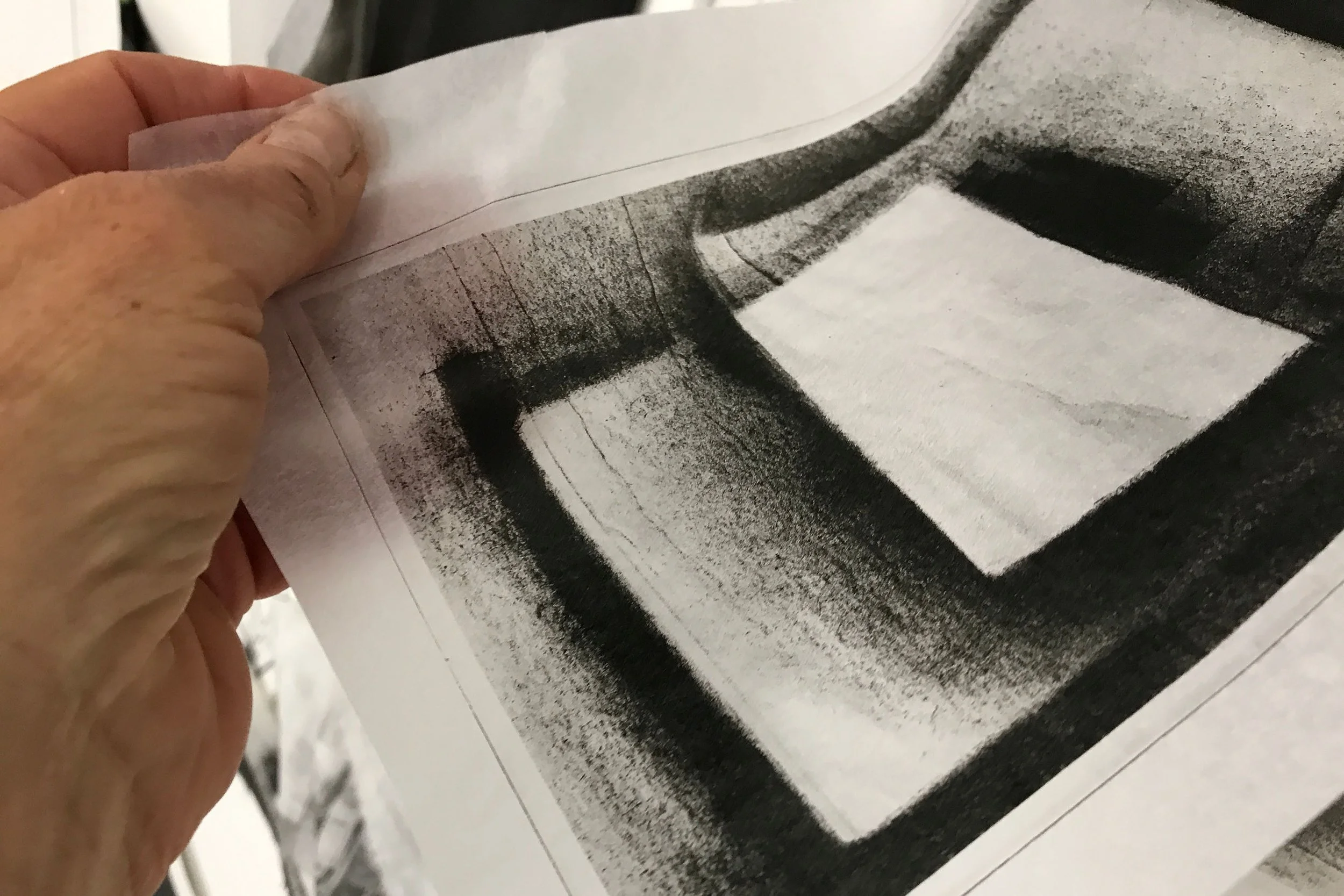
Figure 3. Untitled, 2022, photogravure on linen, plate size 148x210mm
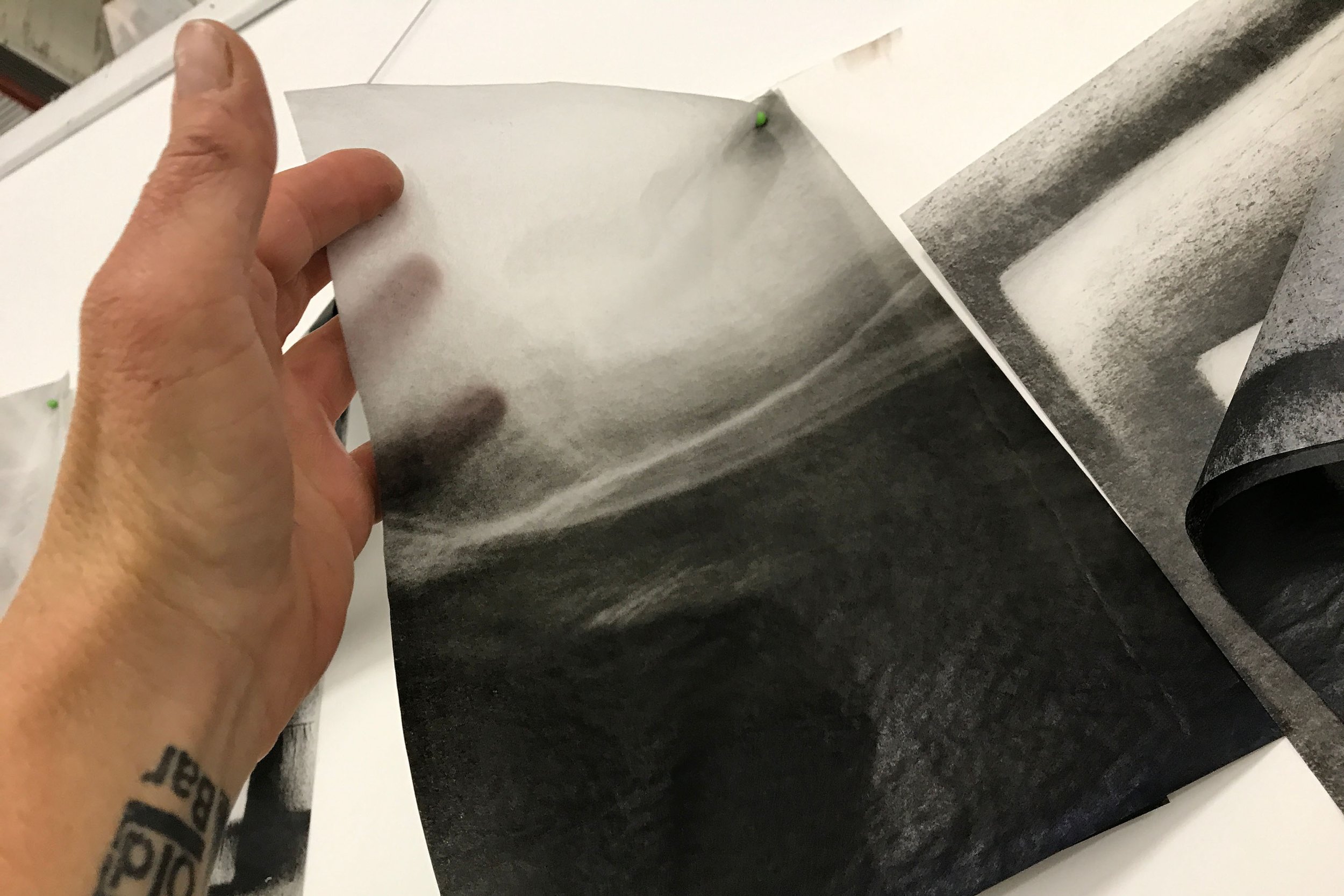
Figure 4. Untitled, 2022, photogravure on tissue paper, plate size 210x297mm
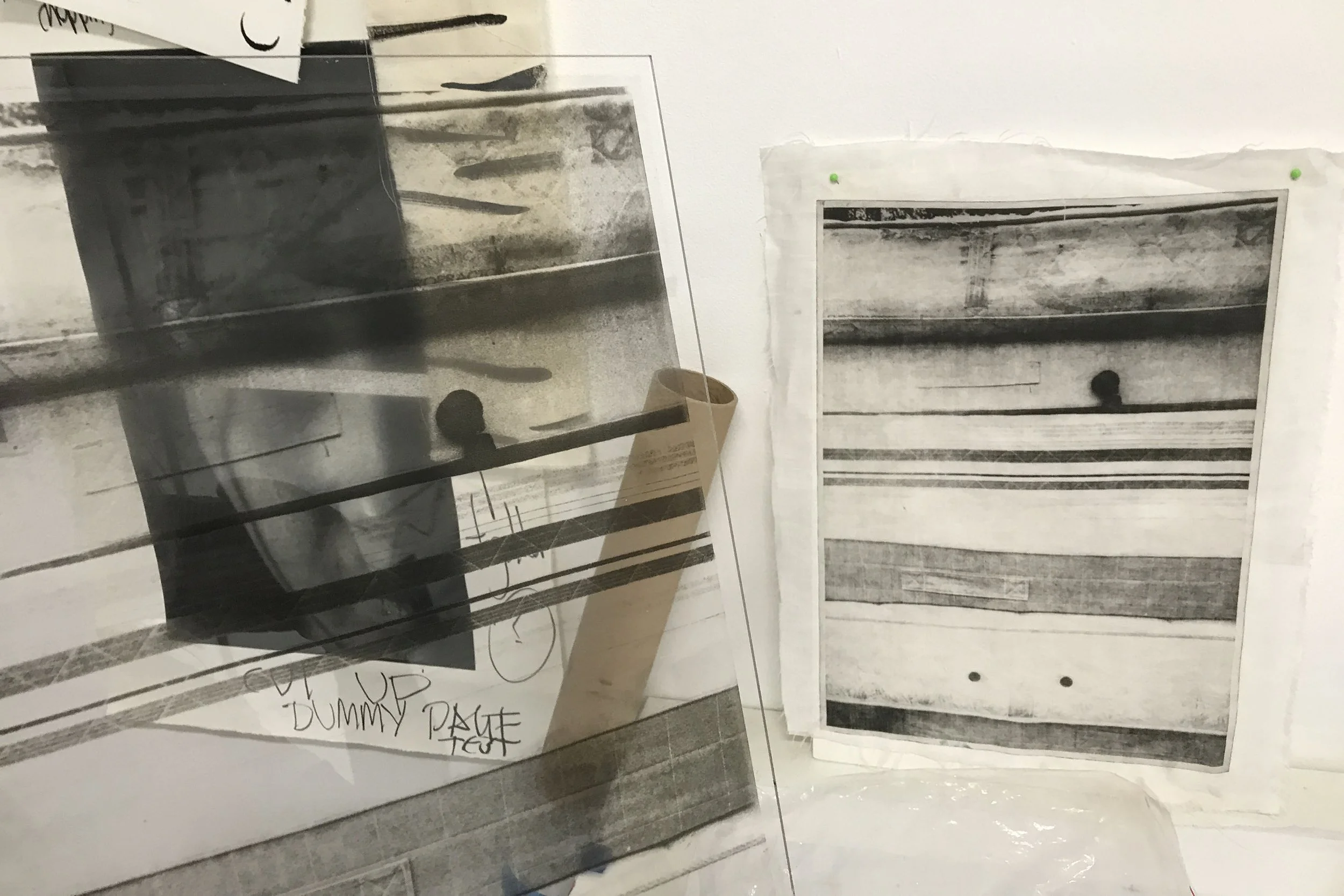
Figure 5. Untitled, 2022, photogravure on 3mm acetate, plate size 297x420mm
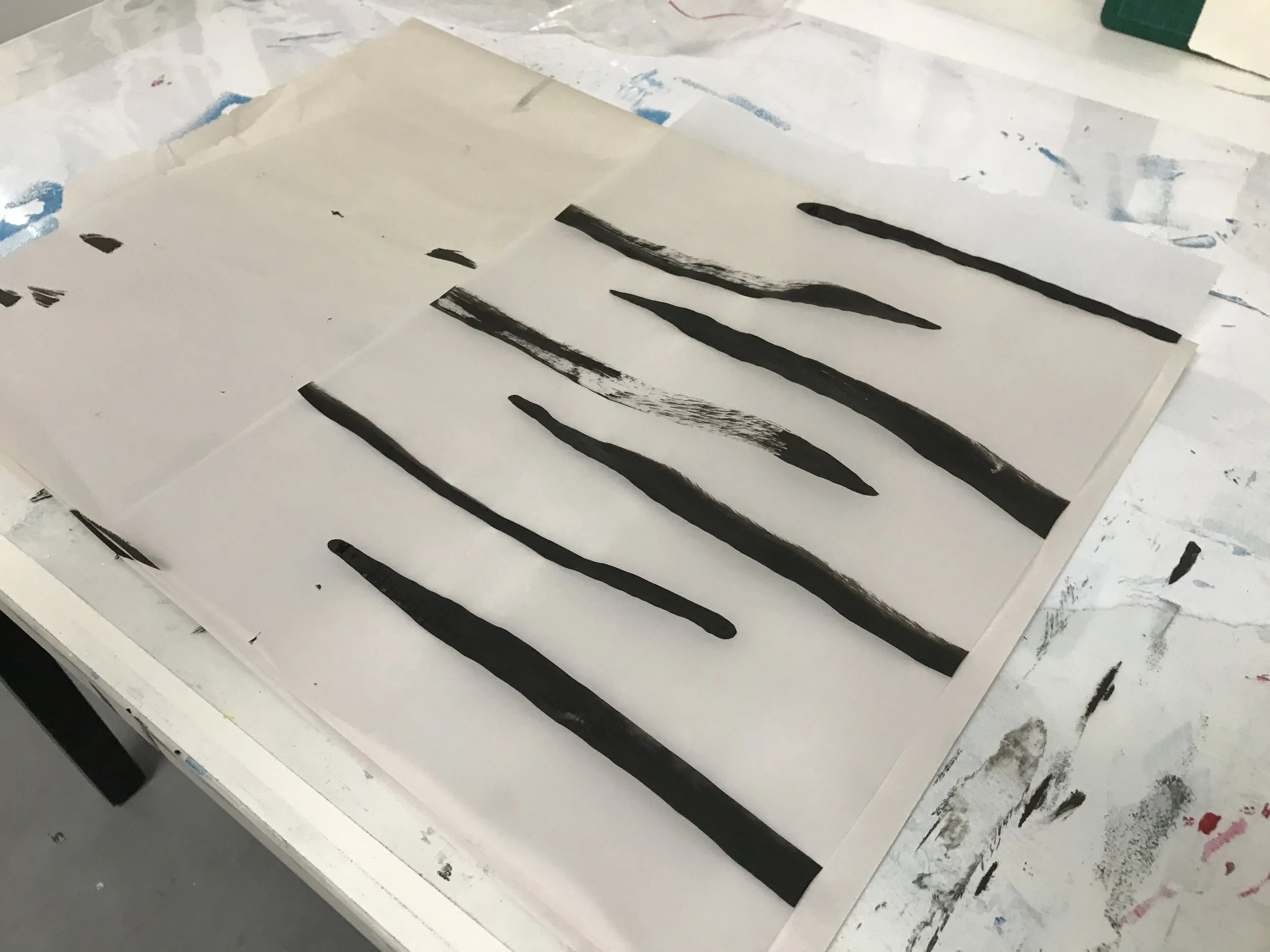
Figure 6. Untitled, 2022, Indian ink on 50gsm tracing paper inspired by basilar membrane ‘hairs’, 297x420mm
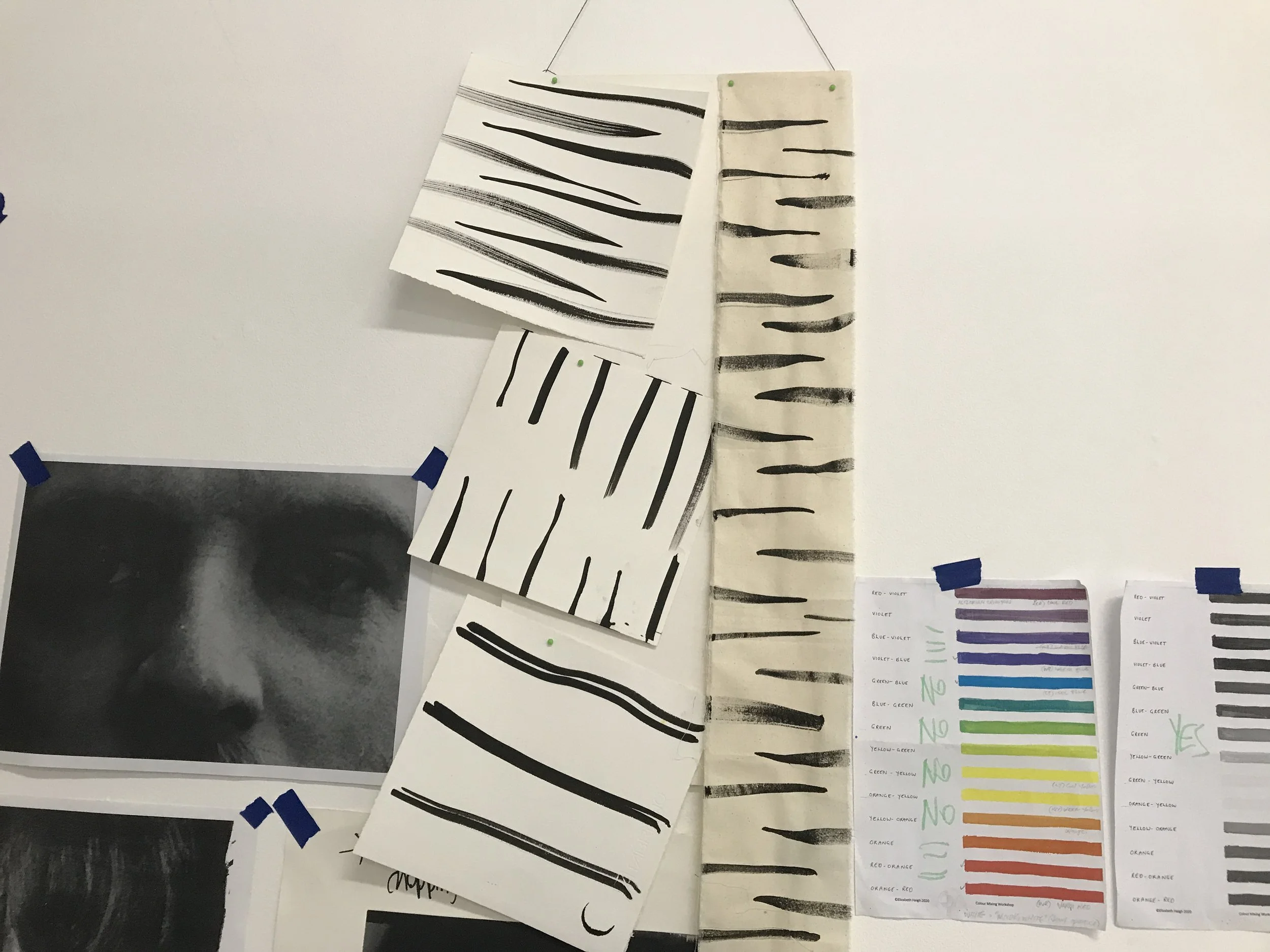
Figure 7. Experiments with Indian ink on printmaking paper (left) and calico (right) inspired by basilar membrane ‘hairs’, 2022
Despite still experimenting with the methods I will use for the project, my initial creative investigations in Studio 1 for the MFA have not produced outcomes worth pursuing. However, the process has reminded me of the adage, “Love what you make and make what you love”, leading me back to photography, where I am photographing my day-to-day life (Figure 8) while continuing to investigate studio-based research. My field of reference includes Modernist and Contemporary artists such as Laszlo Moholy-Nagy, Man Ray, Floris Neusüss, Eileen Quinlan and Mariah Robertson.
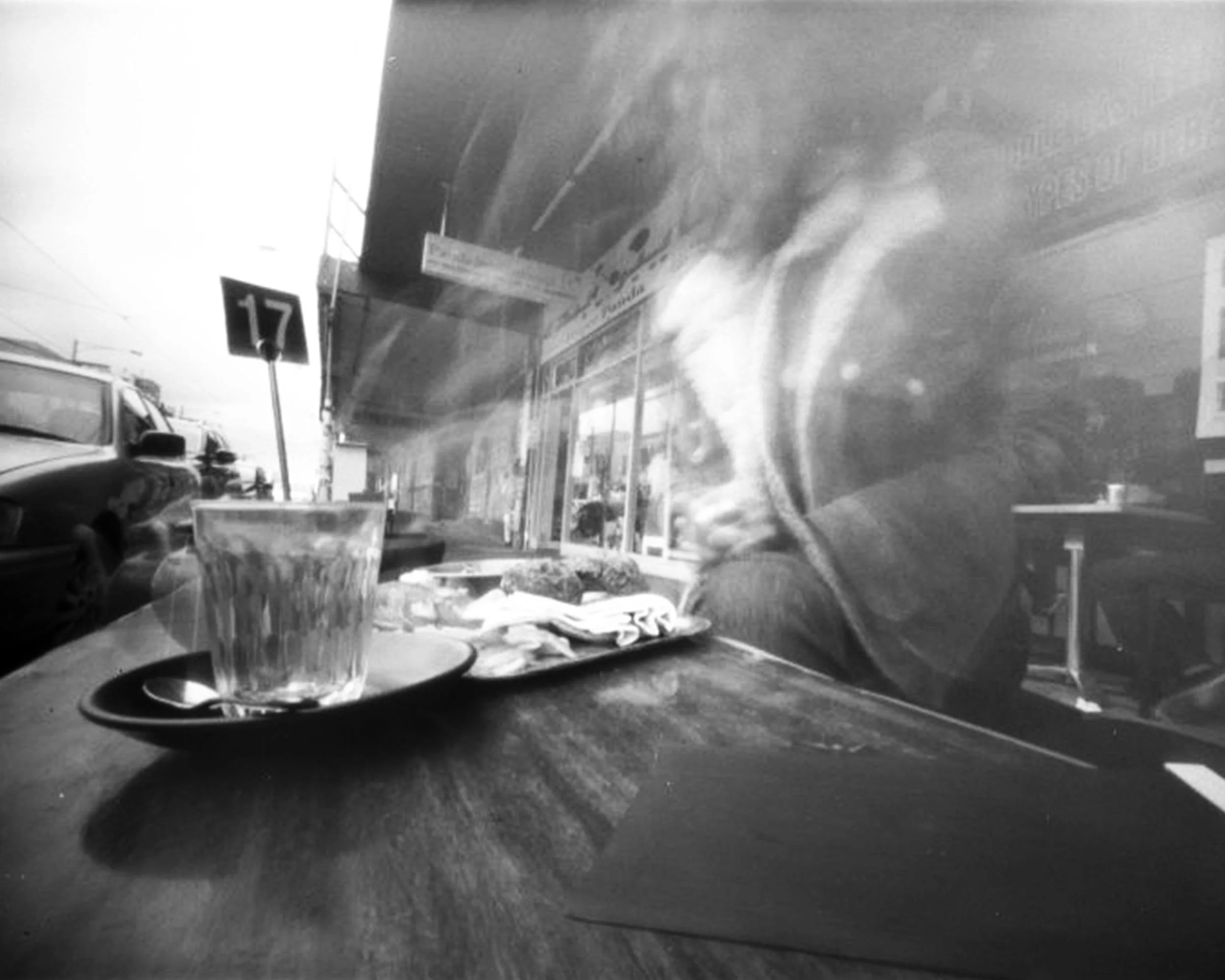
Figure 8
Pinhole photography may be interesting, while another avenue to explore is distortion. All the effects would be achieved in-camera/capture, reflecting, and iterating my own experience. The challenge and the constraints would also serve me well for keeping on an even keel without spinning into a creative hot mess.
It would be fascinating to investigate digital imaging of human responses to visual and auditory stimuli and learn from researchers currently working in the fields of neuroscience and physics.
To share that I have no idea what I am making and am at a complete creative loss is daunting and terrifying. Without a clear plan and outcome to work towards, I flounder without focus. That does not mean I need to know what I will make, but more what I am making for.
Footnotes
[1] Additional creative investigations I have undertaken in the Master of Fine Art program may be viewed online at https://zed-oh.com.
Keywords
Studio 1, Assignment, Reflection
Diana 35mm hack, pinhole and liquid emulsion
Diana F+ 35mm hack
Medium format (120mm film) pinhole
Keywords
Studio 1, Diana, 35mm hack, Lomography, Pinhole, 120mm
Bibliography
ESMONDSIT. 2011. "Lomography - A Proper 35 Mm Film Mod For The Diana F+". Lomography. https://www.lomography.com/magazine/99621-a-proper-35-mm-film-mod-for-the-diana-f.
Group crit 1
Equanimity was shown for the first Studio 1 'Group Crit'. I felt most attempted to 'assert' knowledge (Foucault 2020, 1–153) of the photographic process rather than deconstructing and feedback to 'artworks' (although I do believe that it was given with no ill intent). This response to experimental or alternative modes of photography is commonplace. Contemporary photographer Adam Fuss discusses how the 'technical' is often raised in viewing works stating that 'technical' is irrelevant. Fuss (2011, 00:38) asserts, "We have the illusion that we're going to understand [the image] by a piece of technical information". The artist continues, stating, "I don't see it happen with painting. I don't see people say, 'Hey, did you use a number seven brush and cadmium three'?". Despite coming a long way with being objective in critiques, I grew impatient and frustrated and 'reacted' rather than 'responded', the Group Crit has provided practical prompts to further improve my people skills (which are not my strong point).
Zo Damage, Equanimity, 2022, (IRL) Archival pigment print from scan of original 35mm negative, 1100x360mm
Definition
equanimity
noun
mental or emotional stability or composure, especially under tension or strain; calmness; equilibrium. (dictionary.com)
Keywords
MFA, Studio 1, Equanimity, Group crit, Freeway, 35mm, Film photography
Bibliography
"Definition Of Equanimity". dictionary.com. Accessed April 28, 2022. https://www.dictionary.com/browse/equanimity.
Foucault, Michel. 2020. Power. 3rd ed. UK: Penguin.
Fuss, Adam. 2011. "A&A Portrait - Adam Fuss". 123marketstreet. March 30, 2011. YouTube video, 02:03. https://www.youtube.com/watch?v=QxpeNIN0iRA.
S1 Week 3: Pinhole and Diana
Medium format lomo
Figure 1.
Figure 2.
Long exposure pinhole paper negatives
Figure 3. Scan of paper negative captured with an exposure of four days using my handmade Ilford 5x7” paper box pinhole camera
Figure 4. Digitally inverted scan of paper negative captured with an exposure of four days using my handmade Ilford 5x7” paper box pinhole camera
Figure 5. Scan of paper negative captured with an exposure of four days using my handmade coffee can pinhole camera
Figure 6. Digitally inverted scan of paper negative captured with an exposure of four days using my handmade coffee can pinhole camera
Figure 7. Scan of coffee can pinhole camera solarised paper negative (three day exposure)
Figure 8. Digitally inverted scan of coffee can pinhole camera solarised paper negative (three day exposure)
4x5 pinhole paper positives
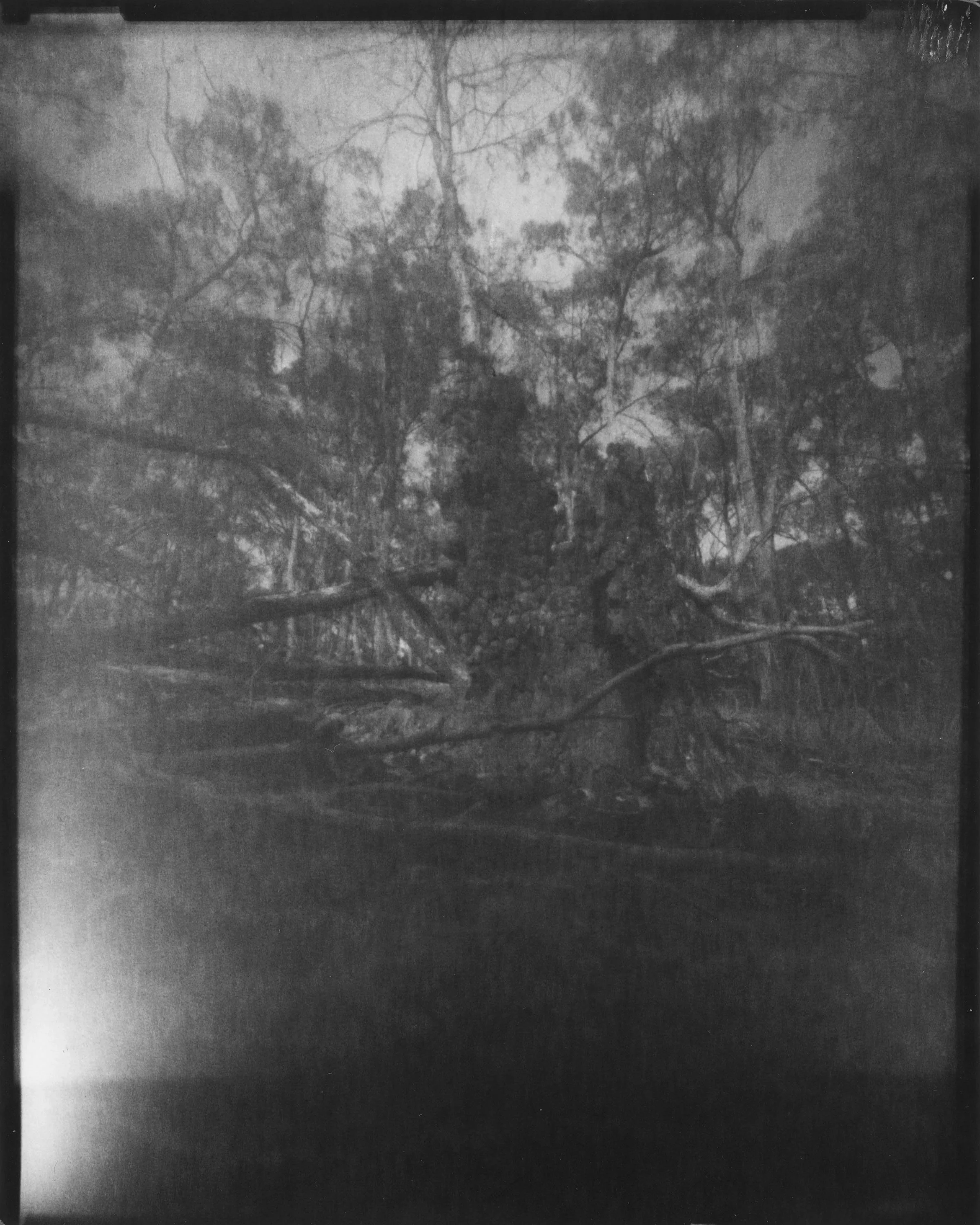
Figure 9.
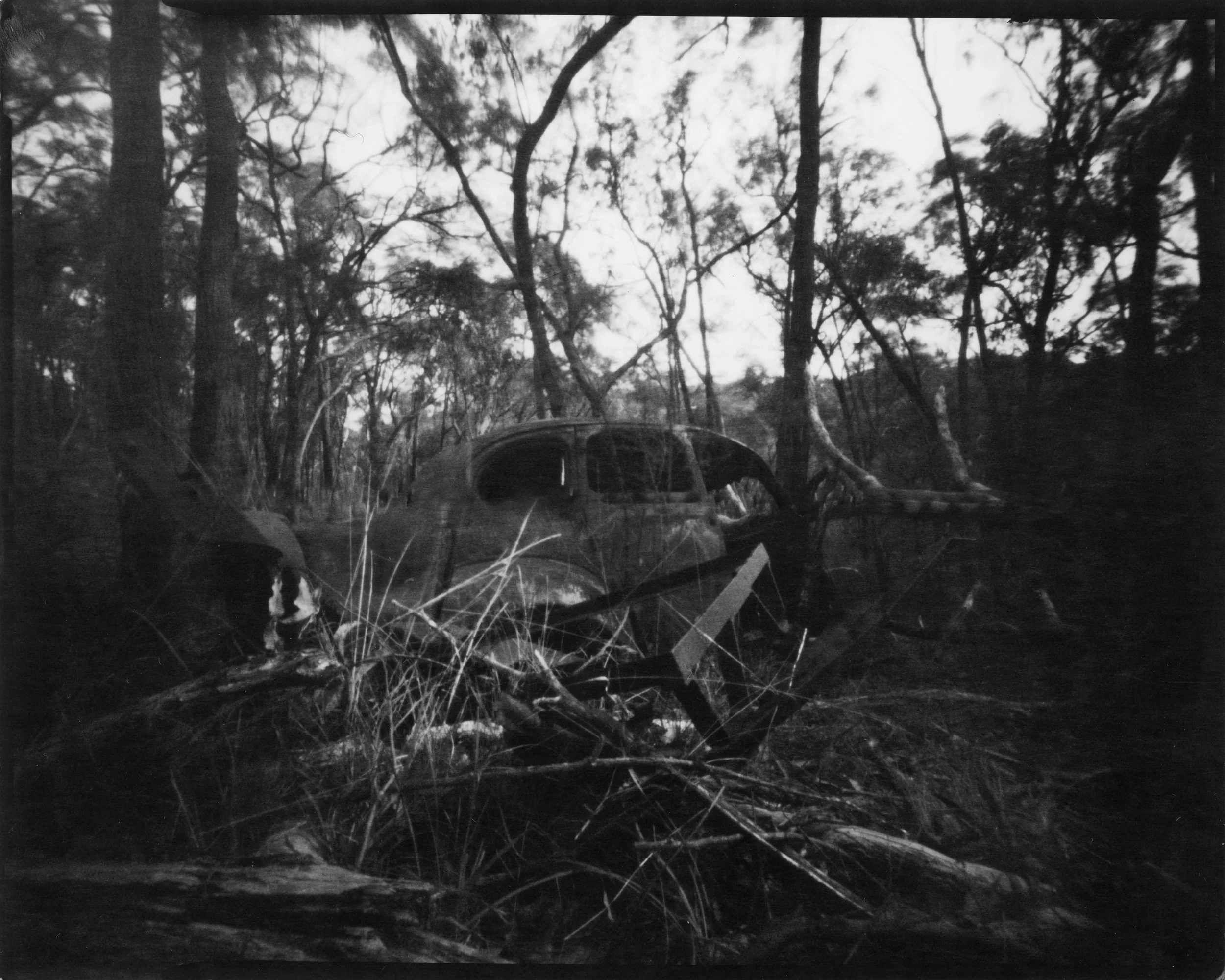
Figure 10.
Figure 11. Scan of paper negative captured with Ilford 5x7” paper box pinhole camera
Figure 12. Digitally inverted scan of paper negative captured with Ilford 5x7” paper box pinhole camera
Keywords
Studio 1, Week 3, Pinhole photography, Lomography, 120mm, 35mm, Paper negative, Solarising, Darkroom
Bibliography
PLASTICPOPSICLE. 2013. "Lomography - 6 Must-Try Tips For The Diana F+". Lomography. https://www.lomography.com/magazine/252635-6-must-try-tips-for-the-diana-f-plus.
S1 Week 2: 120mm lomo, 35mm and making cameras
Making pinhole cameras
Figure 1. Pinhole camera made from cardboard gift box
Figure 2. Pinhole camera made from Ilford 5x7” MGIV paper box
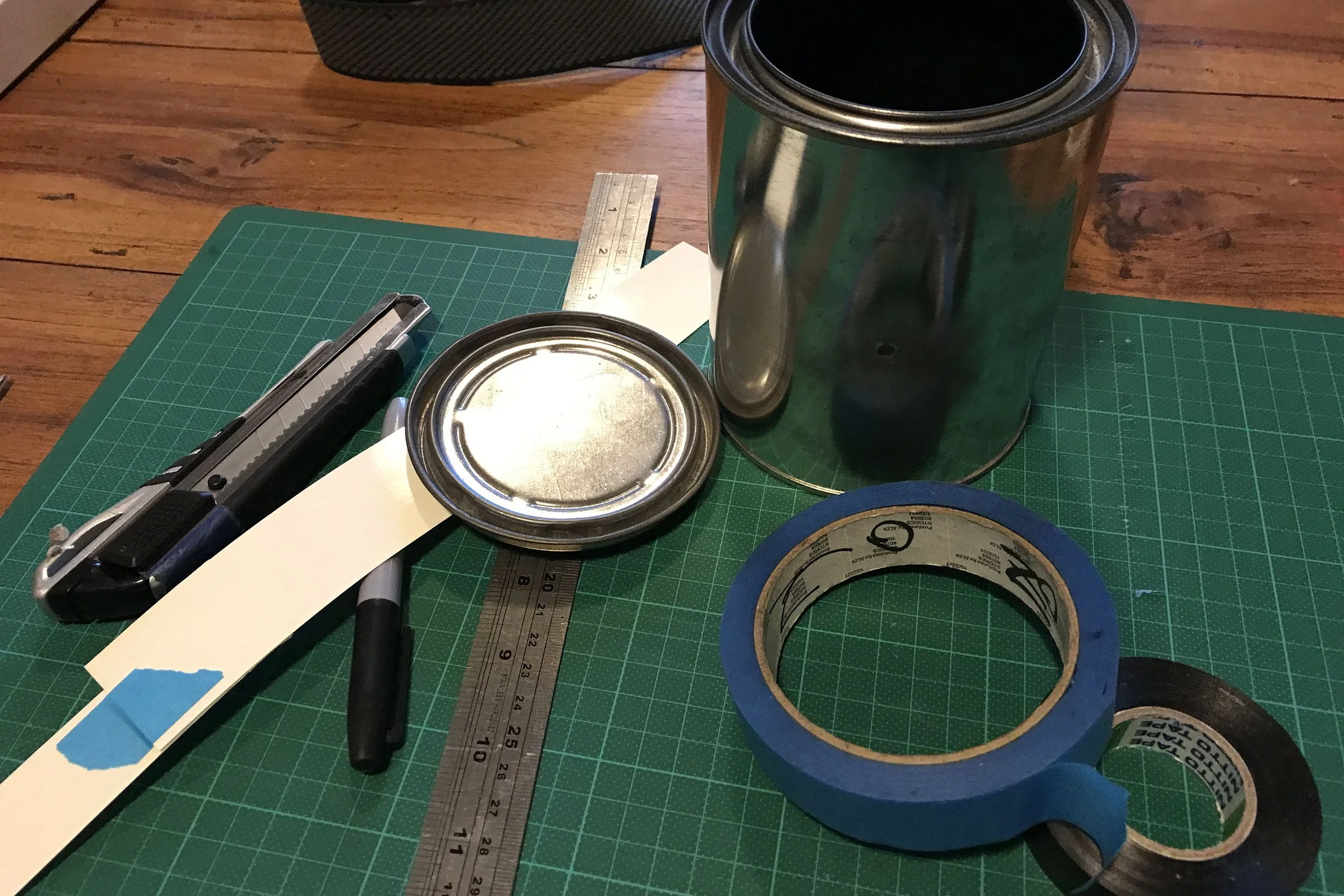
Figure 3. Pinhole camera made from coffee can
Figure 4. Scanned paper negative from test exposure captured with Ilford box pinhole camera (Figure 2)
Figure 5. Scanned paper negative from test exposure captured with Ilford box pinhole camera (Figure 2)
Figure 6. Digitally inverted scan of paper negative from test exposure captured with Ilford box pinhole camera (Figure 2)
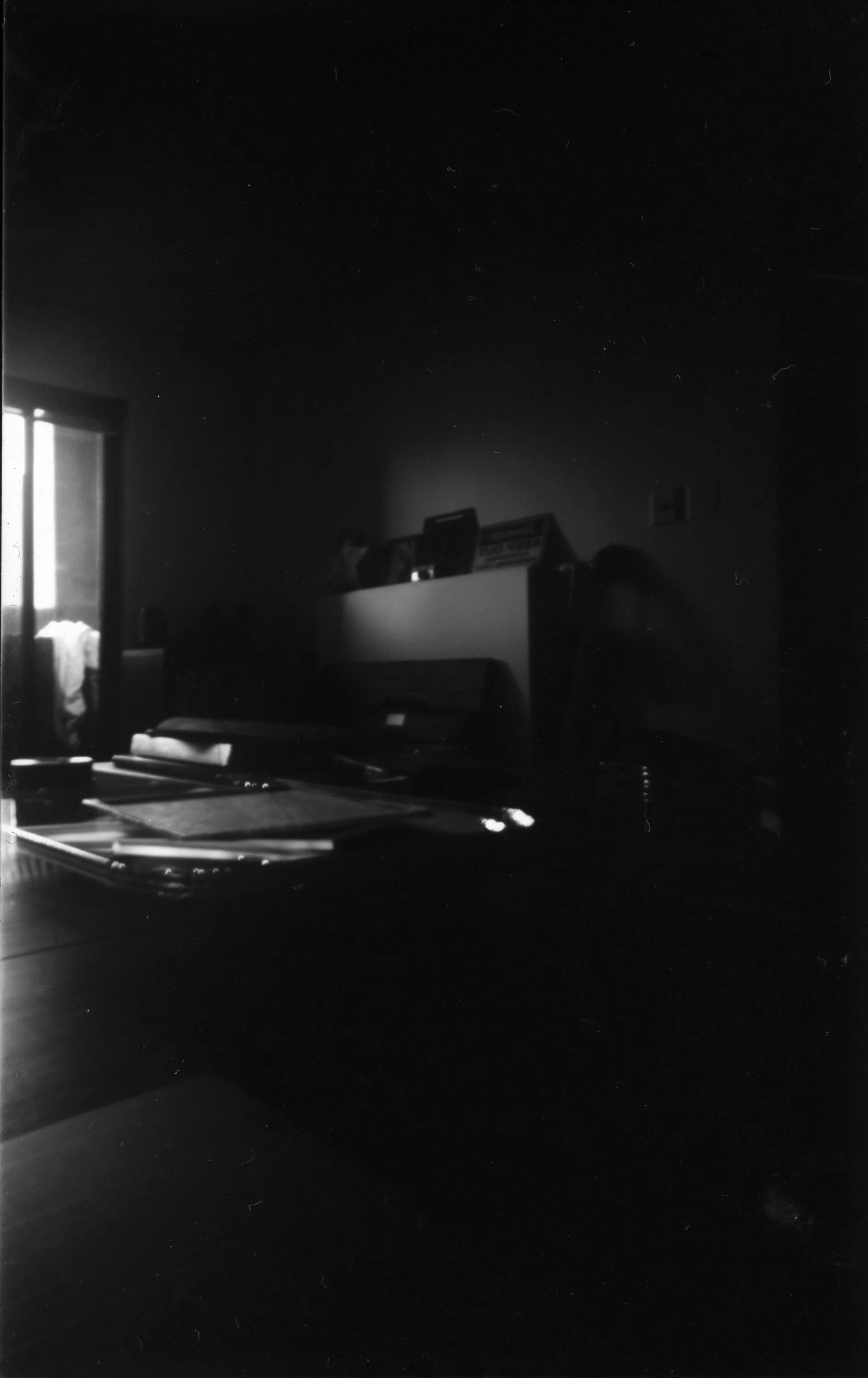
Figure 7. Digitally inverted scan of paper negative from test exposure captured with Ilford box pinhole camera (Figure 2)
4x5” pinhole paper negatives
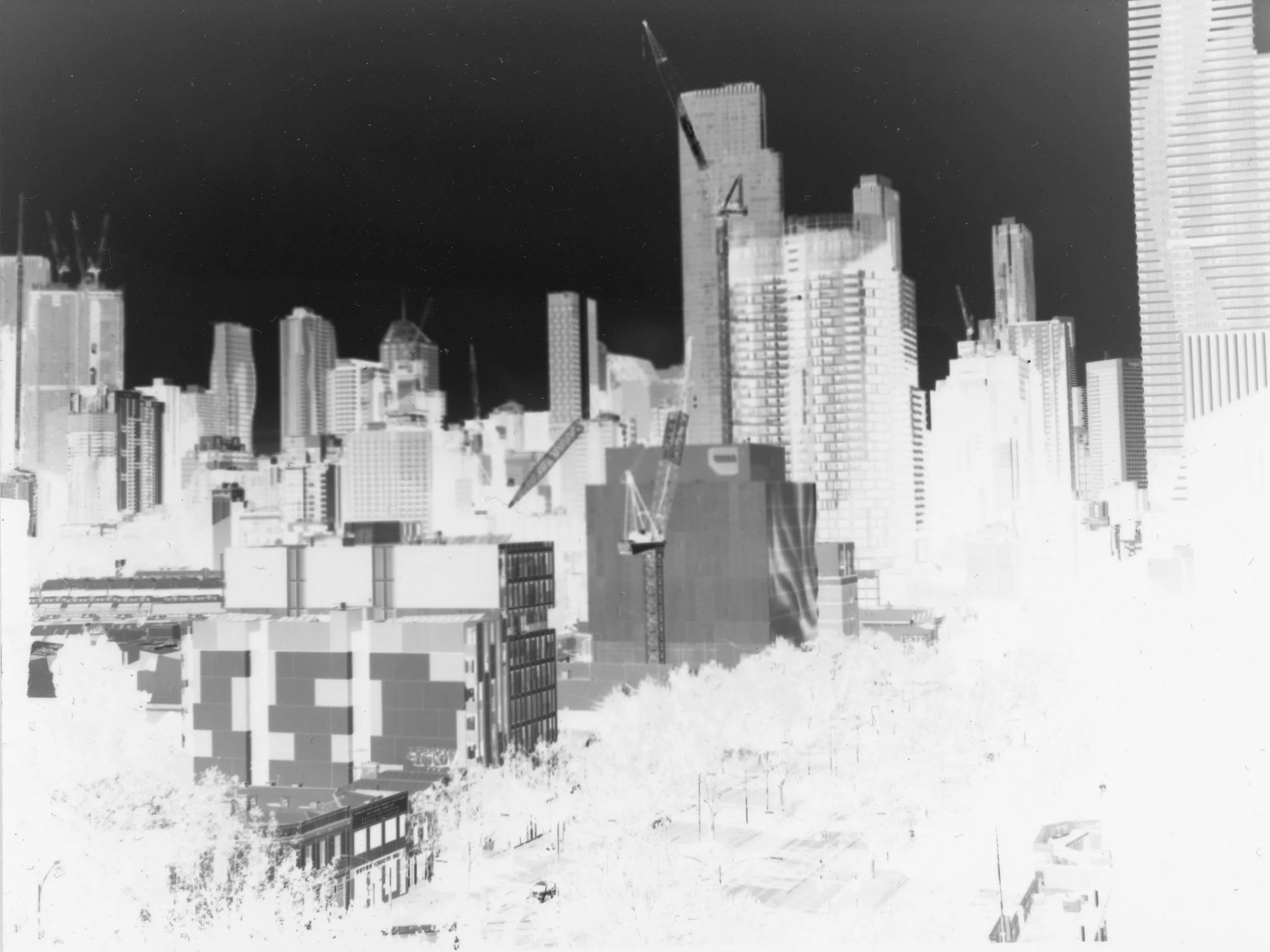
Figure 8. Scanned paper negative captured with 4x5” large format camera
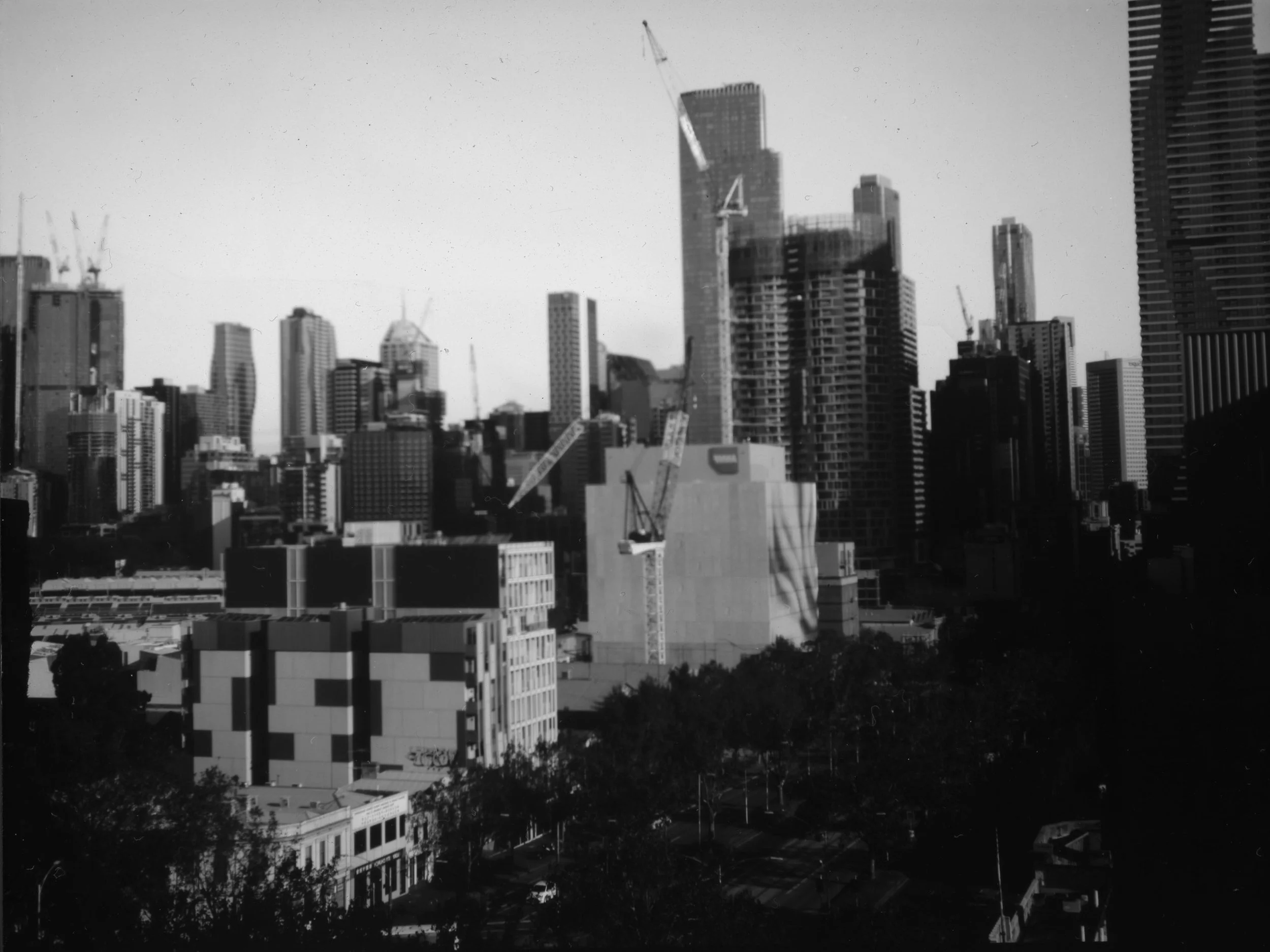
Figure 9. Digitally inverted scan of paper negative captured with 4x5” large format camera
35mm photography
To alleviate the frustration of developing my practice in pinhole photography and with the Diana F+, I shot a roll of 35mm film with the EOS3 riding home from work along the Merri Creek Trail through Thomastown and the Upfield Shared Path through Coburg and Brunswick. Frankly, I needed a reminder that I do know how to use a film camera and take a photograph and get loose myself in developing 35mm negatives.
Figure 10. Sharp left, 2022, scan of original 35mm negative
Figure 11. Mohawk Merri, 2022, scan of original 35mm negative
Figure 12. Pearville, 2022, scan of original 35mm negative
Figure 13. Charred, 2022, scan of original 35mm negative
Figure 14. Hard right … harsh reality, 2022, scan of original 35mm negative
Figure 15. All aboard, 2022, scan of original 35mm negative
Keywords
Studio 1, Week 2, 35mm, Pinhole cameras, Paper negatives, Experimental photography
Pinhole photography
Expand on notes for Contemporary pinhole photography; What is pinhole photography; Making a pinhole camera; Film or paper; Field of view workaround; Light metering formulas; Contemporary pinhole and zone plate photography exhibition
While it can be very time consuming to find online photography resources, it is worth the investment. Pinhole cameras do not have a viewfinder. As such, one of the biggest issues of image capture with a pinhole camera is composition. The formula for estimating the field of view of a pinhole camera provides a reliable estimation (Henson 2020, 06:09).
Calculating field of view for pinhole camera
First measure from the inside left of the film gate to the outside left of the camera and transfer the measurement marking with a small dot on the top of the camera. Repeat for the right side. Next measure from the centre of the pinhole to the outer edge of one (left OR right) side of the camera body and make a small dot. As the pinhole in many cameras is not at the ‘true centre’ is it best to measure one side only. Using a ruler, join the measurement marks to make a ‘V-shape’ (Figure 1). Repeat the steps above on side of the camera to determine the height of the field of view.
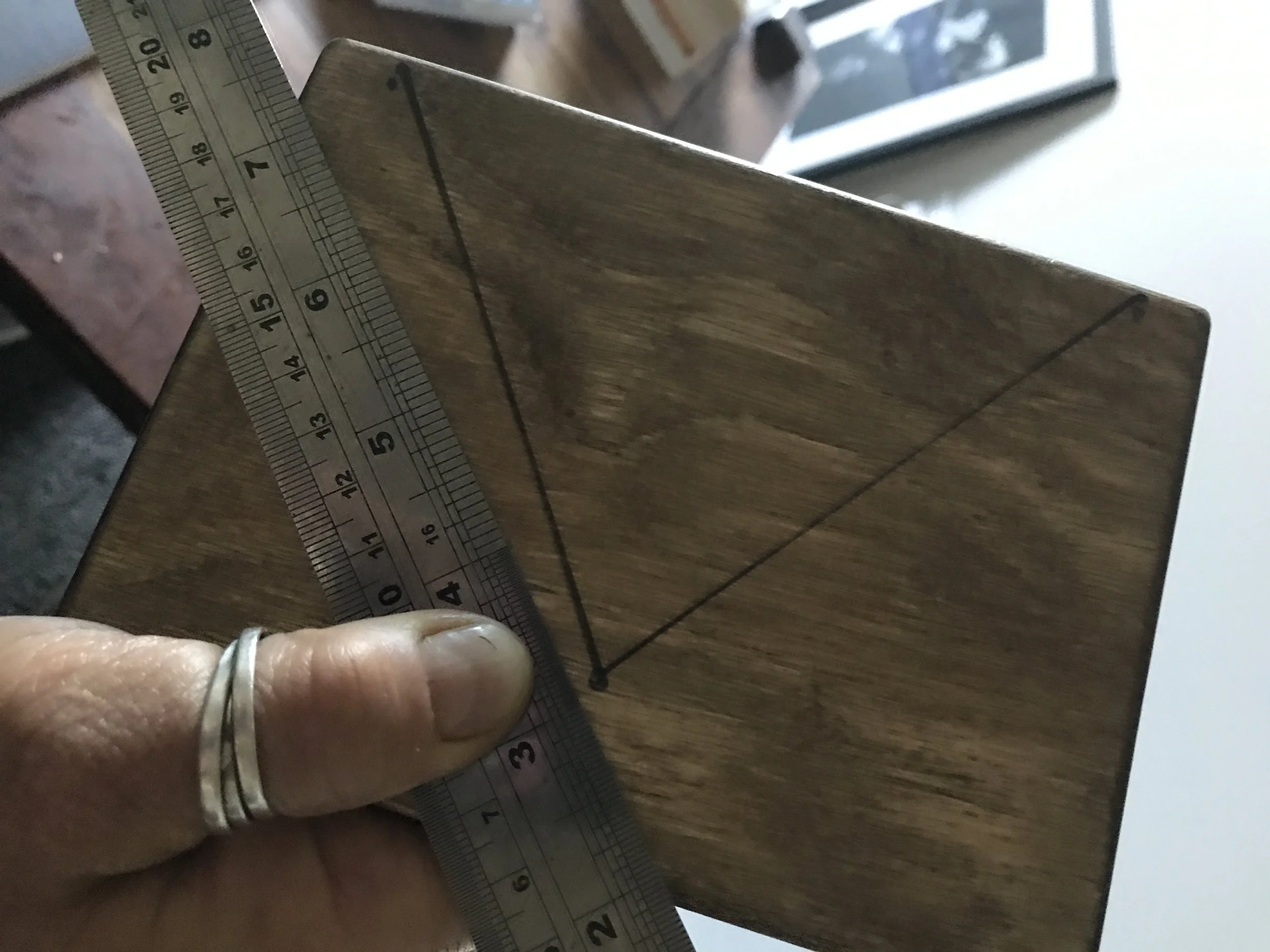
Figure 1. Marking field of view guides on 4x5 pinhole camera
Exposure times (general)
https://www.alternativephotography.com/determining-exposures-for-the-pinhole-camera/
http://www.martinwinfield.co.uk/pinholetech.html
https://www.lomography.com/magazine/69260-holga-wide-pinhole-camera-wpc-user-review-exposure-table-and-more
https://www.lomography.com/magazine/10960-applied-mathematics-to-holga-cameras
Exposure times
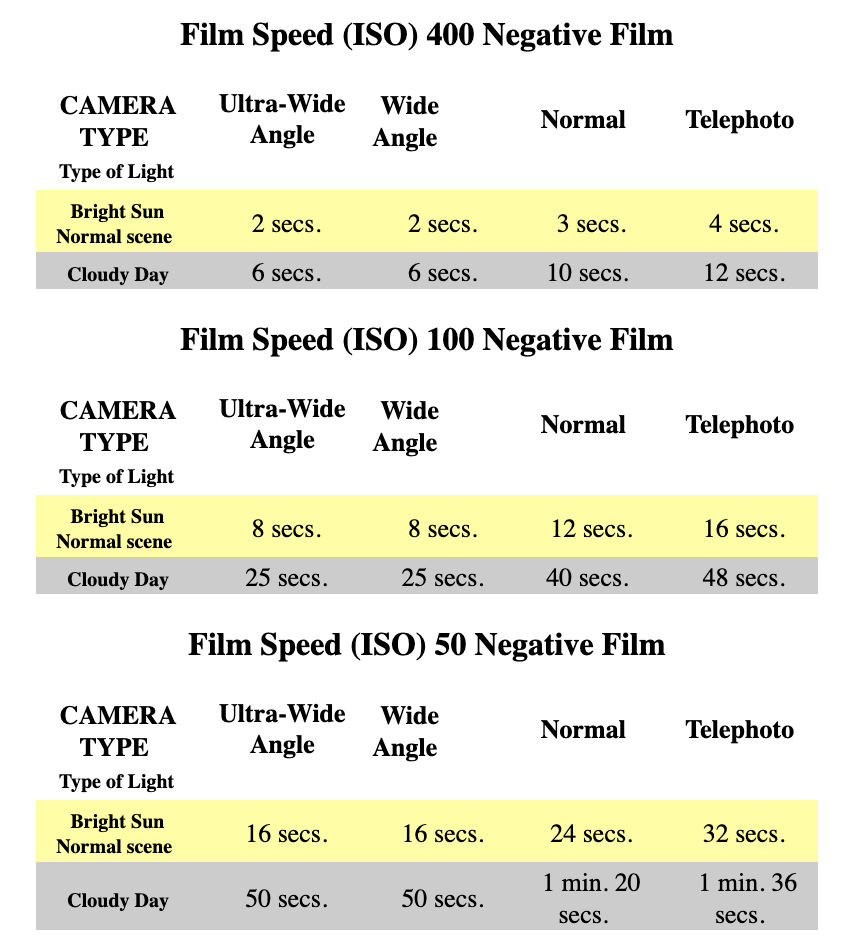
Figure 1. Pinhole exposure times (PinholeCamera n.d.)
Keywords
Pinhole, Field of view, MFA, Studio 1
Bibliography
“Pinhole exposure times”. pinholecamera.com. Accessed April 10, 2022. http://www.pinholecamera.com/exposure.html.
Hammond, Mary Sayer. 1986. "THE CAMERA OBSCURA: A CHAPTER IN THE PRE-HISTORY OF PHOTOGRAPHY (PINHOLE PHOTOGRAPHY, ASTRONOMY, DRAWING MACHINES, KEPLER, PERSPECTIVE)." Order No. 8703552, The Ohio State University. https://login.ezproxy.lib.rmit.edu.au/login?url=https://www.proquest.com/dissertations-theses/camera-obscura-chapter-pre-history-photography/docview/303482885/se-2?accountid=13552.
Henson, Martin. 2020. “Pinhole photography, all about” Martin Henson. May 22, 2020. YouTube video, 09:51. https://youtu.be/nuI5l0t9PHg.
Hymer, Karen. 2021. "Layered Light: Contemporary Pinhole And Zone Plate Photography". Light Art Space. https://lightartspace.com/exhibition/layered-light-contemporary-pinhole-and-zone-plate-photography/.
Madison, James. 2020. "Shooting 8x10 On A Homemade Pinhole Camera With F/264? Why Not?". Fstoppers. https://fstoppers.com/film/shooting-8x10-homemade-pinhole-camera-f264-why-not-508286.
Broadening practice
Following the Master of Photography program, I am determined to broaden my analogue photographic practice and am at a complete creative loss. Dom has provided me with exercises that aim to prompt creative focus and direction, leading me to explore lumen printing and zone plate photography. I am also deepening my study of photograms and pinhole photography.
Recent works include a photogram of a vintage threadbare denim jacket (Figures 1–2) and a series of self-portraits captured using a 4x5" large format pinhole camera (Figure 3). Planning to capture lumen prints of the jacket to compare how the colours and tones in the final images correspond with the photograms and researching pinhole cameras, including how to make them, is inspiring.
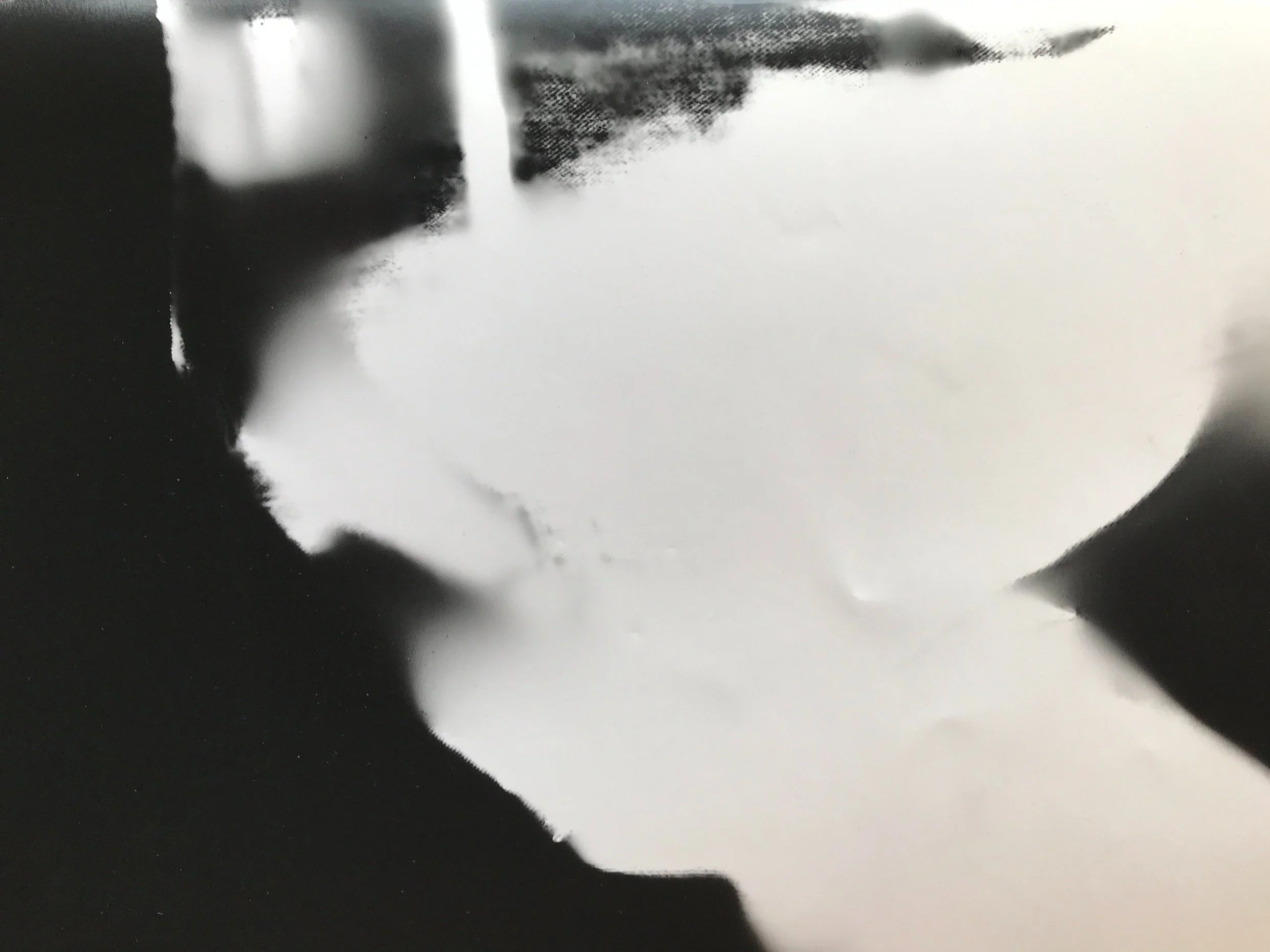
Figure 1. Untitled photogram, 2022
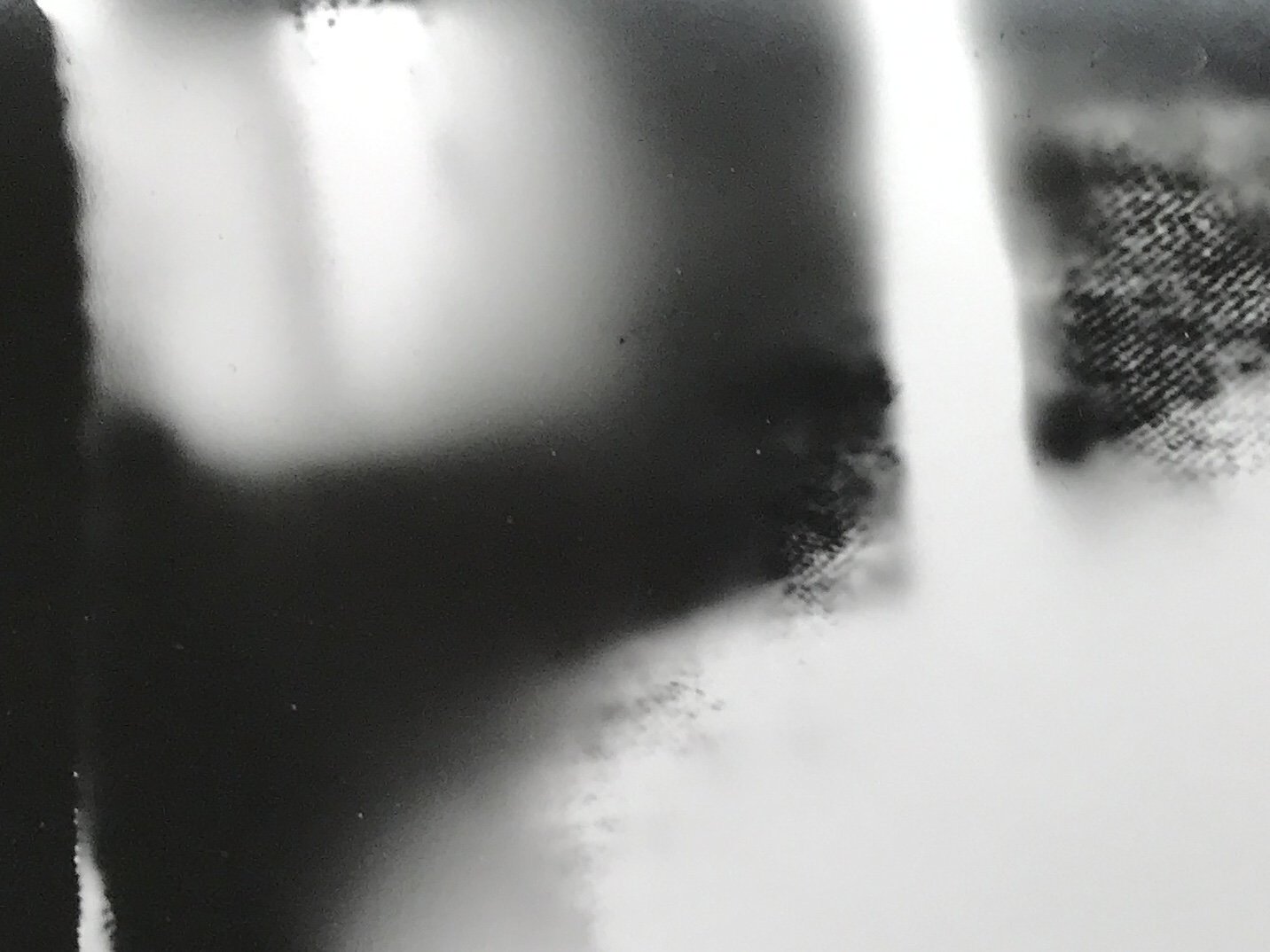
Figure 2. Untitled photogram (detail), 2022
Although creating artworks from items and events (Figure 3) that are part of my everyday life is engaging, it is also confronting, leading me to reflect on Dom frequently asking, "Yeah, but what do you want to make?" prompting me to reflect on past work and motivations. What do 'I' want to make indeed.
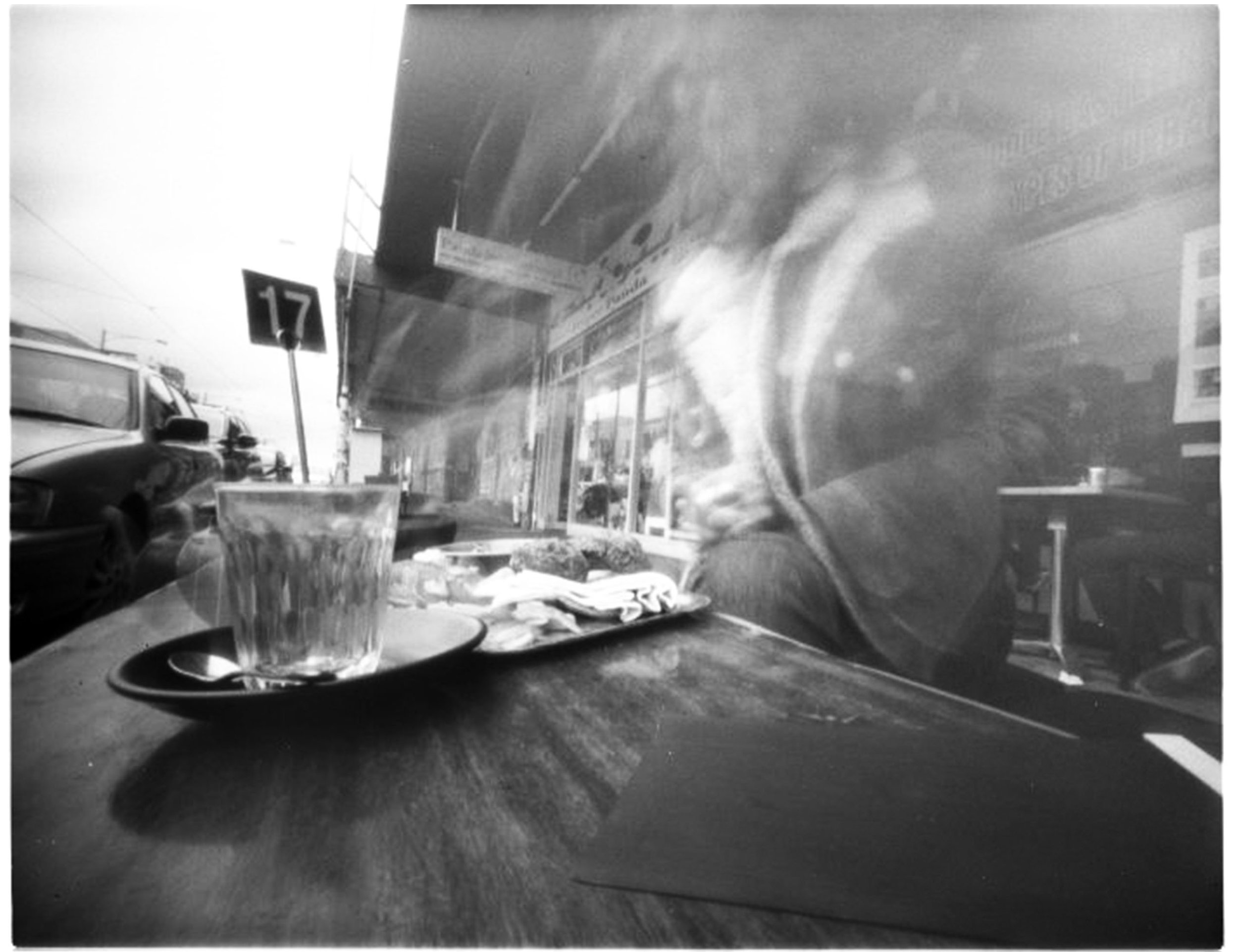
Figure 3. Zo Damage, Tea and falafel (self-portrait), 2022
Keywords
MFA, Studio 1, Photogram, Lumen, Pinhole, Cameraless photography, Film photography
S1 E1: Novice and expert Curiosity, openness and dialogue
Zo Gay
S9753760
Studio 1
Exercise
Novice and expert — Curiosity, openness and dialogue
Position / Dialogue
Novice, in dialogue with Melbourne painter, Angela Chauvin
Angela Chauvin is a Melbourne based painter who is currently studying a Master of Fine Art at RMIT, following her recent completion of a Bachelor of Fine Arts at RMIT and Honours year at VCA. “Angela’s work sits within the traditions of observational oil painting, documenting her experience of the physical world around her” (Stockrooms 2019).
Angela paints in situ (on location) directly onto a blank canvas or linen stretched over timber frames. She also paints on timber boards, stating that the firmness of the boards allows her to “push against” the surface applying “stronger gestures” as opposed to the springy-like surface of the stretched canvas and linen.
Figure 1. Angela shows the back of a painting on timber. Photo by Zo Gay
In 2019 Angela presented a solo exhibition titled “How is a Window” at Stockroom Gallery, Kyneton. Comprising paintings created in artists’ studios from 2016 to 2019, the series focuses on “how windows exist in these spaces symbolically and experientially … exploring the translation of perception of reality into visual and material artworks” (ibid 2019). Sourced from the Stockroom Gallery online room sheet, figures 2–6 are a selection of works from the exhibition, which display Angela’s observational style, creative vision and deep connection with her surroundings and subject matter.
Figure 2. Angela Chauvin, EmptyFull, 2016, oil on linen, 138x112cm
Figure 3. Angela Chauvin, Studio Things, 2017, oil on linen, 41x77cm
Figure 4. Angela Chauvin, The Way Out, 2018, oil on linen, 150x112cm
Figure 5. Angela Chauvin, Blue Print Room, 2019, oil on linen, 120x90cm
Figure 6. Angela Chauvin, Pink Pigeons on Brunswick, 2019, oil on linen, 80x60cm
During our meeting at her RMIT studio, Angela explained that she “draws with paint” and then “paints a little bit on the drawing”, describing the painting as the “placement of paint”, while the drawing – working with line, akin to “handwriting” – fosters spontaneity and immediacy in the making that further asserts her “voice” and personal connection to and with each piece.
Angela is now experimenting with “bringing in elements from her imagination and possibly from photographs”, although she is considering developing her concept first, then sourcing representational objects to paint in a new approach to expressing her imagination combined with her existing observational painting practice.
We also discussed one of her paintings, a work in progress of a charred landscape from recent bushfires (Figures 7–9).
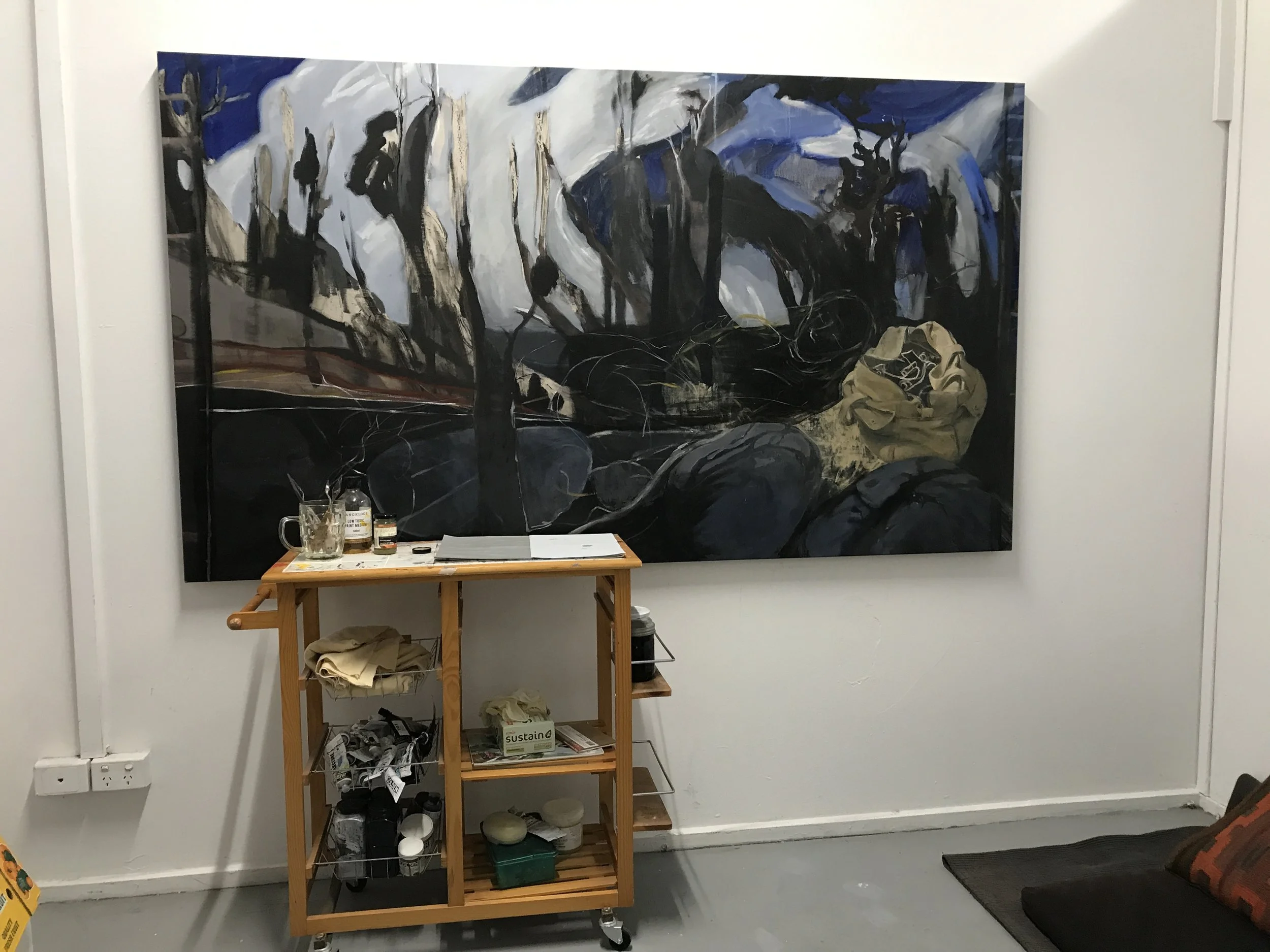
Figure 7. Angela Chauvin, Untitled work in progress, 2022, charcoal and oil on linen, 120x240cm. Photo by Zo Gay
On location, Angela first drew on the canvas using a “chunck of charcoal” taken from the burnt landscape. Returning to her studio, she began building the work with paint. Anglea states her intention is to include fragmented pieces of herself in the artwork and will need to source representational objects to paint to achieve this outcome.
To quote, “I want to bring in other elements, which will be me, in pieces. Then I’ll need to find objects that symbolise those pieces of me, and actually paint them in real life … I will be painting a collage of things from life, but they will not neccessarily be in front of me at the same time.”
When asked about the title, Angela replies, “It is untitled, although I think it will be something like ‘Me in pieces’”, stating that “It is a post-separation piece” and that her paintings “always relate to what is going on in my life as well as what is around me”.
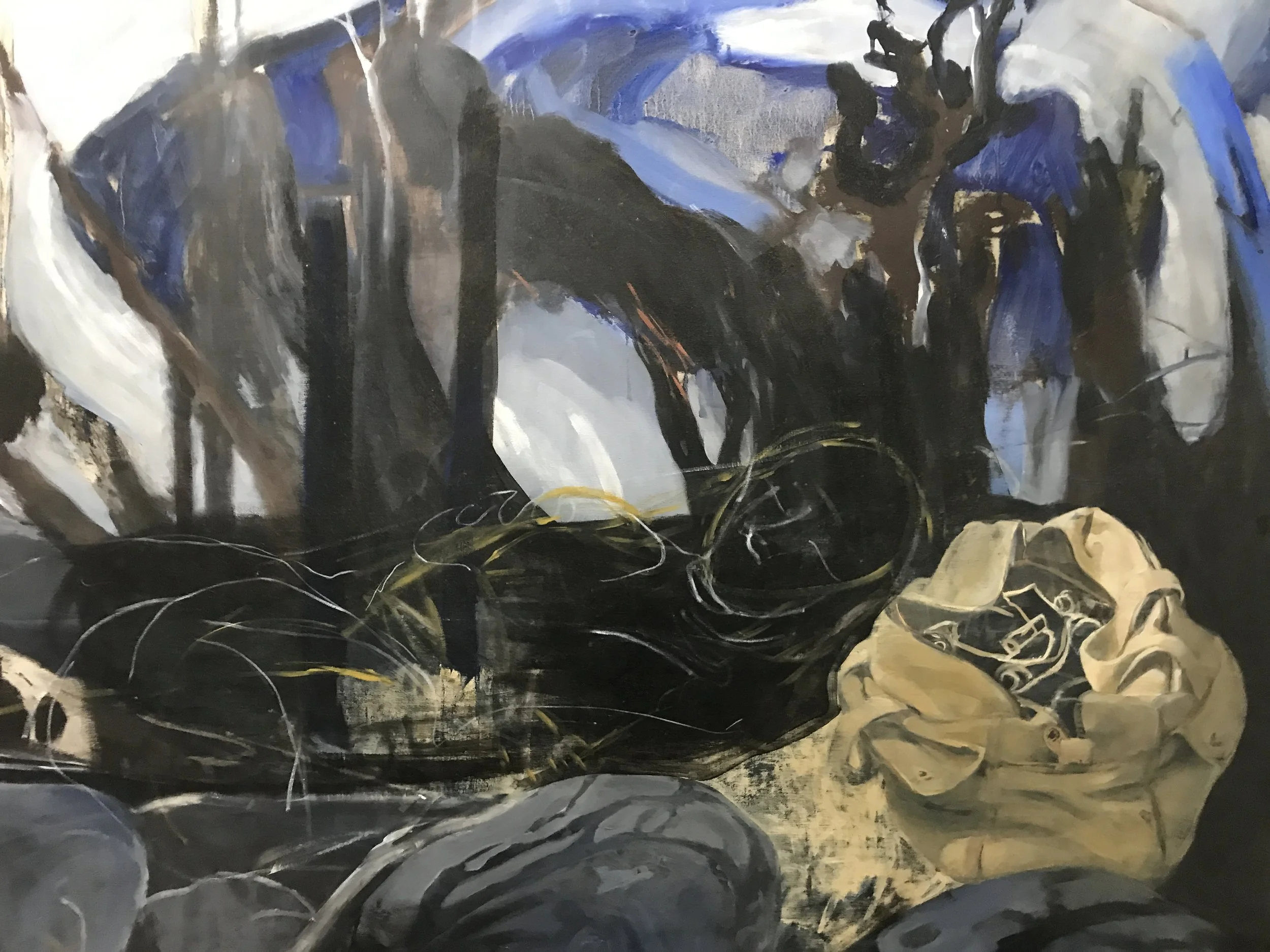
Figure 8. Angela Chauvin, Untitled work in progress (detail), 2022, charcoal and oil on linen, 120x240cm. Photo by Zo Gay
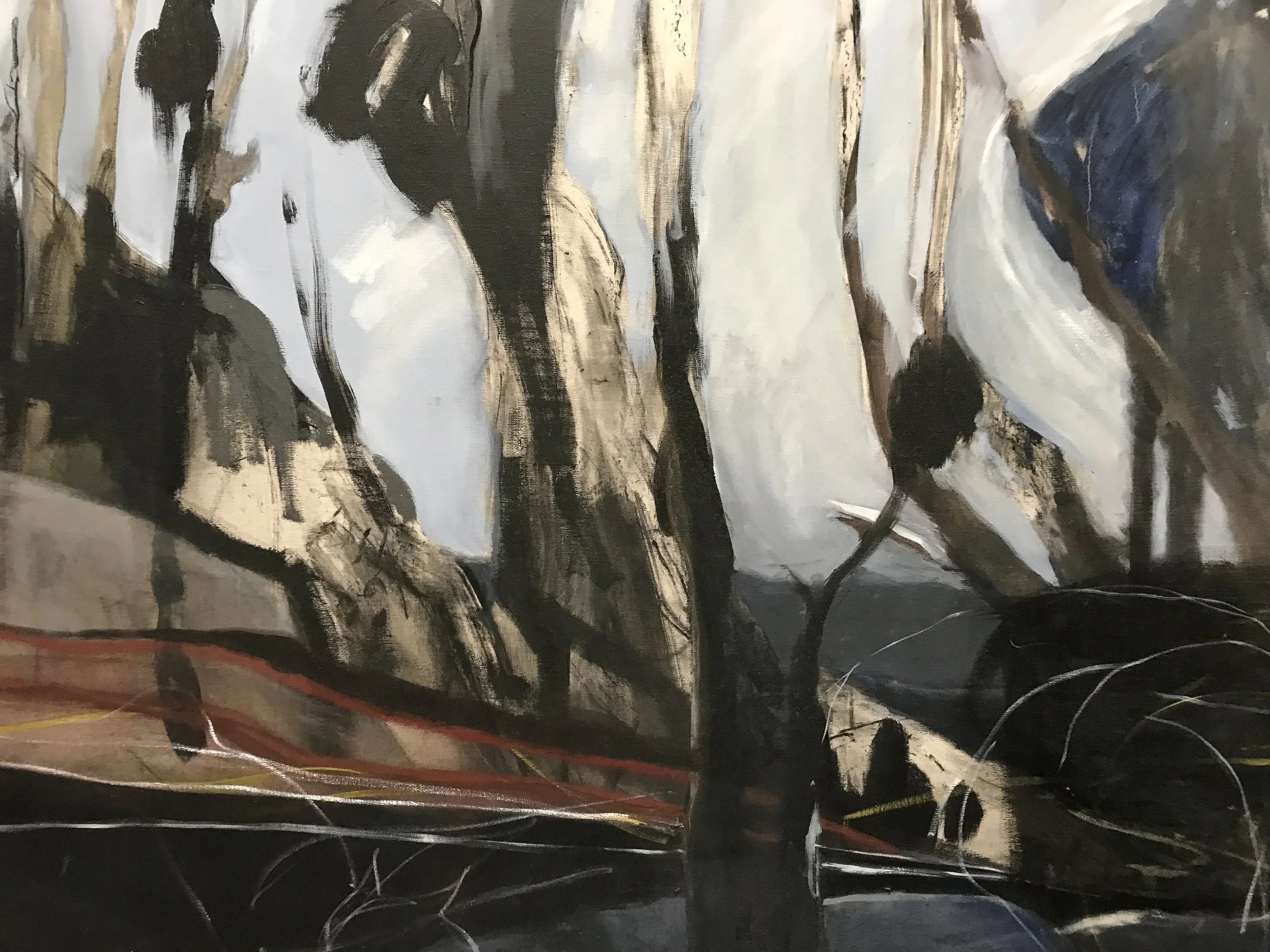
Figure 9. Angela Chauvin, Untitled work in progress (detail), 2022, charcoal and oil on linen, 120x240cm.Photo by Zo Gay
Angela reflects that she grew up in the country, spending much time in the forest, and acknowledges that “nature” and the “non-human’ world” are a “safe space” for her which has significantly influenced the “post-separation” piece. Considered part of her healing process, the painting has enabled her to connect with the bush during a difficult time when she is committed to being city-bound.
When asked if creating the piece has been a cathartic process and conduit for her emotional health and well being, Angela replies, “That’s all my art has ever been”.
Influenced by artists including Nick Cave and Warren Ellis, Angela describes her creative themes as Australian Gothic, a moody melancholy whereby she endeavours to connect with the unspoken and “in betweens” along with the unrepresented and misrepresented fissures of life, with a primary focus on social injustice and contributing to the discourse of post-colonialism through her work.
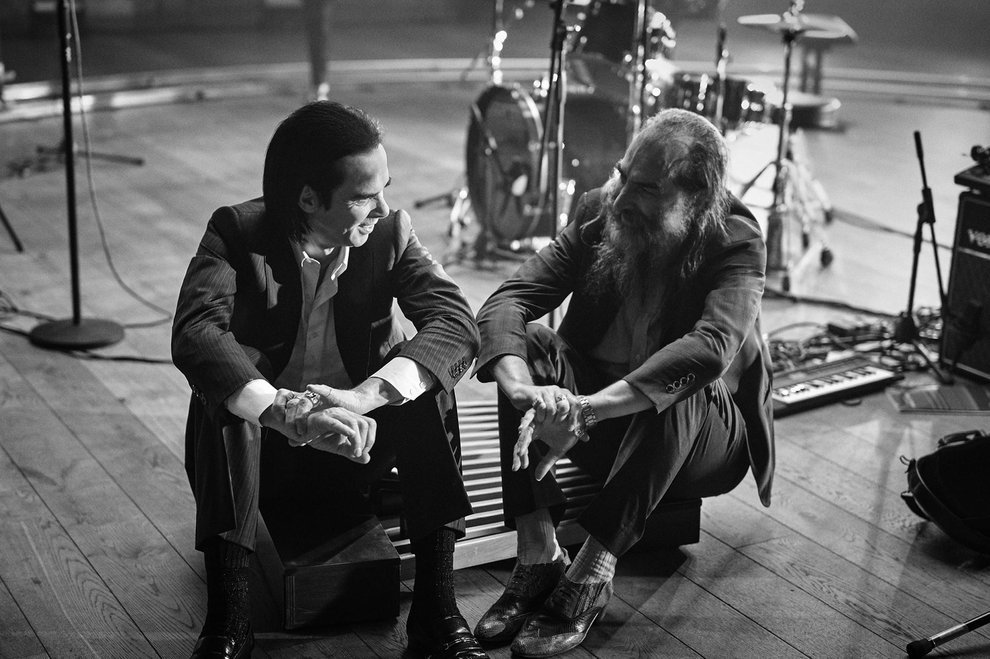
Figure 10. Nick Cave and Warren Ellis (The Scotsman 2021)
Keywords
Studio 1, Novice, Expert, Dialogue
Bibliography
Chauvin, Angela. 2016. EmptyFull. Online image. https://stockroomspace.com/angela-chauvin-exhibitions.
———. 2017. Studio Things. Online image. https://stockroomspace.com/angela-chauvin-exhibitions.
———. 2018. The Way Out. Online image. https://stockroomspace.com/angela-chauvin-exhibitions.
———. 2019. Blue Print Room. Online image. https://stockroomspace.com/angela-chauvin-exhibitions.
———. 2019. Green Tablescape. Online image. https://stockroomspace.com/angela-chauvin-exhibitions.
———. 2019. Pink Pigeons on Brunswick. Online image. https://stockroomspace.com/angela-chauvin-exhibitions.
Gay, Zo. 2022. Conversation with Angela Chauvin.
The Scotsman. 2021. Nick Cave And Warren Ellis. Online image. https://www.scotsman.com/whats-on/arts-and-entertainment/music-review-nick-cave-warren-ellis-playhouse-edinburgh-3391472.
Chords and emotion
I am drawn to musical compositions with minor chords, prompting me to investigate the affects of musical composition on physical and psychological states and the different emotional responses to major and minor chords.
Keywords
Minor chords, Major chords, Emotion, Studio 1, MFA
Further reading
Fritz, Thomas, and Stefan Koelsch. 2008. "The Role Of Semantic Association And Emotional Contagion For The Induction Of Emotion With Music". Behavioral And Brain Sciences 31 (5): 579-580. doi:10.1017/s0140525x08005347.
Wager, Tor D, K.Luan Phan, Israel Liberzon, and Stephan F Taylor. 2003. "Valence, Gender, And Lateralization Of Functional Brain Anatomy In Emotion: A Meta-Analysis Of Findings From Neuroimaging". Neuroimage 19 (3): 513-531. doi:10.1016/s1053-8119(03)00078-8.
McGettigan, Carolyn, Andrew Faulkner, Irene Altarelli, Jonas Obleser, Harriet Baverstock, and Sophie K. Scott. 2012. "Speech Comprehension Aided By Multiple Modalities: Behavioural And Neural Interactions". Neuropsychologia 50 (5): 762-776. doi:10.1016/j.neuropsychologia.2012.01.010.
Bibliography
Bakker, David Radford, and Frances Heritage Martin. 2014. "Musical Chords And Emotion: Major And Minor Triads Are Processed For Emotion". Cognitive, Affective, & Behavioral Neuroscience 15 (1): 15-31. doi:10.3758/s13415-014-0309-4.
Craton, Lincoln G., Daniel S. Juergens, Hannah R. Michalak, and Christopher R. Poirier. “Roll Over Beethoven? An Initial Investigation of Listeners’ Perception of Chords Used in Rock Music.” Music Perception: An Interdisciplinary Journal 33, no. 3 (2016): 332–43. https://www.jstor.org/stable/26417411.
Willetts, Dale. 2020. "How To Make A Pinhole Film Camera At Home With Some Packaging". Petapixel. https://petapixel.com/2020/05/11/how-to-make-a-pinhole-film-camera-at-home-with-some-packaging/.
Biotextiles
Exploring visual iterations of “networks” I have been researching biotextiles, particularly mycelium structures, grown for artistic creative practice (Snoad 2020), although there are the ethics of manipulating organic form to consider. In reference to fungi, it has been suggested that I research psychedelic philosopher Terrance McKenna (Lamb 2021). First, I do not drink alcohol or take mind or mood-altering drugs (prescribed or otherwise). Second, after a precursory look into McKenna, I believe it is fair to state that even if I did use drugs and alcohol, his writing appears (at first glance) to be drug-addled nonsense and another conversation that I am not willing to be part of. My brief research into biotextiles applied methods in creative practice has led to two topics that have no interest to me and have decided to let go of the concept entirely.
Mycelium Lace, Design & Living Systems Lab, Carole Collet, 2015 (Ræbild et al. 2018)
Faber Futures | Void, Natsai Audrey Chieza in collaboration with Ginkgo Bioworks, exhibited at Hubweek, Boston, 2017 (Ræbild et al. 2018)
Keywords
Development of practice, DOP, MFA, Studio 1, Biotextiles, Biotechnology, Posthumanism, Transhumanism, Terrance McKenna, Mycelium, Fungi
Bibliography
Collet, Carole. 2021. "Biotextiles: Making Textiles In A Context Of Climate And Biodiversity Emergency". Materials Experience 2, 207-226. doi:10.1016/b978-0-12-819244-3.00029-6.
Lamb, Robert. 2021. "The Stoned Ape Hypothesis: Did Magic Mushrooms Influence Human Evolution?". Howstuffworks. https://science.howstuffworks.com/life/evolution/stoned-ape-hypothesis.htm.
Ræbild, Ulla & Piper, Anna & Nimkulrat, Nithikul. 2018. Soft Landing.
Snoad, Laura. 2022. "8 Makers Using Biodesign To Grow Their Work". Crafts Council. https://www.craftscouncil.org.uk/stories/8-makers-using-biodesign-grow-their-work.
Thacker, Eugene. 2003. “Data Made Flesh: Biotechnology and the Discourse of the Posthuman.” Cultural Critique, no. 53: 72–97. http://www.jstor.org/stable/1354625.
Painting
I have been experimenting with paint. In the process of a said experiment, I painted on one of my archival pigment prints, hated it, tore it up, then salvaged a section (it was a huge print) and stuck it to some cardboard I had lying around my uni studio. Stepping back I thought, “that's better”. Painting does not in any way shape or form come naturally to me, and I don't know how I feel about sharing this piece. But that is exactly the point.
Fragile, 2022
Acrylic on archival pigment print and cardboard
594x841mm (approx)
Keywords
Painting, Development of practice, Fragile, Studio 1, MFA
Textures and colour
Preparing and making photogravure [1] plates, inspired by and repurposing printmaking artefacts.
Artefacts
Photogravure (photopolymer) printing plates are placed on a magnetic sheet taped to the workbench, stabilising the plate and preventing it from slipping during the inking process. A sheet of newsprint is placed between the magnet and plate to help keep the workstation clean and enable lifting the plate off the magnet post-inking. The black marks on the paper in Figures 1 and 2 clearly show the position of the photopolymer plates and the rub-over of ink from the buffing or polishing in preparation to print. The “under-sheets” are then discarded after two or three uses. The traces of ink are captivating, beautiful and immersive.
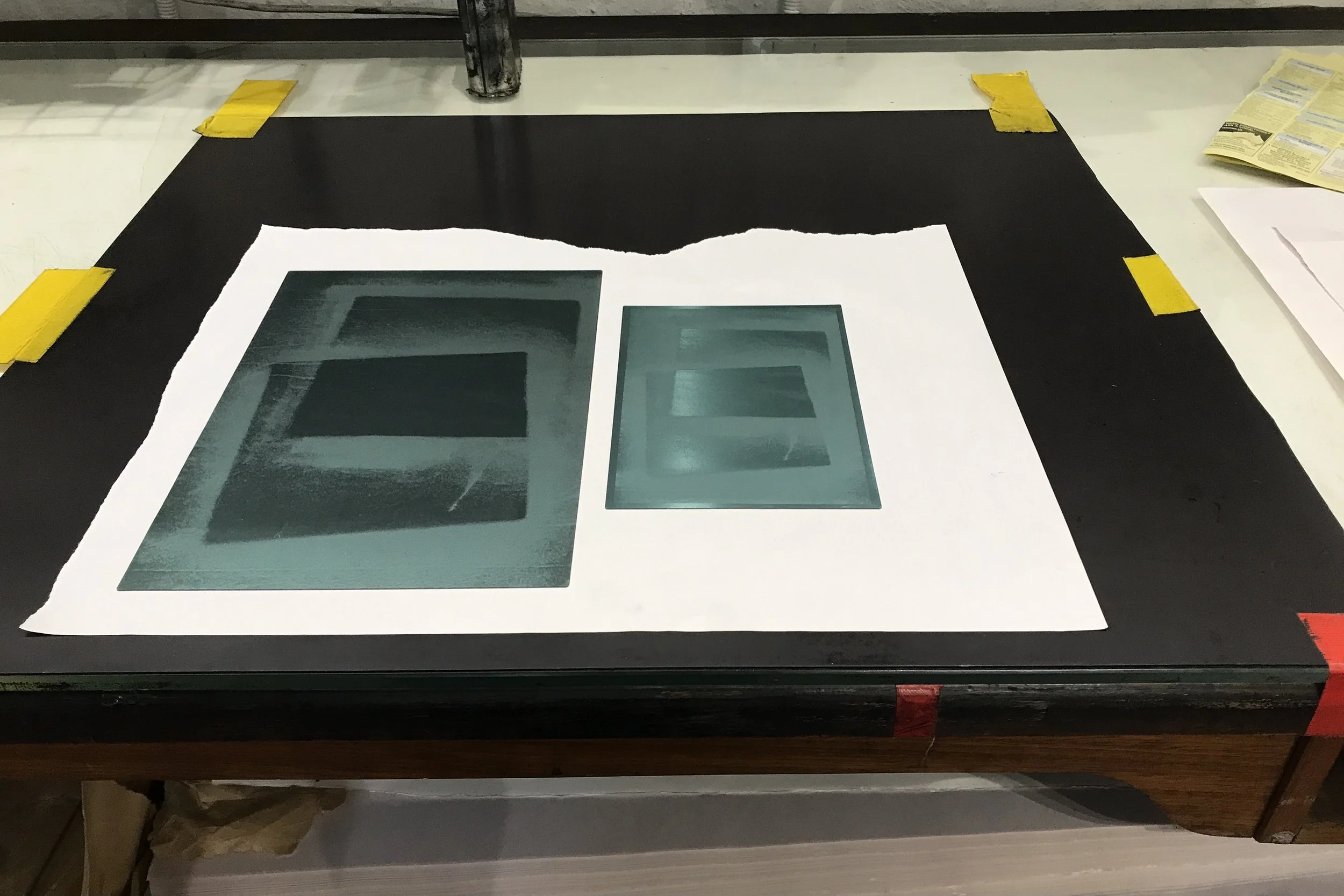
Figure 1
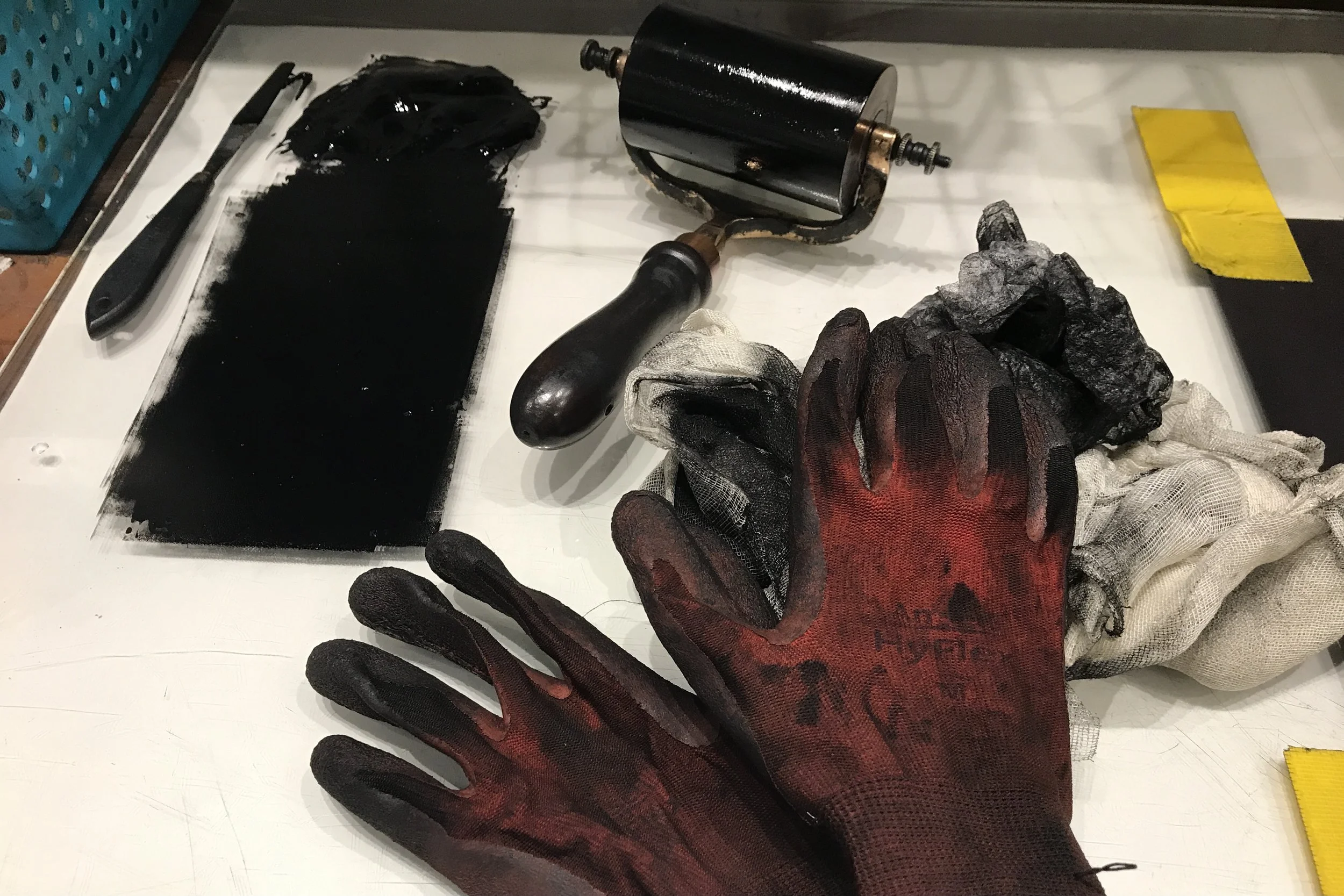
Figure 2
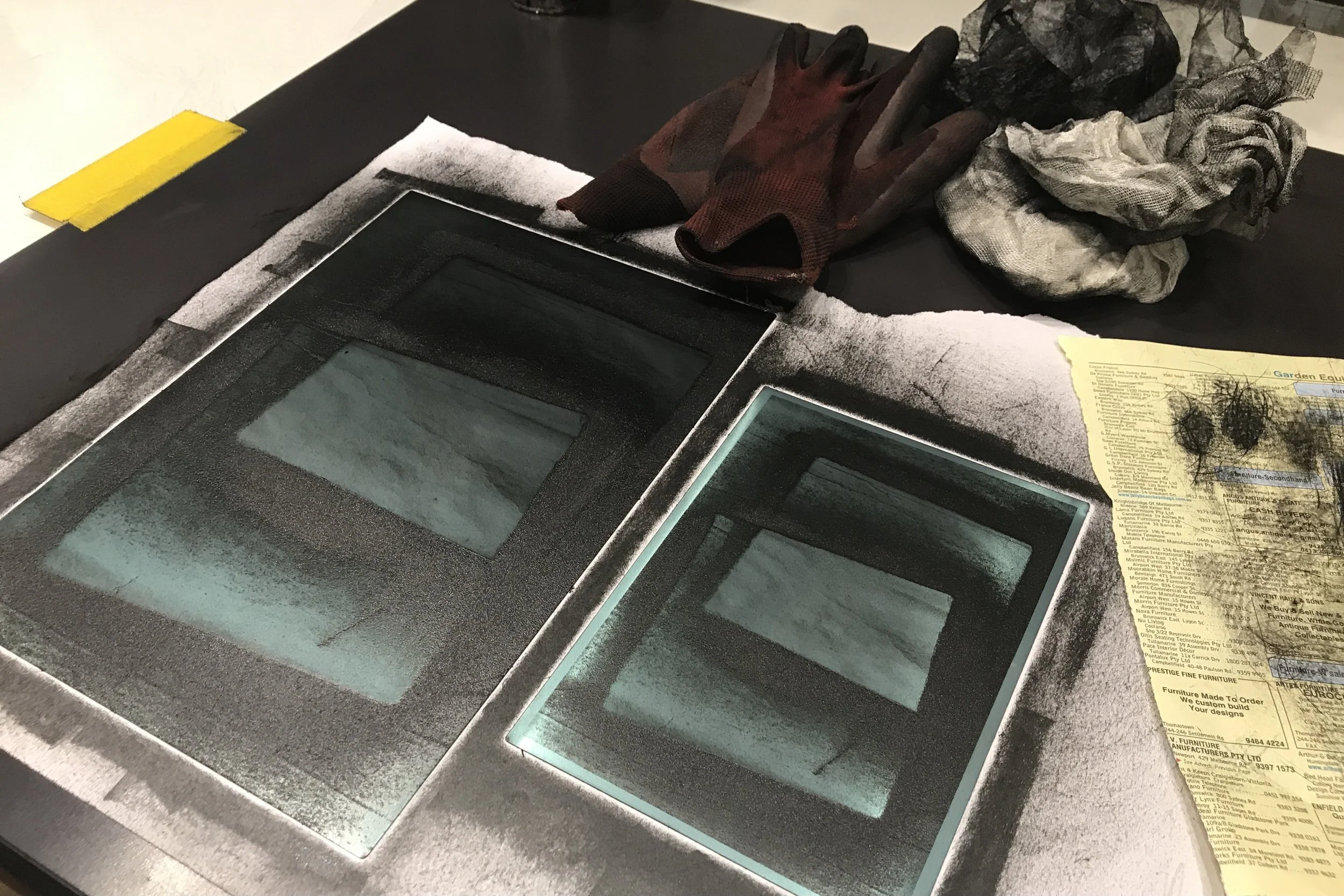
Figure 3
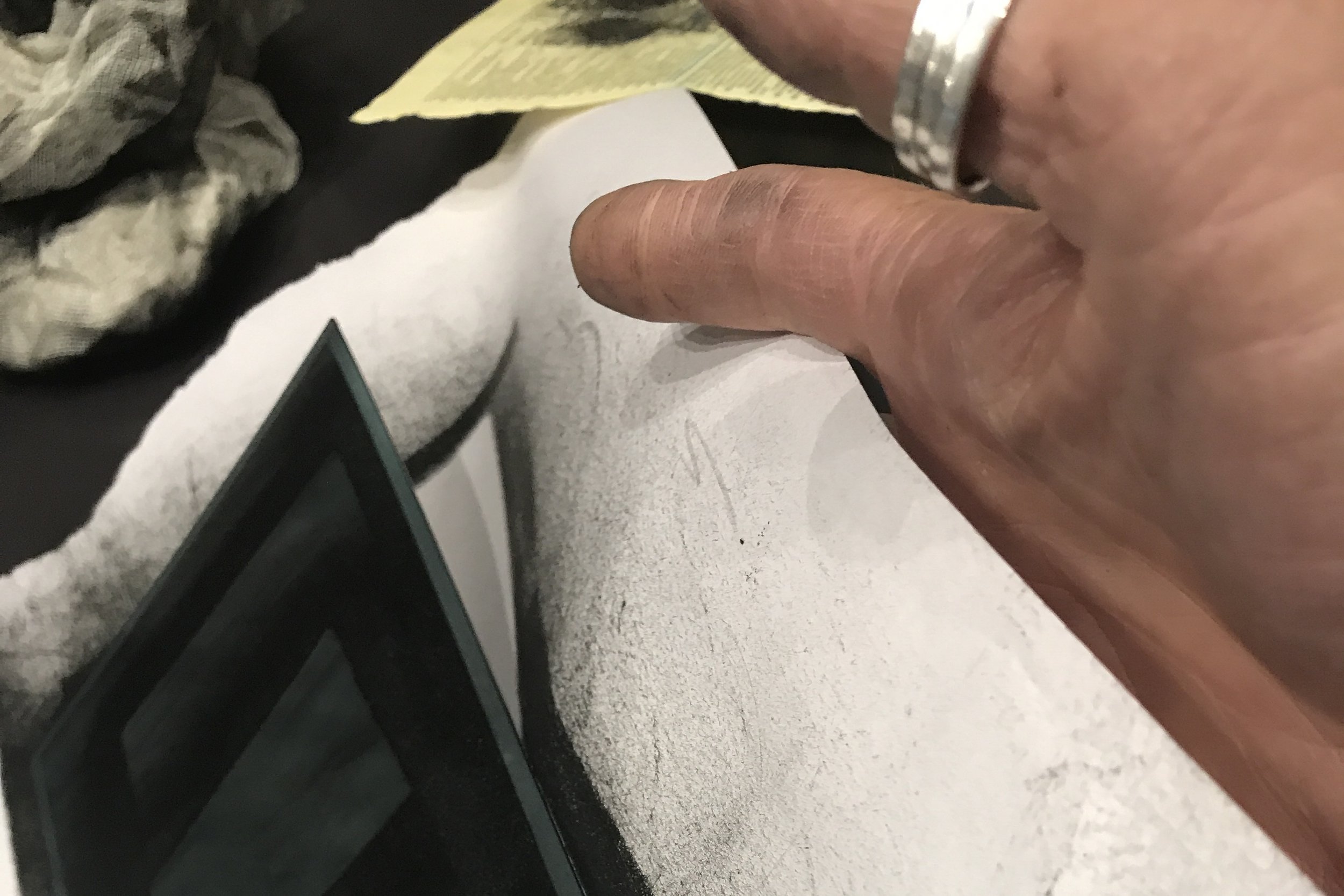
Figure 4
Footnotes
Photogravure etching is non-toxic and without use of solvents, or acids. Images are transferred directly onto a photopolymer plate with the use of an inkjet printer. The plate is then exposed using UV light, processed with water, and printed via an etching press (Glattauer 2021).
Keywords
MFA, Studio 1, Development of practice, Photogravure, Printmaking, Artefacts
Bibliography
Glattauer, Silvi. 2021. “PHOTOPOLYMER PHOTOGRAVURE - WEEK-END WORKSHOP.” Melbourne: Baldessin Press. https://baldessinpress.com.au/upcoming-workshops/photopolymer-photogravure-july2021-wgxz.