
SGR enquiry
Graduate research application and EOI checklist
I have spent June and July researching the application process and gathering as much information as possible.
This includes having meetings with Student Administration, EL Team, numerous academics, and resourcing information about how to apply for a PhD and Masters by Research, including eligibility criteria and available scholarships. I emailed SGR administration and received an auto-response providing a basic outline of the application process and links to information, most of which I already knew.
To date, the following need to be completed before I am able to submit the EOI.
CV: Complete artist statement.
Resume: Tidy and tighten.
Industry experience: See resume.
Research topic: Tidy up objectives and rewrite the closing paragraph of Semester 3 critical review.
Transcripts for academic qualifications: Website issues preventing me from purchasing transcript — emailed SGR (Monday 3 August 2021) for advice and to see if Academic History will suffice for EOI purposes. View Academic History PDF here.
Browse research programs: Done.
Approach two academics requesting supervisory support in EOI: I have asked Richard Harding and Steven Rendall.
Research program application:
Material Experiments in Contemporary Art and Craft https://www.rmit.edu.au/research/research-degrees/find-a-project
This area of focus encompasses studio-led enquiries where the creative exploration through contemporary art and craft practices research the interrelationships between meaning and making, with an emphasis on experimentation in and through material, visual, spatial, sonic and temporal processes.
Engaging the agency, methodologies and encounters of Contemporary Art & Craft, our focus extends to the investigation of the properties of art objects, matter and images, and their temporal manifestation as the transmission of ideas in contemporary culture.
The area supports critical, sensory and speculative practices engaged in specialised and interdisciplinary research examining how transformative acts under domains of materiality and cultural production, advance new manifestations of form and experience. We support projects that materialise critical dialogues mediating the social and the aesthetic, knowledge and imagination.
Through engaged and flexible research, we aim to provide innovation within a rapidly changing and expansive field of contemporary art and craft practices, emerging technologies and contemporary culture.
College: Design and Social Context
School: Art
Discipline: Art, Photography
Program Code: DR208
Campus: City
Project/Team Leader: Mark Edgoose, Irene Barberis-Page, Nicholas Bastin, David Chesworth, Jazmina Cininas, Martine Corompt, Greg Creek, Rhett D’Costa, Mikala Dwyer, Peter Ellis, David Forrest, Ian Haig, Richard Harding, Michael Graeve, Shane Hulbert, Nikos Pantazopoulos, Simon Perry, Dominic Redfern, Steven Rendall, Philip Samartzis, Kristen Sharp, Louise Weaver, Peter Westwood, Kit Wise, Carloyn Eskdale
Sustainable Development Goal(s): Decent Work and Economic Growth; Industry, Innovation and Infrastructure; Reduced Inequalities; Partnership
Funded Project:
Closing Date:
Enabling Capability Platform: Design & Creative Practice
FoR Code(s): 19051 Crafts 190502 Fine Arts (incl. Sculpture and Painting) 190502 Lens-Based Practice 190504 Performance and Installation Art 190599 Visual Arts and Crafts not elsewhere classified 1905 (Visual Arts and Craft), 190103 Art Theory 190104 Visual Cultures 200204 Cultural Theory
Link to page: https://www.rmit.edu.au/research/research-degrees/find-a-project
Email to SGR 20 July 2021
Hello team SGR,
My name is Zo (S9753760), I am a Master of Photography (by coursework) student embarking on my final semester of study.
I also have an EL plan.
The EL team have suggested I contact you regarding my plans for further study in 2022, in which I intend to enrol in a Masters by Research, potentially moving into a PhD.
My grades have been reasonable given the constraints and challenges of Covid and the personal issues that connect me with the EL team, receiving high distinctions in all subjects for 2020 (semesters 1 and 2) and distinctions and high distinctions for semester 3 (2021).
I would appreciate discussing the enrolment and scholarship application process with you.
The EL team have advised it would be beneficial to submit my application while I am still a student as it would be beneficial from an administrative perspective and to work together with the university in planning my study path, including any adjustments that may be required for my ELP.
I look forward to your reply and hope this finds you safe and well.
Thank you,
Zo Gay
SGR auto-reply received 26 July 2021
Dear Zo,
Thank you for your inquiry regarding graduate research at RMIT.
The first step is to check that you meet RMIT’s research entry requirements. RMIT admits applicants based on their demonstrated capacity to conduct independent research. All applicants for research programs must meet the minimum entry requirements. Please follow the links to entry requirements for local and international students.
To be assessed for eligibility for one of our research programs, applicants must submit an expression of interest (EOI). If the EOI is approved, you will then be invited to submit a full application.
The admission selection process has two stages:
Stage 1: Expression of Interest (EOI)
Stage 2: Application
The EOI gathers just enough information about you for the University to assess your eligibility and consider the research you will undertake as part of your research program. If your EOI is successful, you will be invited to complete and submit the rest of your application for admission consideration.
For detailed guidance on the application process please refer to our How to apply website. Please note you must submit your EOI via the application portal found on our How to apply website.
Applicants are encouraged to contact the relevant school to make a preliminary enquiry about the availability of supervision and an acceptable research topic prior to submission of an application. You may refer to our website Find RMIT Researchers.
You may also refer to the following link for College and School HDR contacts, where you may find the contact information for the HDR Coordinator within your area of interest at the School of Design and Social Context: https://www.rmit.edu.au/research/contact/contact-the-school-of-graduate-research.
Below are some helpful links to assist in navigating the RMIT HDR application processes and website:
Please refer to the following link to browse the research programs available at RMIT University: https://www.rmit.edu.au/study-with-us/levels-of-study/research-programs.
To review the list of available projects, please refer to the following link: https://www.rmit.edu.au/research/research-degrees/find-a-project
Unfortunately, there will be no RMIT scholarships available through the usual scholarship rounds for research candidates intending to start their research in 2021 and 2022. An update regarding scholarships will be provided by the end of August 2021. If you require scholarship support, we suggest not submitting the application until further information is provided in mid-2021.
It is recommended to check the range of scholarships made available through funded projects, which are still available- Funded Projects/Scholarships.
For more information about the application process for HDR admission, please refer to the following: How to apply.
Kind regards,
Marie-Claude
Tel: +61 3 9925 5570
Email: sgr.admissions@rmit.edu.au
Web: www.rmit.edu.au/graduateresearch
PCP Week 2
Professional Creative Practice Week 2
Thursday 29 July 2021
Class notes
On Kossak Painting
Photography is often presumed "digital" and or representational over and above the idea of developing a relationship with a "medium" resonates strongly for me. The conversation leads me to think of photographic artists including Mariah Robertson, Justine Varga, Danica Chappell.
Thinking is in the doing.
One to one relationship with medium and practice.
Understanding yourself, your work, what images mean in the world.
Talking about art with artists.
Talking about art with people that are not artists.
Let life get into the work.
What is the artist responsibility with content and subject matter?
Find a way to inhabit and express moments.
To instigate and express.
Having something to do.
Make something every day.
Artists statement
An artists statement represents a basic introduction to your art. A good artists statement ensures greater understanding and appreciation in working towards informing as many people as possible about the artist and their practice or project. Be brief and specific. Aim for two to three paragraphs or approximately 150 words. Appeal to and involve viewers with what you are doing. Know your target audience. What is in it for them? Provide a connection, a reason to engage and care.
Written in plain English (without colloquialisms), an artists statement is not an academic paper and should be easily understood by experts and laymen alike.
Be personal and conversational. Inform what the art is about (signifies, intention of communication, inspiration). Explain why you make art, what inspires you, what your work signifies or represents, how you make it, what it is made out of and what it means to you. (NAVA)
CV
I am rewriting my CV, bio and artist statement as per the course recommendation, utilising the NAVA template “Writing an artist CV” (Cameron-Smith 2014).
The template is very useful, outlining the appropriate structure, citations, and general information required to create a concise and informative CV.
I have completed the Solo exhibitions, Group exhibitions, Collections, Awards and Residencies sections and am currently working on the bio. This includes referencing articles and media coverage. I am also adding curatorial roles to the CV.
CV draft. Zo Gay, 2021.
Bibliography
Cameron-Smith, Joan. 2014. "Writing An Artist CV". NAVA. Accessed July 22, 2021. https://visualarts.net.au/guides/2014/writing-artist-cv/.
NAVA. n.d. Q AND A HOW DO I WRITE AN ARTIST’S STATEMENT? WHY ARE THEY IMPORTANT?. PDF. NAVA.
TCCP Week 2
Themes for Contemporary Creative Practice Week 2
Wednesday 28 July 2021
Class notes
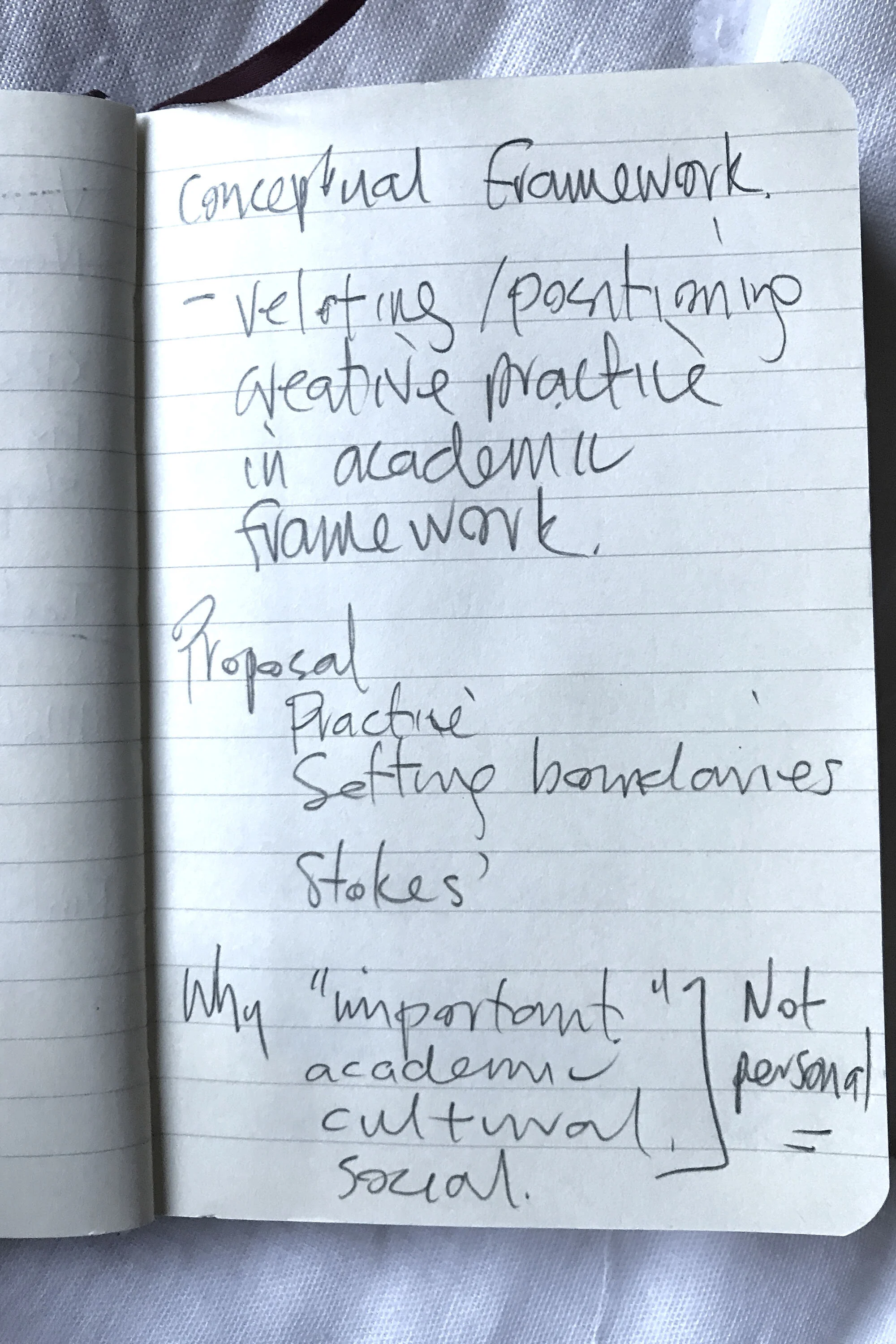
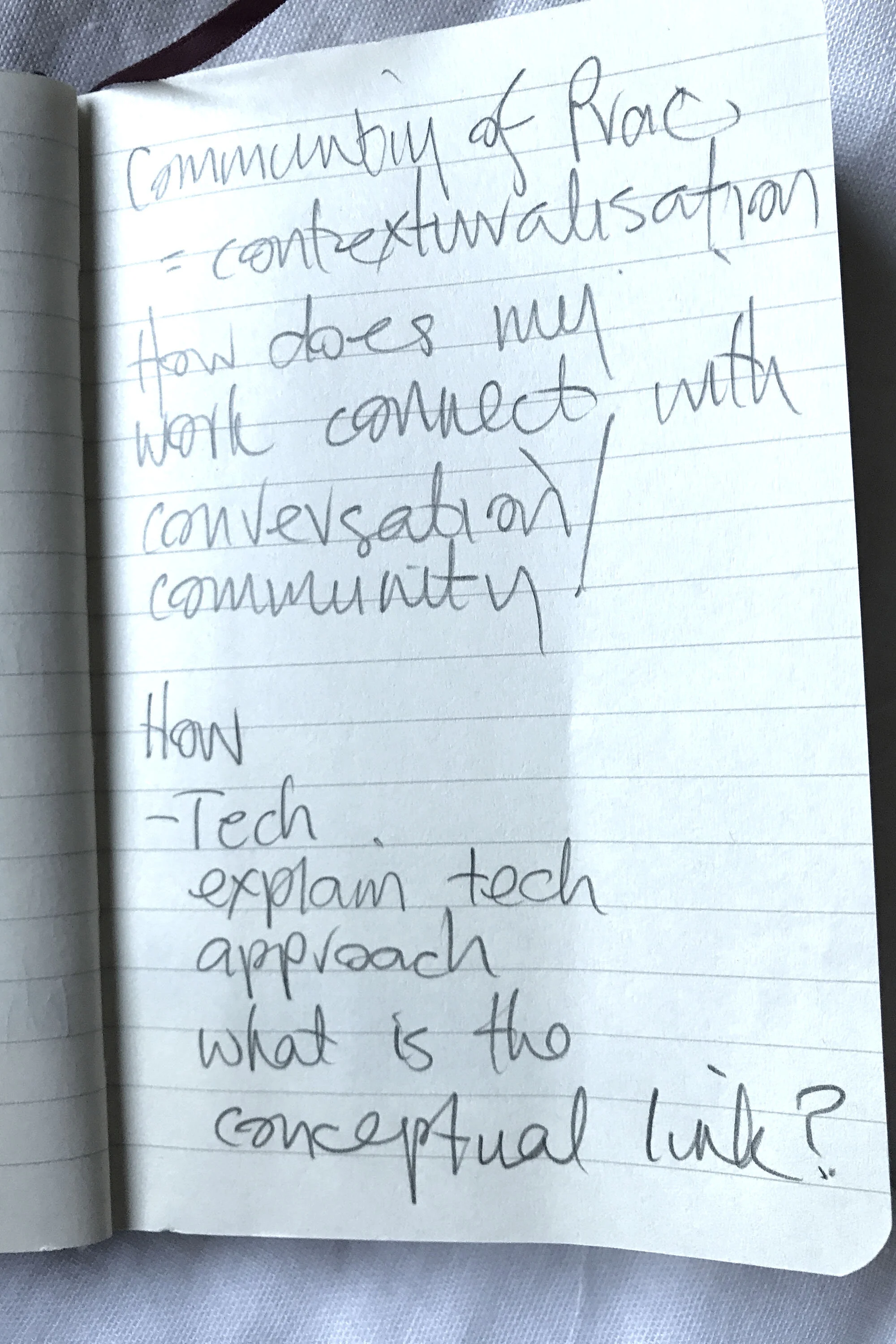
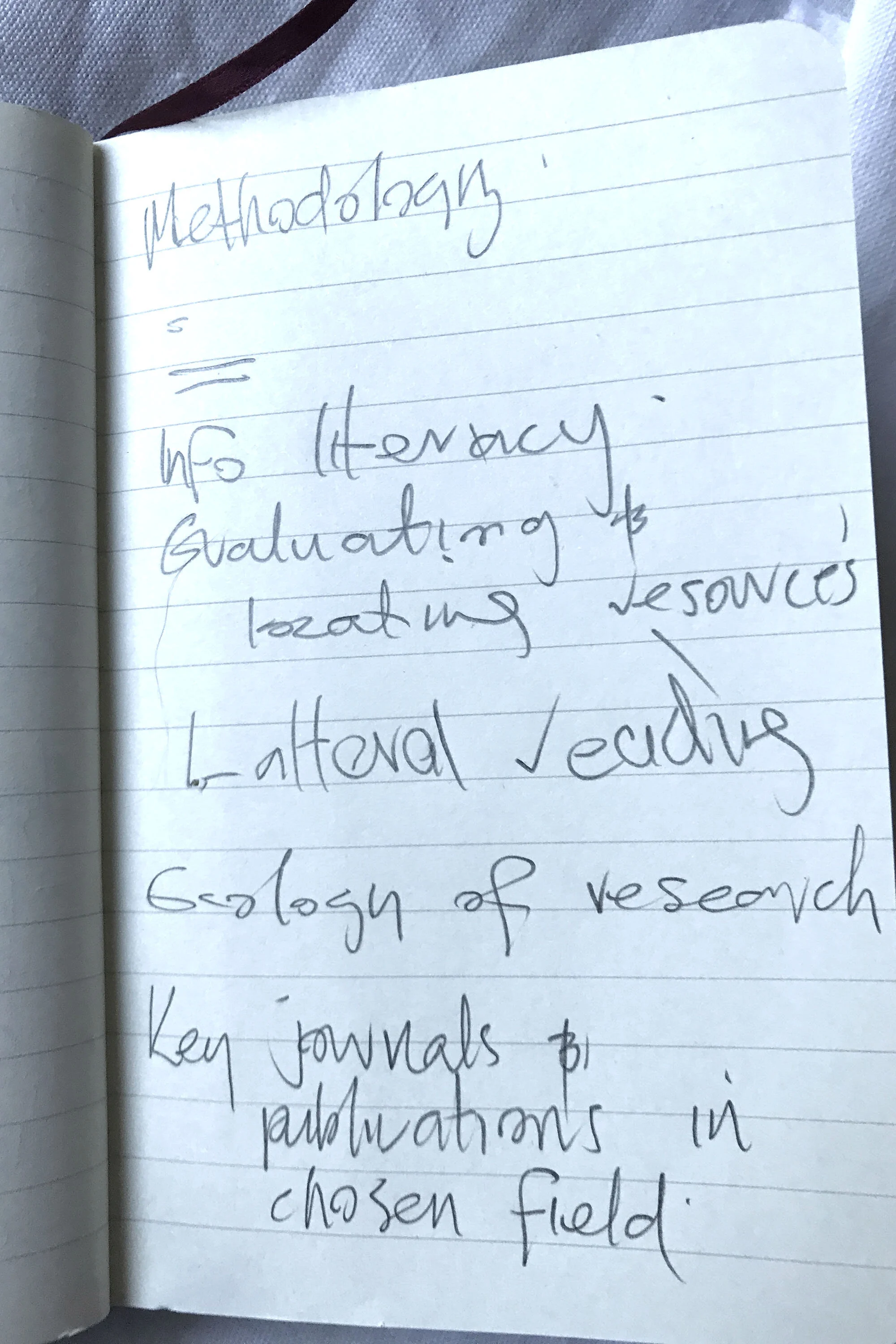
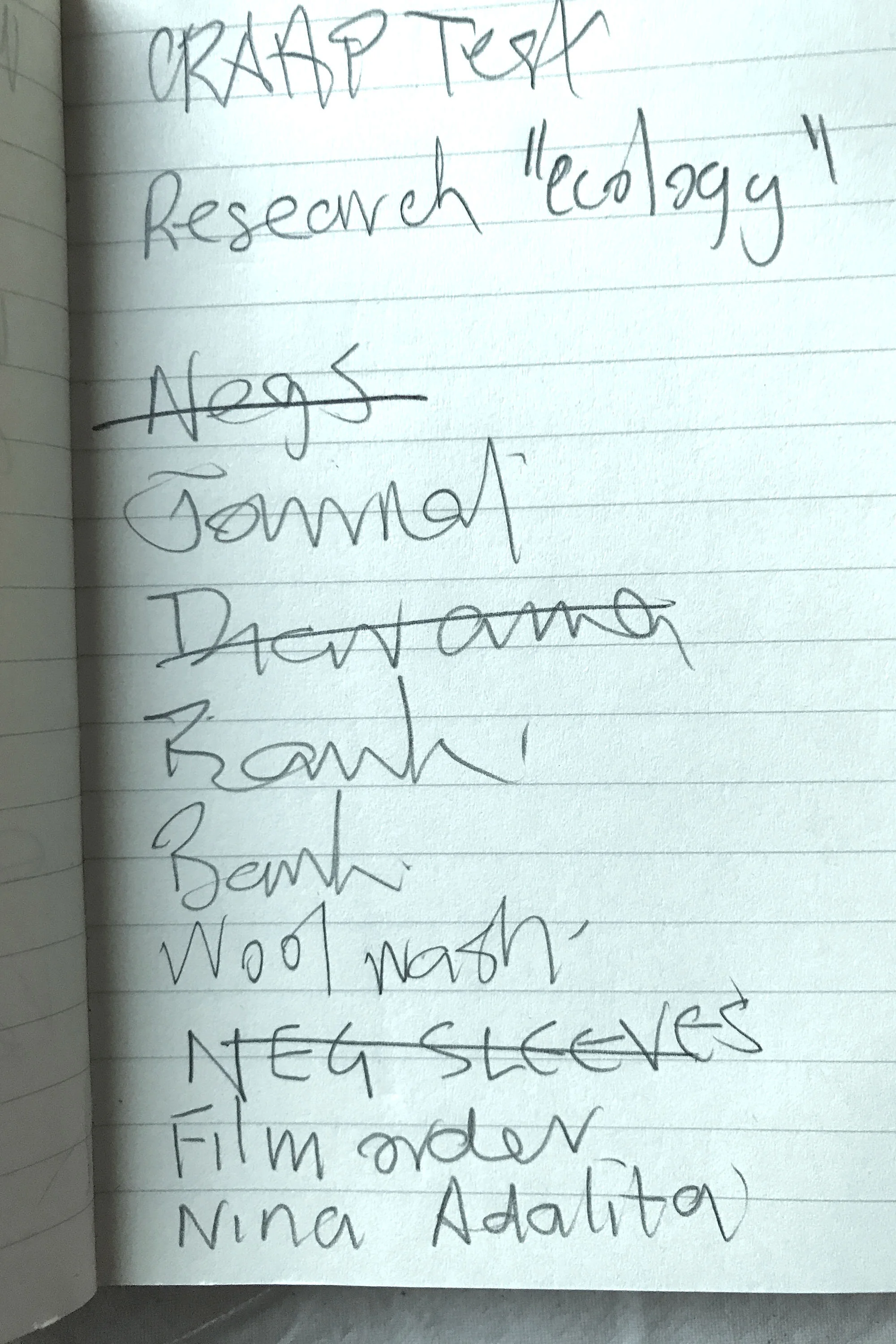
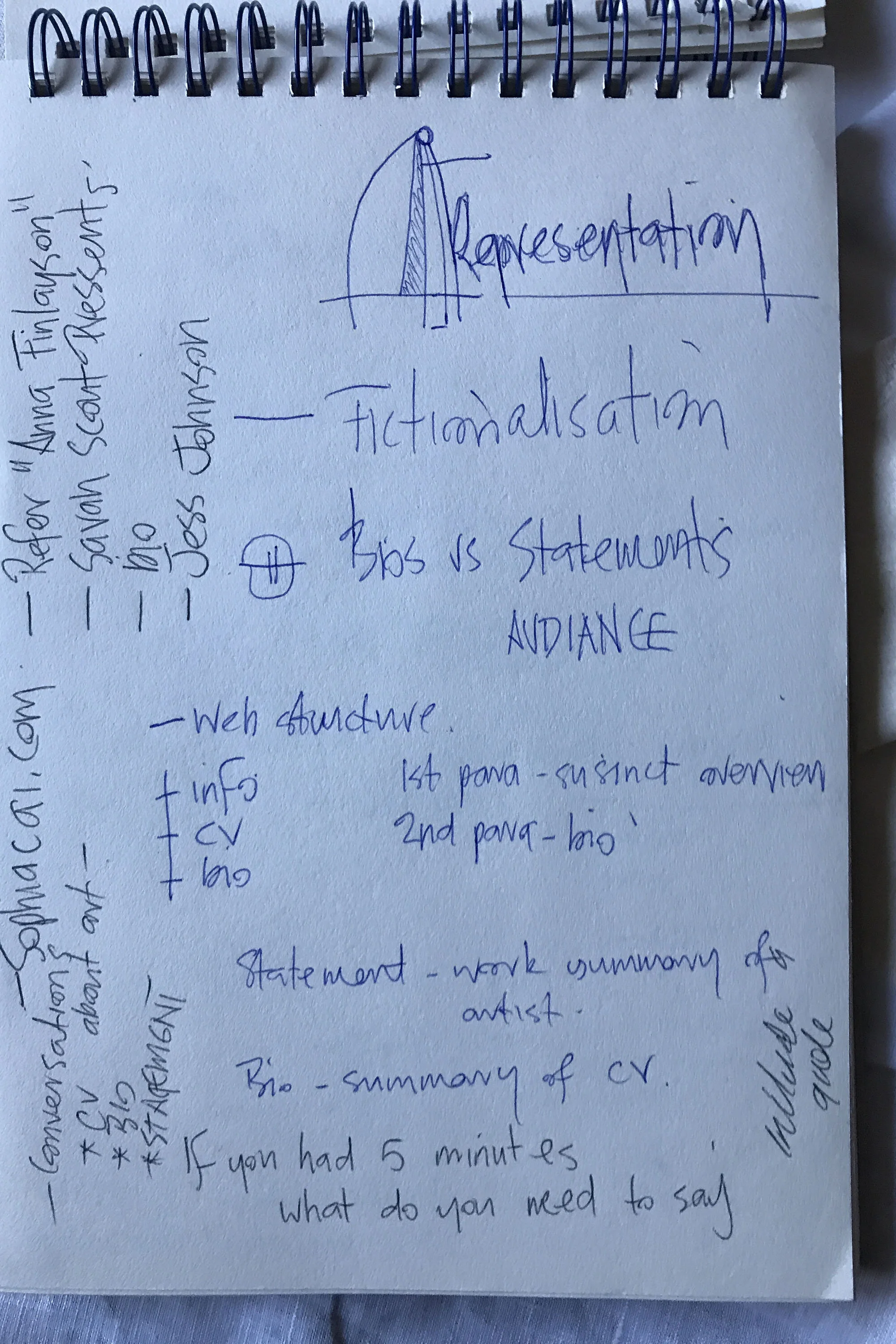
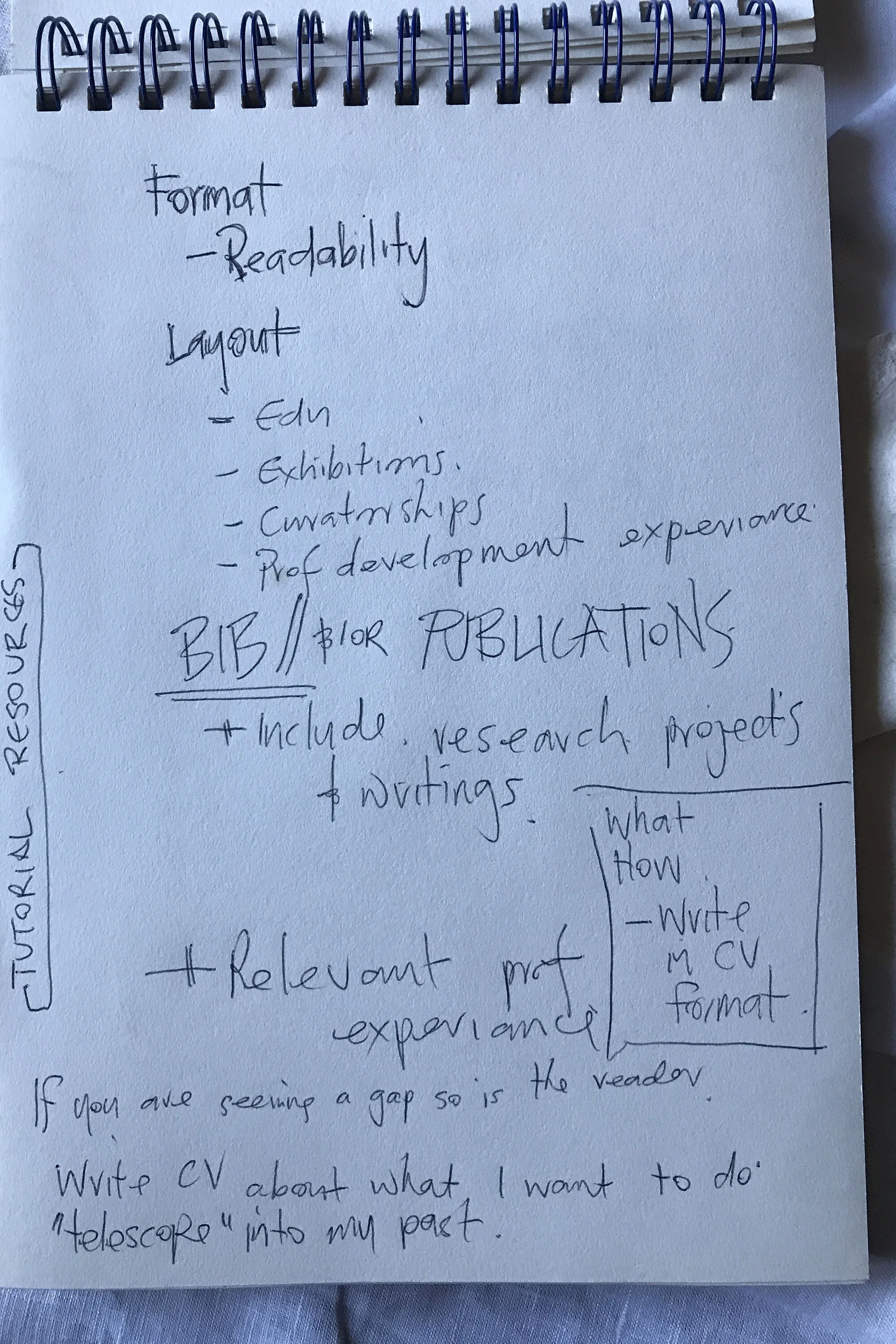
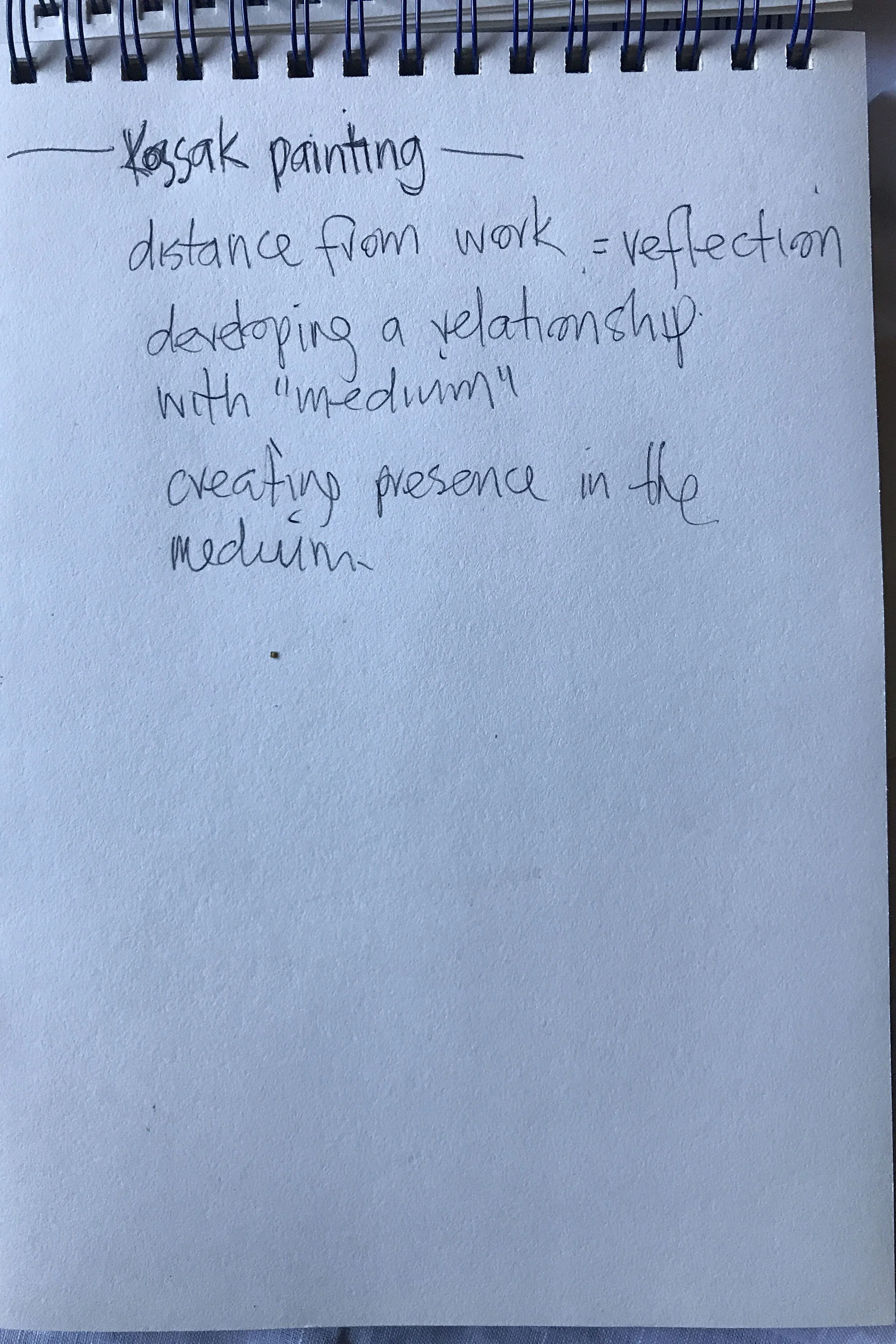
Themes of Contemporary Creative Practice Week 2, 28 July 2021 (Figures 1–4).
Figure 1. TCCP class notes. Week 2, page 1. Zo Gay, 2021.
Figure 3. TCCP class notes. Week 2, page 3. Zo Gay, 2021.
Figure 2. TCCP class notes. Week 2, page 2. Zo Gay, 2021.
Figure 4. TCCP class notes. Week 2, page 1. Zo Gay, 2021.
Discussion group
Program: Tell the group which program you are in.
Master of Photography, Semester 4.
Practice: What is your preferred mode of working? What processes do you use?
Film and cameraless photography, photo screen printing, darkroom printing, photogravure.
Project: What are the starting points for your project in this class.
As suggested, curate and consolidate works.
Priority: Can you articulate your project by telling us which of these you are prioritising (or most interested in exploring): Figuration; Representation; Virtuality. It can be a combination.
Figuration:
Representation:
Virtuality:
Problem: What problems are you encountering in your project?
Access to studio spaces to create works.
People: What are the key thinkers, artists, makers, writers, theorists etc that matter to your project … how might they help with the problems that you might be encountering?
Danica Chappell:
Justine Varga:
Sigmar Polke:
Laszlo Moholy-Nagy:
Dr Gregory Minissale: Neuroscientist and author of “Rhythm in Art, Psychology and New Materialism”.
Dr Michael Thaut: Neuroscientist and author of “Rhythm and the Brain”.
Steven shared from McEvilley’s “13 Ways of Looking at a Blackbird”.
“Some of you might have looked at McEvilley's 13 Ways of Looking at a Blackbird in Strategies: Content that arises from the aspect of the artwork that is understood as representational. This type of content is widely regarded as the least problematical; ironically, this very assumption lies at the heart of a tangled problem. We tend to feel that representation works by a recognizable element of objective resemblance, yet it seems more accurate to say that what we experience as representation is, like aesthetic taste, a culturally conditioned habit response not involving objective resemblance. In fact, it is difficult if not impossible to say what would constitute objective resemblance. And in reverse, the conviction of objective resemblance habituated in our pictorial tradition seems to exercise control over our perception of nature. The pictorial tradition, presented to us as representation of nature, has remade our perception of nature to conform with the conventions of pictures (as Goodman and others have demonstrated in their critiques of representation and, especially, of the tradition of perspectival drawing). The resemblance we seem to see between pictures and nature does not result from the fact that art imitates nature, but from the fact that our perception of nature imitates our perception of art. Seen thusly, just as it seems we can't think anything that our language can't formulate, so it seems we can't see anything that our pictorial tradition does not include or imply.! Representation, then, especially two-dimensional representation, is not an objective imitation, but a conventional symbolic system which varies from culture to culture. What "looks like" nature to an Australian aborigine looks like symbols to us, and vice versa. Virtually every culture has a tradition of representation which it sincerely regards as based on resemblance. Faced with a painting of the Battle of Waterloo, we seem to recognize horses, weapons, warriors, and so on; what we are in fact recognizing are our conventional ways of representing horses, weapons, warriors, and so on. The fact that it is specifically the Battle of Waterloo must come from the next level of content.” — Steven Rendall
A motif represented through different processes tate.org.uk/art/art-terms/m/motif.
Anchor conversations in the work.
SV meeting Week 2
27 July 2021
Meeting agenda — view PDF.
Discussion
Steven has suggested I utilise the Themes for Contemporary Creative Practice course to “consolidate and curate” my work.
Masters by Research
Get CV and research proposal in order. This can be aligned with my final report so nothing is wasted which is great.
Objectives and rationale require the most work.
Clearly outline objectives. Ensure each objective is covered, ie: film photography, cameraless photography, printmaking, materiality/physicality, performance, collaboration, installation.
So long as the objectives are well structured and articulated, the rationales should be simple.
Using headings
I agree that this will help keep the writing on track.
Continuation of Semester 3 project
Consolidate and build structure/project plan for the subject matter and concepts for Semester 4 as discussed in the last meeting. — Live music community and culture in-betweens, personal spaces, behind the scene creative hubs.
Incorporating a selection of work from Semester 1 and 2. My current work is a natural progression from these projects (Invent Define Destruct, and IZO) which were informed by the live music community and culture.
Installation artist: Liz Deschenes
“Deschenes has brought Bayer's principle of "extended vision" to life with six photograms (Figure 1) … created by exposing photosensitive paper to the subtly varying light from the moon, stars, and surrounding buildings. The photograms act as hazy mirrors, reflecting fragments of their gallery setting back onto the other panels and onto the gallery itself, and at the same time accumulating traces of these settings as their surfaces oxidize in response to shifting atmospheric conditions. In this way, the work retains an ever-growing memory of the situations in which it is exhibited, belying the notion that a photograph represents a single moment that has passed.” (MoMA 2014)
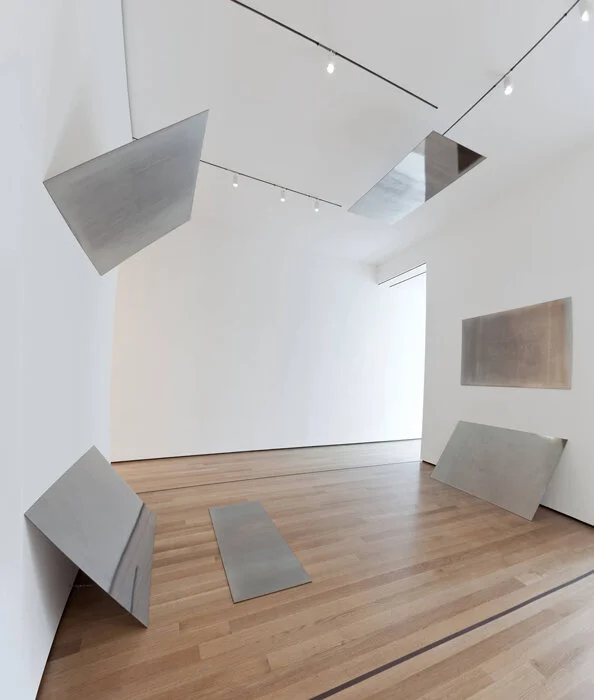
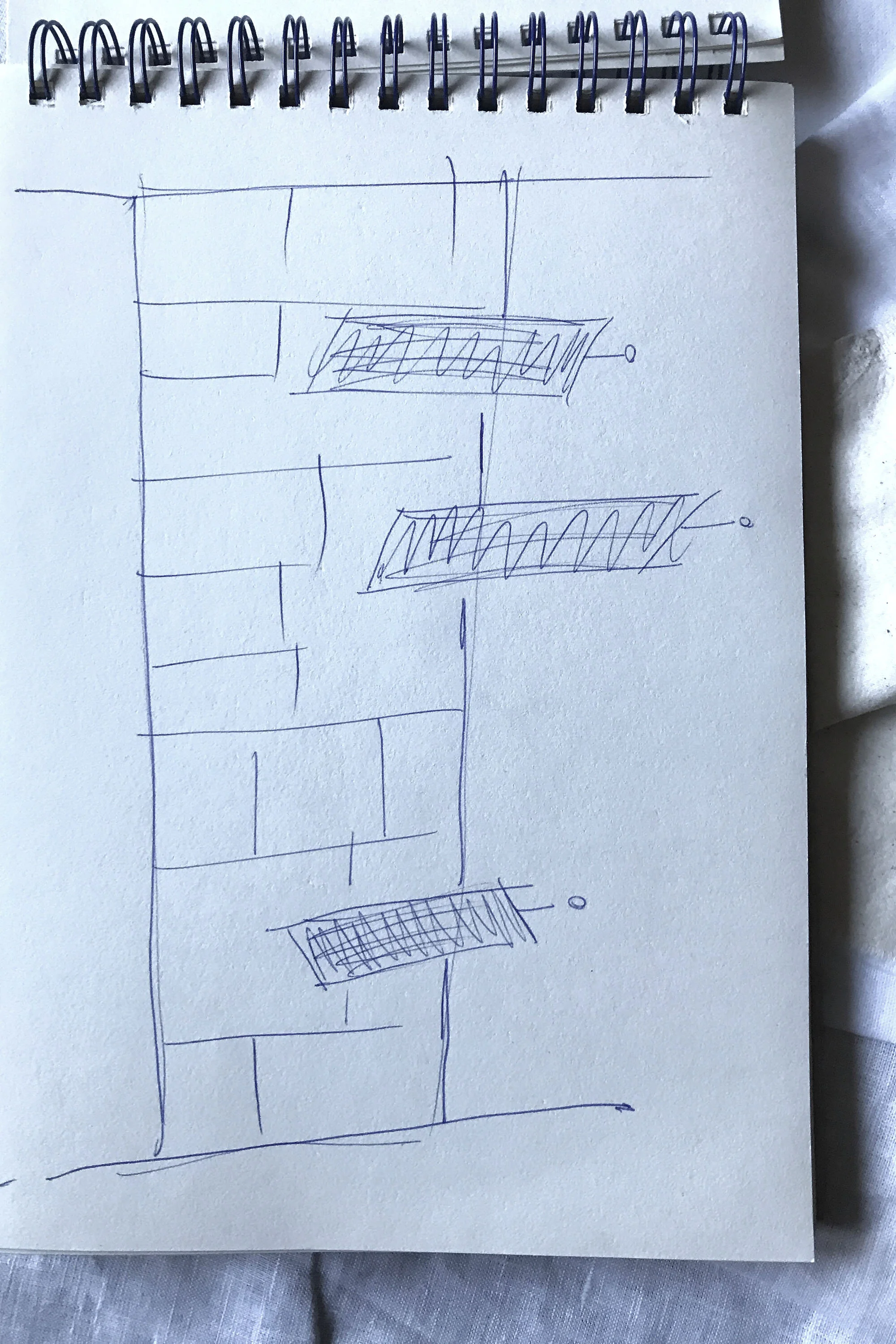
Figure 1: Tilt/Swing is an installation of photograms: (360º field of vision, version 1) (Deschenes 2009)
Bibliography
Deschenes, Liz. 2009. Tilt/Swing (360º Field Of Vision, Version 1). Image. https://www.moma.org/collection/works/161348.
MoMA. 2021. "Liz Deschenes. Tilt/Swing (360º Field Of Vision, Version1). 2009". The Museum Of Modern Art. https://www.moma.org/collection/works/161348.
SV meeting Week 1
20 July 2021
Meeting agenda — view PDF.
Meeting notes
Link process with conceptual aims = methodology
Conceptual aims
Create a link to process
Main methods responding to the concept. (The xxx were used because they relate directly to the xxx concept.)
Viewer to the work
Exploring their body in relation to viewing my work
one of the most underrated art cultures in this country
Interviews are important = humanise it
How does process inform methodology?
Community of practice = installation artists
I like the in-betweens
Consider using photograms to address in-betweens
Overlap
Incomplete
Development of practice
Continue with photograms and film
Continue with alternative substrates: fabric, darkroom paper, plastic
Research INSTALLATION artists
David suggestions of installation artists to investigate
Miyako Ishiuchi (SFMOMA)
Miyako Ishiuchi (Robert 2020)
Joy Episalla (Episalla)
Waylead Beshty (Brown 2014)
Waylead Beshty (Barbican Centre 2014)
Bibliography
Barbican Centre. 2014. "Walead Beshty". 1995-2015.Undo.Net. Accessed July 23, 2021. http://1995-2015.undo.net/it/mostra/182300.
Brown, Mark. 2014. "Rubbish Idea: Walead Beshty Artwork Made From Year’S Detritus Goes On Show". The Guardian. Accessed July 23, 2021. https://www.theguardian.com/artanddesign/2014/oct/08/walead-beshty-artwork-years-detritus-rubbish-barbican.
Episalla, Joy. 2021. Joy Episalla. https://www.joyepisalla.com/.
Robert, Henri. 2020. “Miyako Ishiuchi and her Mother, the Evolution of Japanese Society”. Accessed July 20, 2021. https://pen-online.com/arts/miyako-ishiuchi-and-her-mother-the-evolution-of-japanese-society/.
SFMOMA. n.d. "Ishiuchi, Miyako". SFMOMA. Accessed July 23, 2021. https://www.sfmoma.org/artist/miyako_ishiuchi/.
Studio Workshop Week 1
Studio workshop week 1
Friday 23 July 2021
Notes
The class was a repeat of the first class of last year. Alison discussed the course structure and Shane discussed the course history, RMIT as an institution, workflow, learning paths and outcomes. Both offer a concise overview of the course.
Discussion (Bennett 2021)
Class discussion on the essay “READING PICTURES: THE IMPOSSIBLE DREAM?” Analysis and Metaphysics 9 (2010): 62–75 (Woodrow 2010).
View PDF
Class overview
Online Academic Workshop TEAM LINK
Overview of Friday Workshop Schedule
Using the Outlook Calendar
Process Journal
Introduction to technical assignment
Discussion of photography discourse
Tolarno Galleries with fine print consultants Andrey Walkling TBC
Bibliography
Bennett, Alison. 2021. “WEEK 1 FRIDAY WORKSHOP OVERVIEW with Alison Bennett”. Accessed July 18, 2021. https://rmit.instructure.com/courses/81834/pages/s2-academic-w1?module_item_id=3451357
Woodrow, Ross. 2010. "READING PICTURES: THE IMPOSSIBLE DREAM?" Analysis and Metaphysics 9: 62-75. PDF. Accessed July 18, 2021. http://ezproxy.lib.rmit.edu.au/login?url=https://www-proquest-com.ezproxy.lib.rmit.edu.au/scholarly-journals/reading-pictures-impossible-dream/docview/855603586/se-2?accountid=13552.
Studio Praxis Week 1
Semester 2 Studio 3 & 4
Studio praxis week 1 (Bennett 2021)
Thursday 22 July 2021
CLASS PLAN
Acknowledgement of Country
Introductions
Course Overview
Discussing images
Compare & Discuss: Bill Henson and Zanele Muholi
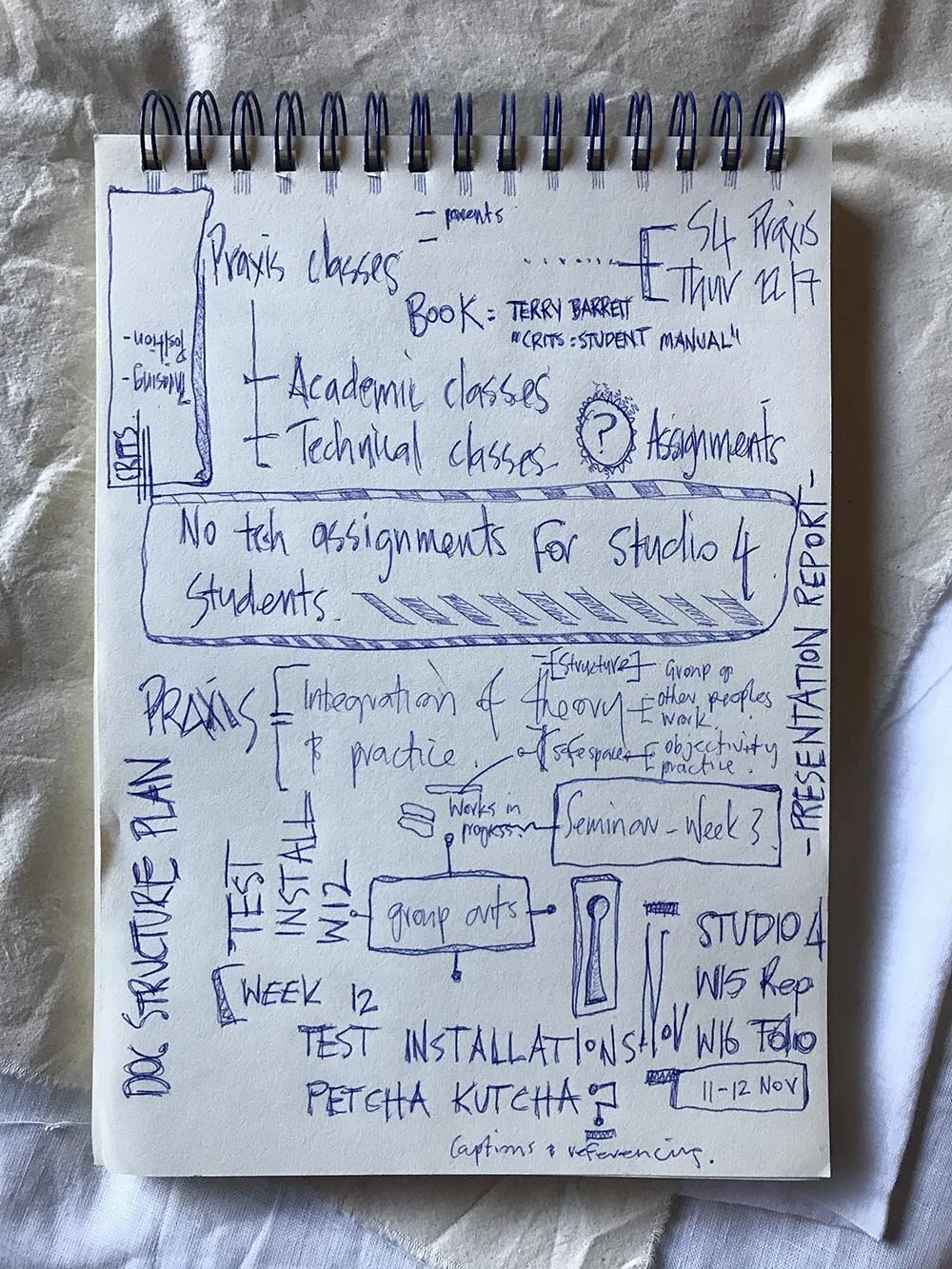
Work in progress will be presented via three group critiques through the semester and prior to the final folio presentation.
Bibliography
Bennet, Alison. 2021. “SEMESTER 2 STUDIO 3 & 4: THURSDAY STUDIO PRAXIS”. Accessed July 18, 2021. https://rmit.instructure.com/courses/81834/pages/s2-praxis-w1?module_item_id=3451356.