
SV meet 210830
Why is it important — relationship between rhythm energy / neuroscience
It could be that i want explore to further develop my own process and art form
Why is it important to use my processes in twenty first century (old school in new time)
What - reiterate the what (music community and culture)
Why is this community important in my work now (reflect back on the what and telling the reader why
What is the connection between music and project - why is it important to use this community base
street / space scapes exegesis
what works what doesn’t and why
keep it simple
why and i doing the what — interrogate my self on the “what” to talk to the why
why is it important — acknowledge the music scene in lockdown, my position in that space
elaborate on my performance collaboration with the process
installation performance collaboration — expand on that
works have energy and rhythm in response to people viewing the work
the installation can never be seen the same way twice — why
why are these elements important
OBJECTIVES
Before writing objectives interrogate myself and work out what is my motivation and why it is important to me
objectives — WRITE THE OBJECTIVES
SV meeting 210823
David
Discussed image of John (Figure 1). Include in the report.
Reference “John”
No eyes
No face
Relevance to project topic
No face and no eyes relate directly to the ephemeral nature of energy and rhythm. Opens a discussion of the contradiction in the relationship between the ephemeral and the physical. The image reflects on how energy and rhythm can be seen or articulated, yet are physical. — Restructure writing.
Articulate the relevance of including straight photography to the project.
Figure 1. “John”. Zo Damage 2021. Mockup of screen print on acetate disk from scan of original in-camera multi-exposure of John.
Mural
David suggested experimenting with stipples for the mural. I have also thought of this so it was great to have this feedback. I will make more composite mockups of the mural walls in photoshop to test.
David also suggested using the dot screen files on the mural. My thoughts are that, if applied, the images will need to be from the in-camera multi-exposure (ICX) series.
Either of these will need careful consideration.
My concern is that if not applied and treated correctly, the mural images will appear to be errors or overpower the hanging (primary) installation of screen printed acetates.
Straight photography
7–10% stipple for murals.
Note more than 15% stipple may appear to be a “mistake” in printing and be too strong thus distracting from the main installation component.
ICX
Try full strength
Links to further research in relation to the installation
Additional resource material
Franz Kafka
Characteristic or reminiscent of the oppressive or nightmarish qualities of Franz Kafka's fictional world — "a Kafkaesque bureaucratic office".
Catching up with Ceri
“Use writing as an expressive device.”
“Am I allowed to do that?”
“For Themes in Contemporary Creative Practive? Sure.”
Note
I am very confused by parallel classes and differentiating between the nuances of what is required.
Keywords
Semester 4, Studio 4, SV, Mural, Screen printing, Andy Warhol, Installation, Juxtaposition
SV meeting notes 210816
Supervisor meeting note
David
Screen prints
Revisit photos of Hana.
Keep to images of musicians.
Abstracts are good.
Remove venue facade images and keep to the musician images (including abstract and abstraction) screen print body of work (keep to wall murals).
Ensure images align with the statement.
Wall mural
Reshoot curtin if possible.
Shoot other wide shots of gardens.
Proposal
Experiment TEEL
Paragraph use?
Clarify “physicality” (relating to the body) / “embodiment” giving form to / “materiality” the quality or character of being material or being composed of matter.
Be consistent.
Look at theoretical and contemporary definitions.
Premise of project: Are rhythm and energy physical to the human experience (change “human experience” see notes below)?
Articulate in a more concise manner.
Use linking words:
Extends to neuroscience … as such/this is related to.
Topic sentence
Quote GM: answer quotes “E-xpaination of the TEEL” — be clear and state explanations.
From this we can conclude that … / it is clear that.
Talk about installation and special aspects in greater detail.
Viewer body – interact with and through the space.
Art unfolding in time.
Music unfolds in time. It’s not static.
I am exploring how photography can unfold in time through installation.
Can installation make the 2 d image unfold in time?
Can a 2 d image be activated and given kinaesthesia through installation?
Richard
The work comes before the theory
Use theory to inform or explain a point for the work
What
Questions are too general.
Create “expand” on question / introduce what I want to investigate.
Scientific theory to expand.
What scientific theory will inform the research project or particular research question?
Think about what the research question is.
Lotto
Reword , “It does activate a sense of colour theory.”
Think about:
How does lotto’s project relate to my project
Does it inform my project?
How has it informed my research.
Use the above to sit along side or align with my research.
Bring footnote (Thaut and Lotto) into body of text as direct quote — thaut and lotto support and substantiate what I am saying.
The hero of the writing is my project.
References and resource materials including theory substantiate and support my project research.
Can also use people to negate or disprove topics.
Informed argument = discussion
Who
EOI is about the next project — write as completely new project.
Needs to have research questions that have general position but have a specificity to them.
Think community, body of knowledge I am interested what is it that I want to prove or disprove.
Think of it as a scientific project in an art space/voice.
Community of practice.
Footnotes
Varga cotton award. Talk to the controversy. What’s the big deal. “winning the award and created a huge fuore because blah blah” <<direct quote from respected highly regarded news paper or magazine>>
Fresh approach
Includes restructuring and renegotiating my research leading in.
Locate the trigger that wanted me to do a PhD on rhythm and energy.
Think about the idea behind the making.
What is the concept of the project.
Talk to the content.
Why is xx being used?
Why are the images being made as xx.
What’s the point of the methods.
The content is the image.
What is the benefit of making an image to the field of neuroscience (brain / rhythm / energy).
General notes
Using tech to express and idea, or express — don’t kill the position of the art.
Think about 3 words that epitomise my current research project.
Hang other things off the three words.
Draft up an expression of interest.
New project springboards off past projects.
New project = can be same topic.
EOI / project proposal = plan = more meaningful = written with authenticity
Do not describe the obvious. Refer closing sentence of Folio Proposal.
PhD project
Write new project proposal specifically for the application, meeting the application guidelines and requirements.
Proposal must not be from masters project writing.
It can be same topic.
Sending request for supervision
PhD EOI requires a prospective candidate to source two supervisors and show the communication. The request must be made formally, sending basic email asking if they would be prepared to be supervisors for my PhD project.
Dear Richard and Steven,
Please accept this email as a formal request for you to be my supervisors should I be successful in my application for a PhD by project in the School of Art..
SV meeting Week 2
27 July 2021
Meeting agenda — view PDF.
Discussion
Steven has suggested I utilise the Themes for Contemporary Creative Practice course to “consolidate and curate” my work.
Masters by Research
Get CV and research proposal in order. This can be aligned with my final report so nothing is wasted which is great.
Objectives and rationale require the most work.
Clearly outline objectives. Ensure each objective is covered, ie: film photography, cameraless photography, printmaking, materiality/physicality, performance, collaboration, installation.
So long as the objectives are well structured and articulated, the rationales should be simple.
Using headings
I agree that this will help keep the writing on track.
Continuation of Semester 3 project
Consolidate and build structure/project plan for the subject matter and concepts for Semester 4 as discussed in the last meeting. — Live music community and culture in-betweens, personal spaces, behind the scene creative hubs.
Incorporating a selection of work from Semester 1 and 2. My current work is a natural progression from these projects (Invent Define Destruct, and IZO) which were informed by the live music community and culture.
Installation artist: Liz Deschenes
“Deschenes has brought Bayer's principle of "extended vision" to life with six photograms (Figure 1) … created by exposing photosensitive paper to the subtly varying light from the moon, stars, and surrounding buildings. The photograms act as hazy mirrors, reflecting fragments of their gallery setting back onto the other panels and onto the gallery itself, and at the same time accumulating traces of these settings as their surfaces oxidize in response to shifting atmospheric conditions. In this way, the work retains an ever-growing memory of the situations in which it is exhibited, belying the notion that a photograph represents a single moment that has passed.” (MoMA 2014)
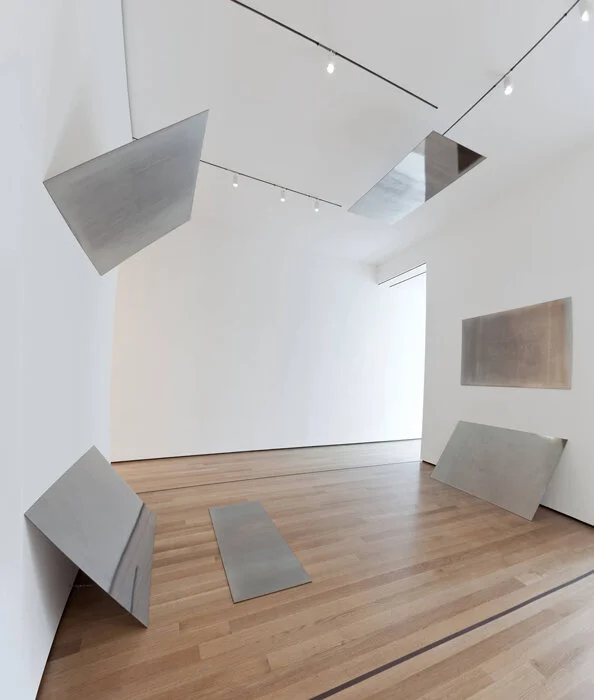
Figure 1: Tilt/Swing is an installation of photograms: (360º field of vision, version 1) (Deschenes 2009)
Bibliography
Deschenes, Liz. 2009. Tilt/Swing (360º Field Of Vision, Version 1). Image. https://www.moma.org/collection/works/161348.
MoMA. 2021. "Liz Deschenes. Tilt/Swing (360º Field Of Vision, Version1). 2009". The Museum Of Modern Art. https://www.moma.org/collection/works/161348.
SV meeting Week 1
20 July 2021
Meeting agenda — view PDF.
Meeting notes
Link process with conceptual aims = methodology
Conceptual aims
Create a link to process
Main methods responding to the concept. (The xxx were used because they relate directly to the xxx concept.)
Viewer to the work
Exploring their body in relation to viewing my work
one of the most underrated art cultures in this country
Interviews are important = humanise it
How does process inform methodology?
Community of practice = installation artists
I like the in-betweens
Consider using photograms to address in-betweens
Overlap
Incomplete
Development of practice
Continue with photograms and film
Continue with alternative substrates: fabric, darkroom paper, plastic
Research INSTALLATION artists
David suggestions of installation artists to investigate
Miyako Ishiuchi (SFMOMA)
Miyako Ishiuchi (Robert 2020)
Joy Episalla (Episalla)
Waylead Beshty (Brown 2014)
Waylead Beshty (Barbican Centre 2014)
Bibliography
Barbican Centre. 2014. "Walead Beshty". 1995-2015.Undo.Net. Accessed July 23, 2021. http://1995-2015.undo.net/it/mostra/182300.
Brown, Mark. 2014. "Rubbish Idea: Walead Beshty Artwork Made From Year’S Detritus Goes On Show". The Guardian. Accessed July 23, 2021. https://www.theguardian.com/artanddesign/2014/oct/08/walead-beshty-artwork-years-detritus-rubbish-barbican.
Episalla, Joy. 2021. Joy Episalla. https://www.joyepisalla.com/.
Robert, Henri. 2020. “Miyako Ishiuchi and her Mother, the Evolution of Japanese Society”. Accessed July 20, 2021. https://pen-online.com/arts/miyako-ishiuchi-and-her-mother-the-evolution-of-japanese-society/.
SFMOMA. n.d. "Ishiuchi, Miyako". SFMOMA. Accessed July 23, 2021. https://www.sfmoma.org/artist/miyako_ishiuchi/.