
El Lissitzky
Russian Constructivist El Lissitzky's interests were expansive. As with Laszlo Moholy-Nagy, Lissitzky worked in “graphic arts, architectural forms, photography, painting, and other formal types into a unique and dynamic art” (Sarabianov 2022). In meeting and working with other artists – including Alexander Rodchenko and Lazlo Moholy-Nagy – “Lissitzky became a transformational figure, intermin-gling the innovative arts of Europe and Russia and advancing the exchange of experimental forms and ideas” (ibid).
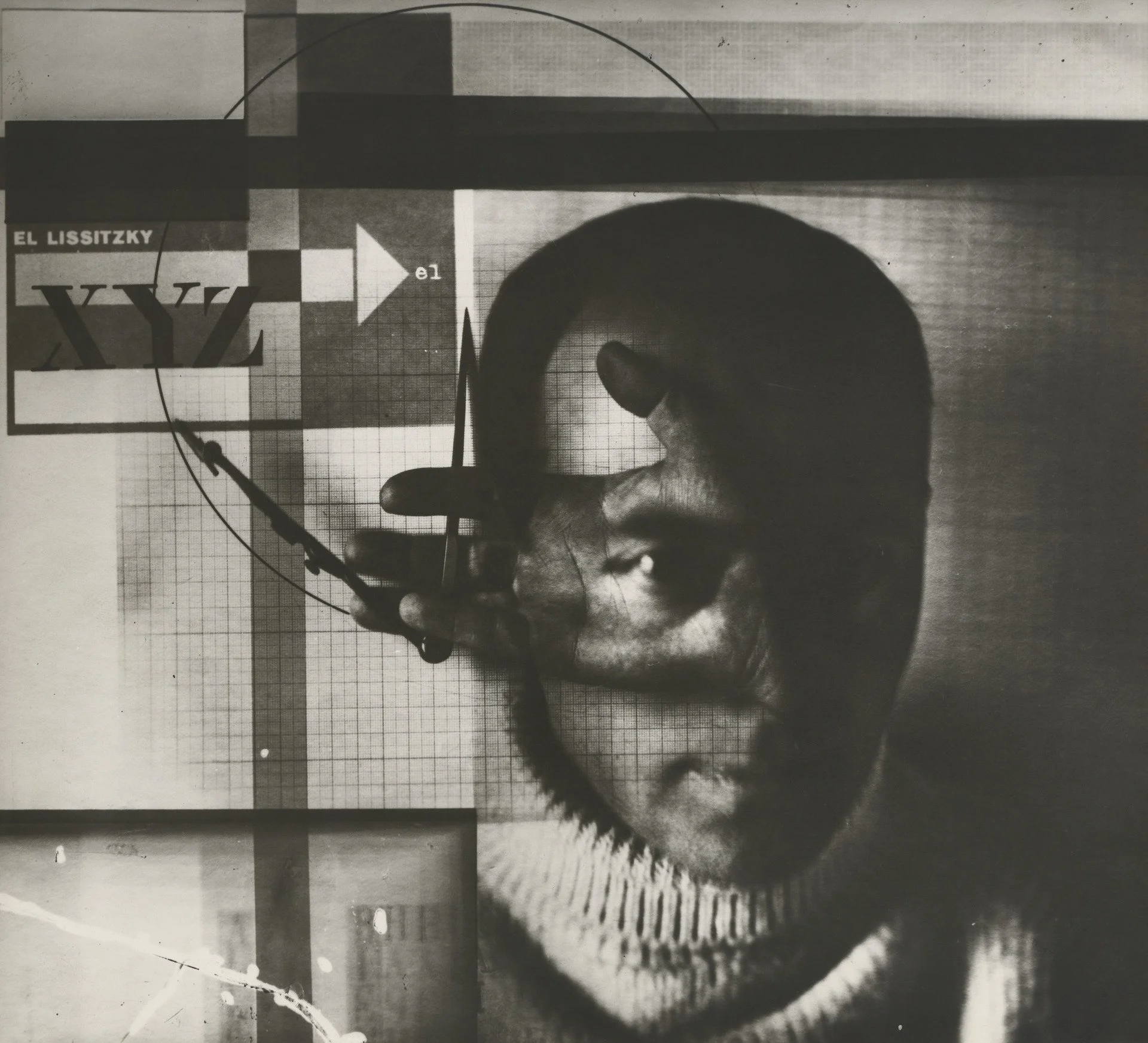
El Lissitzky, The constructor – Self-portrait/Photomontage, 1925
Bibliography
Levinger, Esther. 1989. “Art and Mathematics in the Thought of El Lissitzky: His Relationship to Suprematism and Constructivism.” Leonardo 22 (2): 227. https://doi.org/10.2307/1575236.
Perloff, Nancy, and Brian Reed. 2003. Situating El Lissitzky. Vol. 12. Los Angeles, CA: The Getty Research Institute.
Rocco, Vanessa. “Activist Photo Spaces: ‘Situation Awareness’ and the Exhibition of the Building Workers Unions.” Journal of curatorial studies 3, no. 1 (2014): 26–48.
Sarabianov, Andrei D. 2022. “El Lissitzky | Russian Artist.” Encyclopedia Britannica. https://www.britannica.com/biography/El-Lissitzky.
Bauhaus
The Bauhaus (The Staatliches Bauhaus) was a German art school (1919–1933) that became famous for its approach to design, which strove to combine beauty with function and attempted to unify the principles of mass production with individual artistic vision.
The Bauhaus movement had a profound influence on subsequent developments in art, architecture, graphic design and typography.
Although the school was closed by its own leadership under pressure from the Nazi regime who believed the Bauhaus was a centre of communist intellectualism, the staff continued to spread its idealistic precepts as they fled Germany and emigrated all over the world.
Russian painter, printmaker and graphic artist, Wassily Kandinsky was a teacher at The Bauhaus. Kandinsky is credited for creating the first purely abstract works, and as a pioneer of Abstract which I question in my journal entry Futurism (Gay 2020). Kandinsky is considered to be one of the great Modernists. No arguments from me on that point, in fact I would go so far as to say that Kandinsky is an undisputed great of the Modernist period.
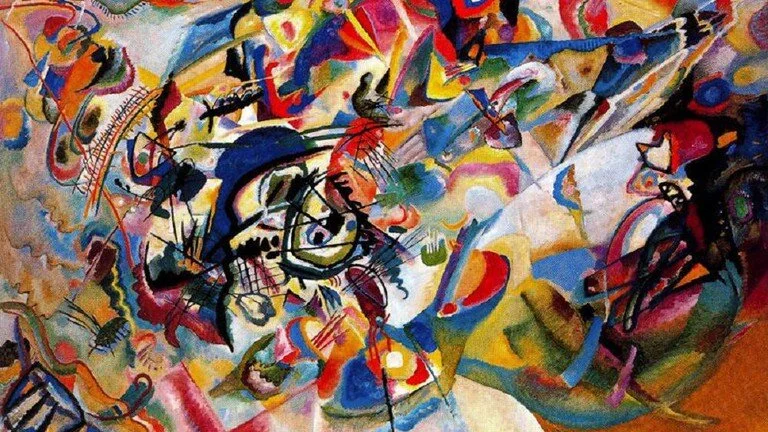
Composition 7, Wassily Kandinsky 1913
László Moholy-Nagy, a teacher of the Bauhaus, is my favourite artist. Of all the creatives I have researched and discovered throughout the year, Moholy-Nagy has had the most powerful and profound impact on me and my practice.
Moholy-Nagy authored Bauhausbücher 8: Painting Photography Film (1925). As represented by the title, the first half of the book finds Moholy-Nagy discussing various styles of art with a focus on painting, photography and film and theory. Curated by Moholy-Nagy, the second half of Bauhausbücher 8: Painting Photography Film presents a collection of works – ranging from sheet music to photograms – by artists of the Bauhaus.
In the introduction to Bauhausbücher 8: Painting Photography Film, Moholy-Nagy states that “This book is in defence of photography, which many people still think of as an inferior mechanical operation of recording.”
One hundred years down the track, Moholy-Nagy stands strong as a profound thinker and creative. His art and writing continue to be a powerful influence on contemporary artists, particularly in the field of photography. To me, Moholy-Nagy is God.
Things to come, László Moholy-Nagy 1936
Community of practice
I identify many of the teachers and artists from the Bauhaus movement in my community of practice, particularly Moholy-Nagy and Kandinsky. I am a book designer and typesetter by trade. My father (an illustrator, photographer, commercial artist, graphic designer and typographer) has also had a significant impact on my creative development. Considering this, it comes as no surprise that I am so passionately drawn to the Bauhaus movement.
Quotes
With few exceptions, music has been for some centuries the art which has devoted itself not to the reproduction of natural phenomena, but rather to the expression of the artist's soul, in musical sound. — Wassily Kandinsky (Kandinsky n.d.)
Keywords
Moholy-Nagy, Kandinsky, Mondrian, Constructivism, Bauhaus, WWII, Germany, Bauhausbücher, Books, Modernism, Futurism, Expressionism, Dada, Abstract, Typography, Film, Design, Photography, Art history
References
Kandinsky, Wassily. n.d. “Quotes”. Wassily Kandinsky. https://www.wassilykandinsky.net/quotes.php.
Kandinsky, Wassily. 1913. Composition 7. In ‘10 Artworks By Kandinsky You Should Know’. Culture Trip. https://theculturetrip.com/europe/russia/articles/10-artworks-by-kandinsky-you-should-know/.
Maholy-Nagy, Laszlo. [1928] 2019. Bauhausbücher 8: Painting Photography Film. Switzerland: Lars Müller Publishers.
Moholy-Nagy, Laszlo. 1936. Things to come. Image. http://www.artnet.com/artists/l%C3%A1szl%C3%B3-moholy-nagy/special-effect-f%C3%BCr-things-to-come-njNeWNe6qcXCU1TD_H-W1A2
László Moholy-Nagy
László Moholy-Nagy
Hungary
1895–1946
Practice: Painting; Photography; Sculpture; Film
Movement/Style: Dada, Constructivism, Expressionism, Bauhaus style, Modern art
The complexity, depth and structure of Moholy-Nagy’s work are deceiving. ‘Photogram’ by László Moholy-Nagy (1926) has had a significant impact on me and how I look at photography. Although simple at first glance, the layers, exposure and the opacity of the objects are complex and highly technical.
László Moholy-Nagy, a teacher of the Bauhaus (Staatliches Bauhaus), authored Bauhausbücher 8: Painting Photography Film (1925). As represented by the title, the first half of the book finds Moholy-Nagy discussing various styles of art with a focus on painting, photography and film and theory. Curated by Moholy-Nagy, the second half of Bauhausbücher 8: Painting Photography Film presents a collection of works – ranging from sheet music to photograms – by artists of the Bauhaus.
In the introduction, author Moholy-Nagy states that “This book is in defence of photography, which many people still think of as an inferior mechanical operation of recording.” The books are as magnificent to look at as it is to read. Typography is as much as a graphic element as a means of communication. One hundred years down the track, Moholy-Nagy was a profound thinker and creative. His art and writing continue to be a powerful influence on contemporary artists, particularly in the field of photography.
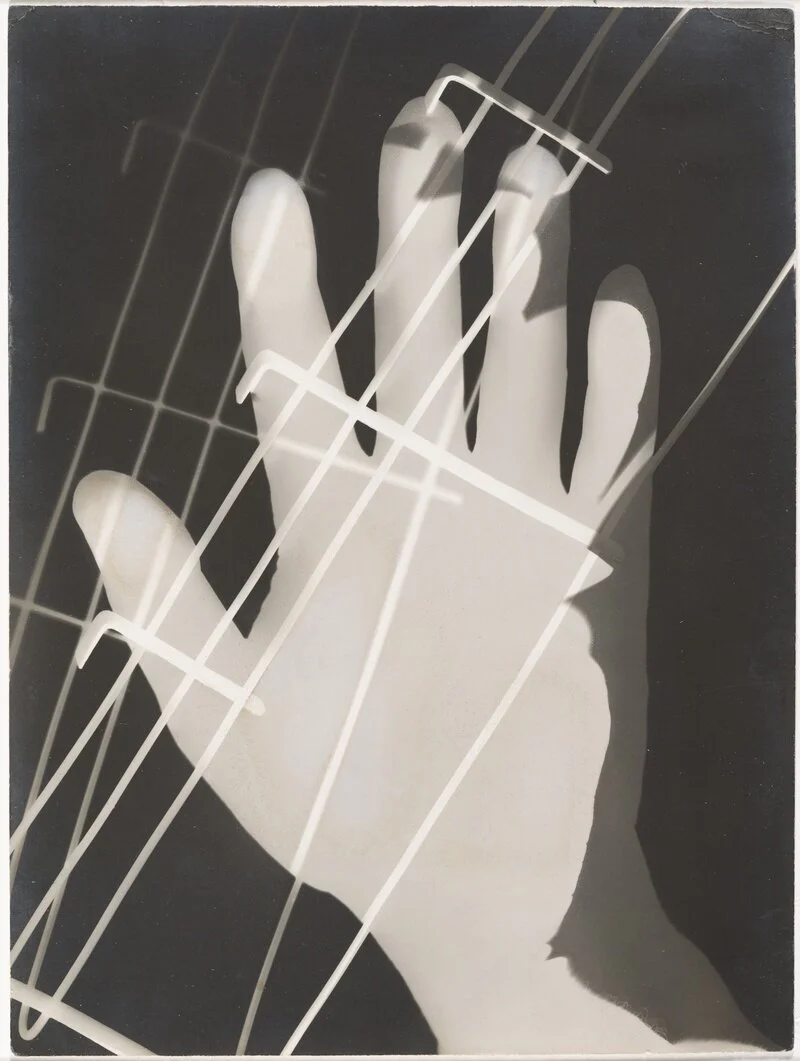
Laszlo Moholy-Nagy, Photogram, 1926
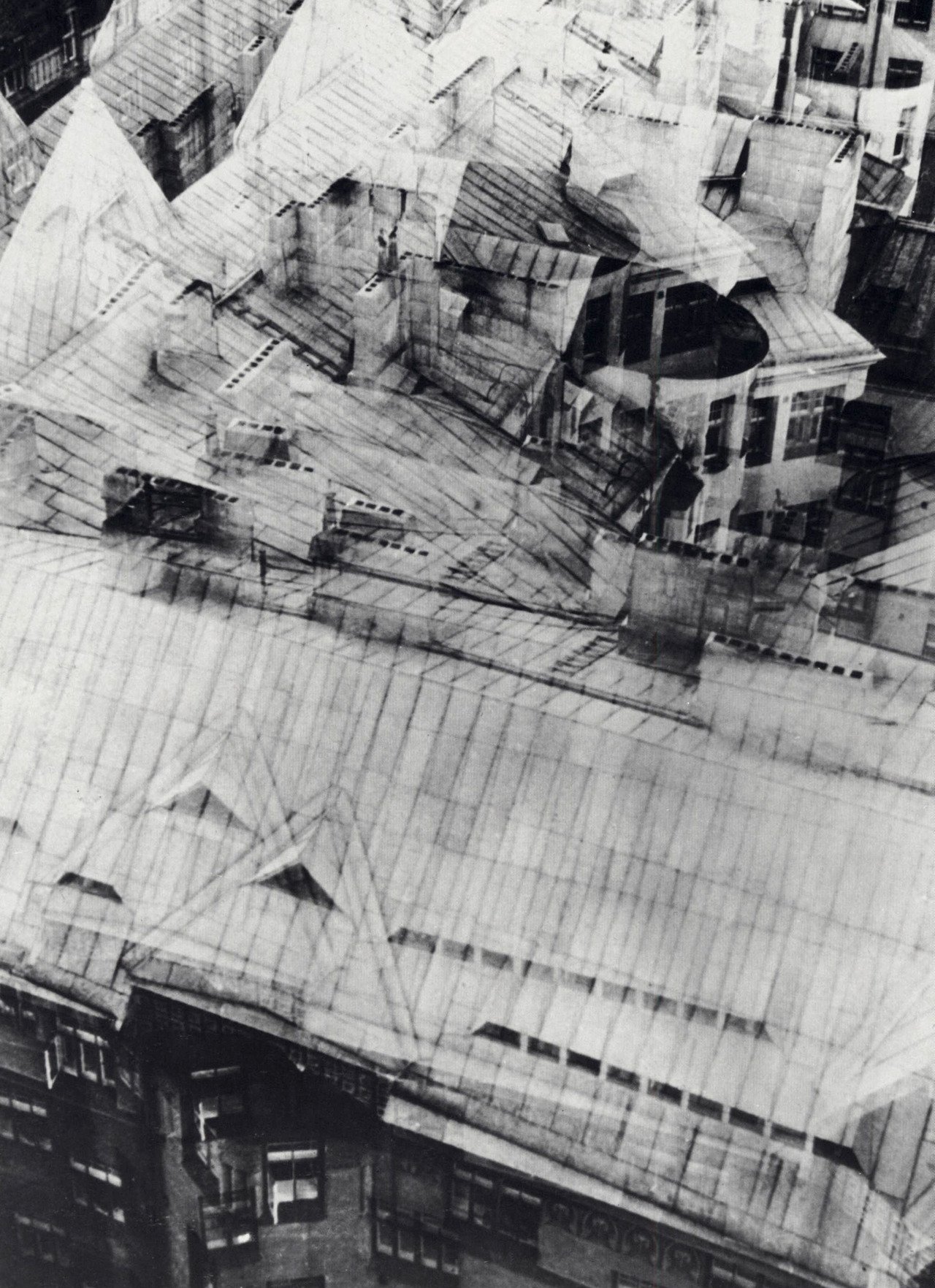
László Moholy-Nagy, Helskini, 1930, gelatin silver print, 394×292mm
Keywords
Dada, Modernism, Photogram, Experimental, Art, Community of practice
References
Laszlo Moholy-Nagy. 1926. Photogram. Image. https://moholy-nagy.org/.
Laszlo Moholy-Nagy. 1930. Helsinki. Image. https://www.sfmoma.org/artwork/98.243/.
Tate n.d. “Laszlo Moholy-Nagy”. TATE. Accessed March 11, 2020. https://www.tate.org.uk/art/artists/laszlo-moholy-nagy-1649.
Alexander Rodchenko
Alexander Rodchenko
Russia
1891–1956
Practice: Photography; Painting; Graphic design; Sculpture
Movement/Style: Modern art, Constructivism; DADA
Rodchenko’s diversity in style and mediums is captivating. The book Design: Rodchenko (Milner, J 2009) delivers a comprehensive account of Rodchenko’s career, the introduction, although short, providing a concise timeline of Rodchenko’s childhood and connections to the theatre, as a painter, through to political and sociological occurrence that saw Rodchenko’s evolution from painter through to designer and one of the most influential creatives of the Constructivist movement. Milner touches on Rodchenko’s connections with Futurism (and the differences between the Russian and Italian factions), the artist’s ideals based in disassociation in art, minimalism, contrast and colour, along with several constraints that led Rodchenko to these styles and social connections. Sadly, the book does not present any of Rodchenko’s photography. The book is an excellent resource for general information about Rodchenko and valuable resource for further research.
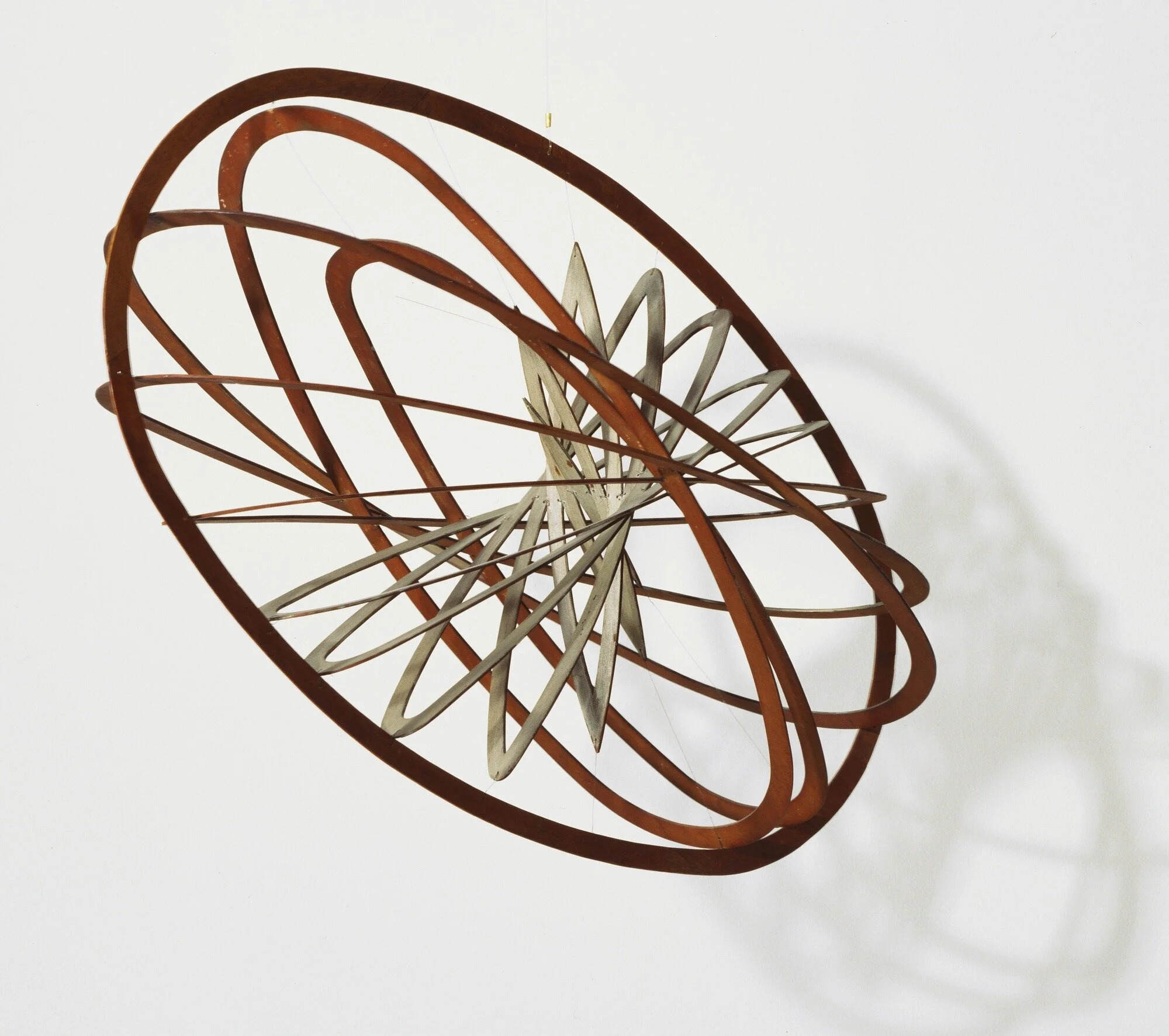
Alexander Rodchenko, Spatial Construction no. 12, 1928
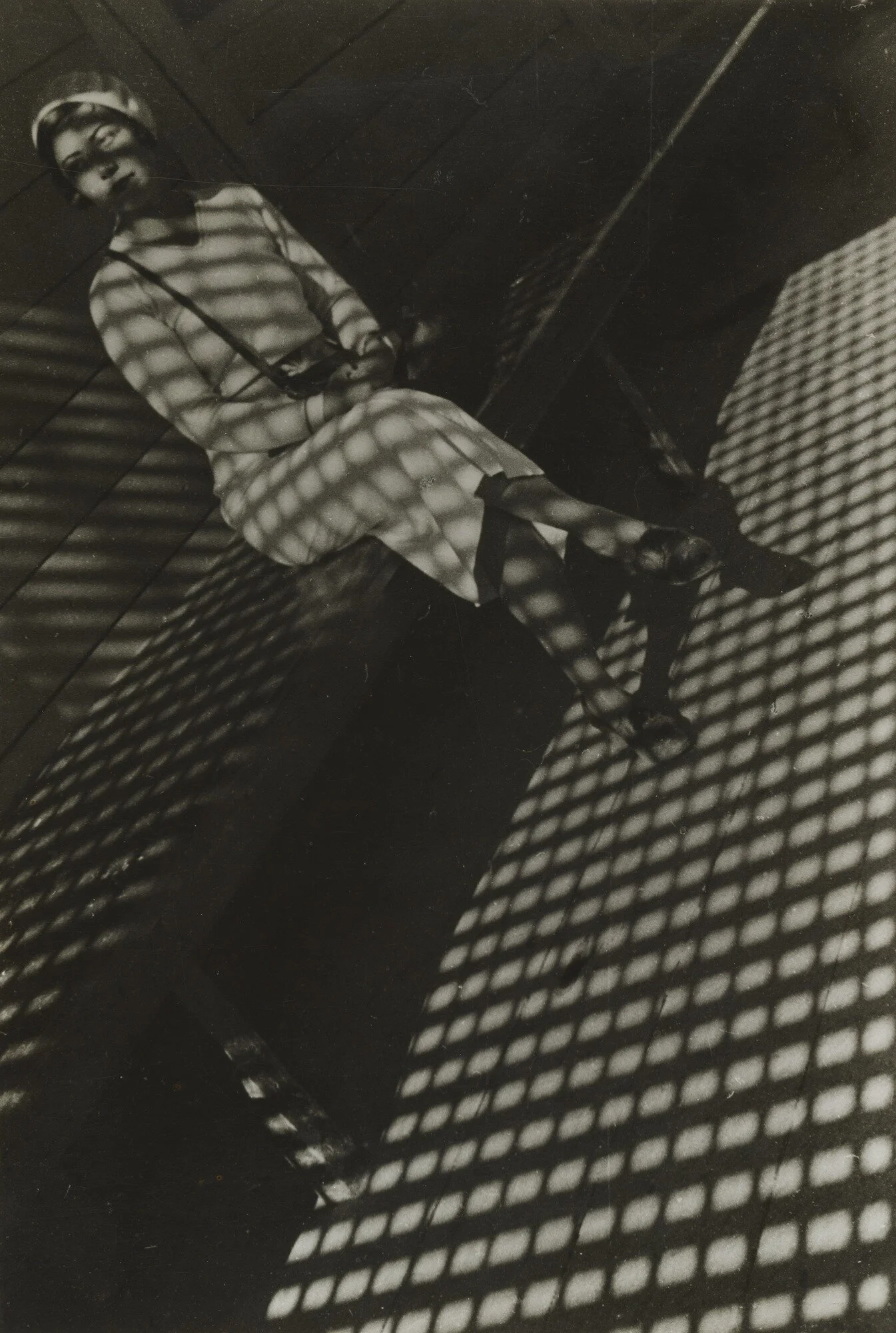
Alexander Rodchenko, Girl with a Leica, 1932–33
Notes
Rodchenko's subject matter and approach to photography are fascinating. Girl with a Leica (Rodchenko 1932–33) is an excellent example of how strongly Rodchenko's graphic design background influenced his photography. Rodchenko is one of the great Modernists for a reason.
Keywords
Russia, WW1, Anti-art, Graphic design, Collage, Photography, Politics, Socioeconomics, Poster art, Influence, Constructivism, Dada, Propaganda, Communism, Revolutionary, Theatre designer, Printer, Painter, Sculptor, Photographer, Art theory, Education, Constructivists' Manifesto, Realist Manifesto, Machine-made, Materials , Illustration, Commercial design, Photomontage, Flexible, Trademark, Techniques
Bibliography
Milner, J 2009, Design: Rodchenko, Antique Collectors Club, Woodbridge, Suffolk
MoMA n.d., Alexander Rodchenko, viewed 14 March 2020, <https://www.moma.org/artists/4975#works>
Rodchenko, A 1920, Spatial Construction no. 12, photograph, viewed 14 March 2020, <https://www.moma.org/collection/works/81043>
Rodchenko, A 1932–33, Girl with a Leica, photograph, viewed 14 March 2020, <https://www.moma.org/collection/works/83882>
The Art Story n.d., Constructivism, viewed 14 March 2020, <https://www.theartstory.org/movement/constructivism/>