
Bauhaus
The Bauhaus (The Staatliches Bauhaus) was a German art school (1919–1933) that became famous for its approach to design, which strove to combine beauty with function and attempted to unify the principles of mass production with individual artistic vision.
The Bauhaus movement had a profound influence on subsequent developments in art, architecture, graphic design and typography.
Although the school was closed by its own leadership under pressure from the Nazi regime who believed the Bauhaus was a centre of communist intellectualism, the staff continued to spread its idealistic precepts as they fled Germany and emigrated all over the world.
Russian painter, printmaker and graphic artist, Wassily Kandinsky was a teacher at The Bauhaus. Kandinsky is credited for creating the first purely abstract works, and as a pioneer of Abstract which I question in my journal entry Futurism (Gay 2020). Kandinsky is considered to be one of the great Modernists. No arguments from me on that point, in fact I would go so far as to say that Kandinsky is an undisputed great of the Modernist period.
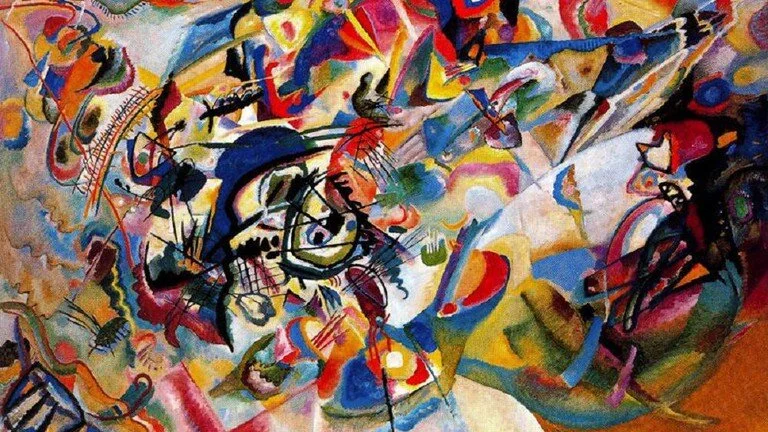
Composition 7, Wassily Kandinsky 1913
László Moholy-Nagy, a teacher of the Bauhaus, is my favourite artist. Of all the creatives I have researched and discovered throughout the year, Moholy-Nagy has had the most powerful and profound impact on me and my practice.
Moholy-Nagy authored Bauhausbücher 8: Painting Photography Film (1925). As represented by the title, the first half of the book finds Moholy-Nagy discussing various styles of art with a focus on painting, photography and film and theory. Curated by Moholy-Nagy, the second half of Bauhausbücher 8: Painting Photography Film presents a collection of works – ranging from sheet music to photograms – by artists of the Bauhaus.
In the introduction to Bauhausbücher 8: Painting Photography Film, Moholy-Nagy states that “This book is in defence of photography, which many people still think of as an inferior mechanical operation of recording.”
One hundred years down the track, Moholy-Nagy stands strong as a profound thinker and creative. His art and writing continue to be a powerful influence on contemporary artists, particularly in the field of photography. To me, Moholy-Nagy is God.
Things to come, László Moholy-Nagy 1936
Community of practice
I identify many of the teachers and artists from the Bauhaus movement in my community of practice, particularly Moholy-Nagy and Kandinsky. I am a book designer and typesetter by trade. My father (an illustrator, photographer, commercial artist, graphic designer and typographer) has also had a significant impact on my creative development. Considering this, it comes as no surprise that I am so passionately drawn to the Bauhaus movement.
Quotes
With few exceptions, music has been for some centuries the art which has devoted itself not to the reproduction of natural phenomena, but rather to the expression of the artist's soul, in musical sound. — Wassily Kandinsky (Kandinsky n.d.)
Keywords
Moholy-Nagy, Kandinsky, Mondrian, Constructivism, Bauhaus, WWII, Germany, Bauhausbücher, Books, Modernism, Futurism, Expressionism, Dada, Abstract, Typography, Film, Design, Photography, Art history
References
Kandinsky, Wassily. n.d. “Quotes”. Wassily Kandinsky. https://www.wassilykandinsky.net/quotes.php.
Kandinsky, Wassily. 1913. Composition 7. In ‘10 Artworks By Kandinsky You Should Know’. Culture Trip. https://theculturetrip.com/europe/russia/articles/10-artworks-by-kandinsky-you-should-know/.
Maholy-Nagy, Laszlo. [1928] 2019. Bauhausbücher 8: Painting Photography Film. Switzerland: Lars Müller Publishers.
Moholy-Nagy, Laszlo. 1936. Things to come. Image. http://www.artnet.com/artists/l%C3%A1szl%C3%B3-moholy-nagy/special-effect-f%C3%BCr-things-to-come-njNeWNe6qcXCU1TD_H-W1A2