
MFA S4: Research Document
Flow: Embodying aesthetic responses through process-based analogue photography
This heuristic investigation[1] uses process-based analogue photography[2] to embody my aesthetic responses to my life experiences. The research aims to harness the merging of my body, mind, lifeworld[3] and artistic practice to engage with photography in terms of an embodied art form. The research investigates cognitive neuroscience in the context of developing a greater understanding of phenomenological interplays that connect me to the world and my creative practice. Practical and theoretical elements of painting are fused with analogue photography to not only challenge the truth value of the medium but, importantly, to materialise my intent and authorship in my creative outcomes. The conclusion of this exegesis reflects on how contesting the tropes of “intellectual, and technical concepts and aesthetics [may broaden] the notion of what a photograph could be in art” (Squires 2013, 9).
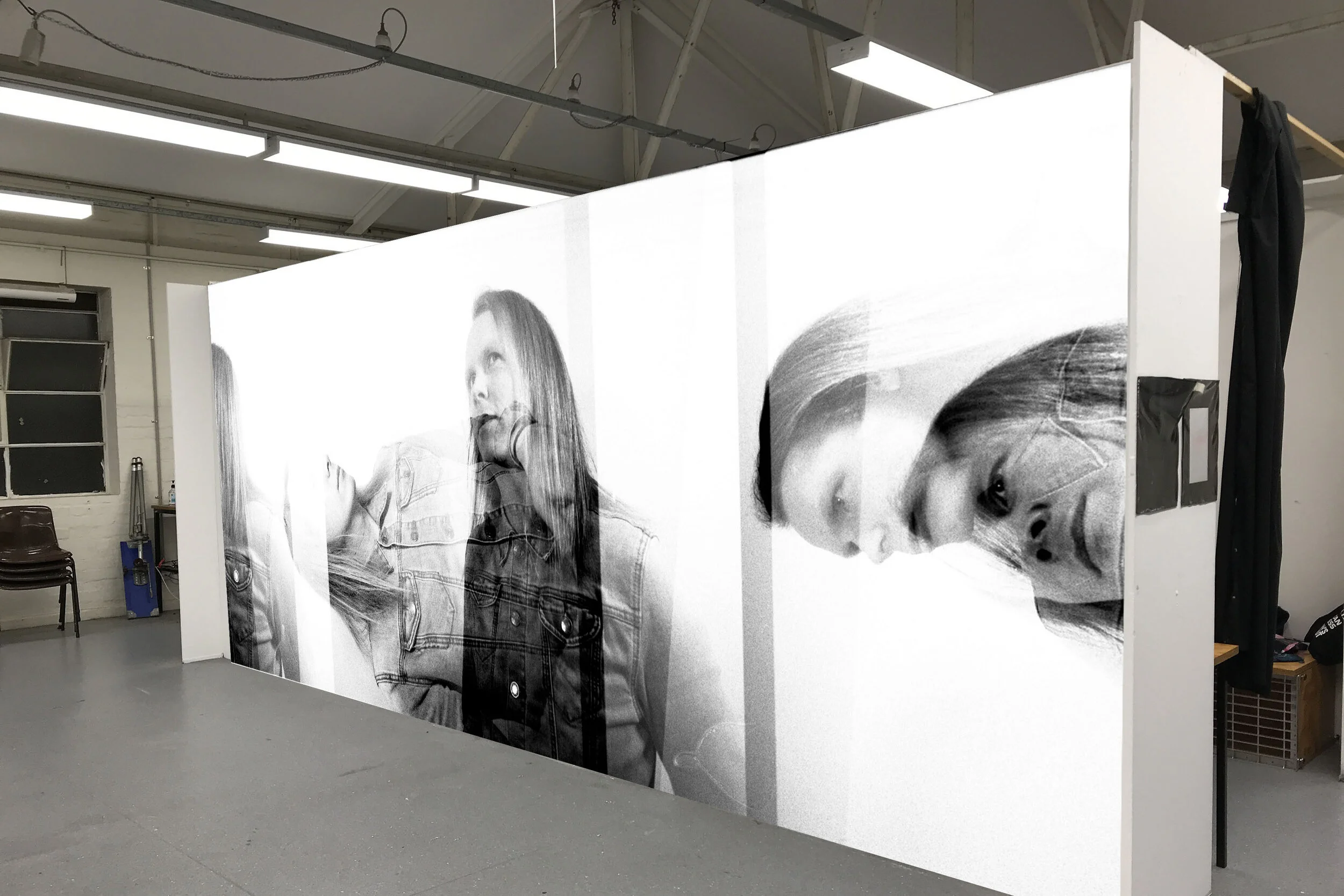
West wall detail
Footnotes
[1] A heuristic learning method applies discovery and problem-solving grounded in reasoning and experience (Sultan 2019).
[2] Analogue photography refers to nondigital, emulsion-based modes of the medium where the latent image emerges during chemical development.
[3] Lifeworld is a phenomenological term that “refer[s] to the idea that ‘individuals’ realities are invariably influenced by the world in which they live” (Neubauer, Witkop, and Varpio 2019, 94).
MFA S4: Major Presentation of Artworks
Studio 4
Assignment 3
Major Presentation of Artworks
FLOW
Embodying aesthetic responses to lived experience through process-based analogue photography
This heuristic investigation[1] uses process-based analogue photography to embody my aesthetic responses to my life experiences. Informed by theoretical readings in cognitive neuroscience, philosophy, psychology and art, the research aims to harness the merging of my body, mind, lifeworld[2] and artistic practice to engage with photography in terms of an embodied object. The artwork included in my final folio presentation – Respite, Trust, Possibilities, and Truth – exploits the interconnected relationship between my lived body, lifeworld and creative practice. Applying a blended or meta-methodological approach to my practice-led study, each artwork speaks back to each to reflect an interconnected narrative of my aesthetic experiences, united in FLOW, my final folio presentation for the Master of Fine Art program, RMIT University, Melbourne, 2023.
The title of this practice-led study, FLOW, denotes movement and continuity in my creative process, which “[results] through the embodied reconstruction of meanings and relationships in activity … proposing that mind, body and world are interwoven in agency” (Banfield and Burgess 2013, 64 and 65). Conceptually, Flow is situated at a juncture where creative process and material converge to explore the expressive potentiality of uncertainty and chaos. “Chaotic systems [that] demonstrate healthy flexibility, adaptability, readiness for change, resistance to environmental entrapment, autonomy, and openness to new information” (Schuldberg 2011, 188).
In terms of introspective heuristic investigation, German philosopher Dr Georg Wilhelm Friedrich Hegel provides further context to the methods and methodologies discussed in this exegesis, asserting that the purpose of art "is to enable us to bring to mind the truth about ourselves, and so to become aware of who we truly are" (Houlgate 2020).
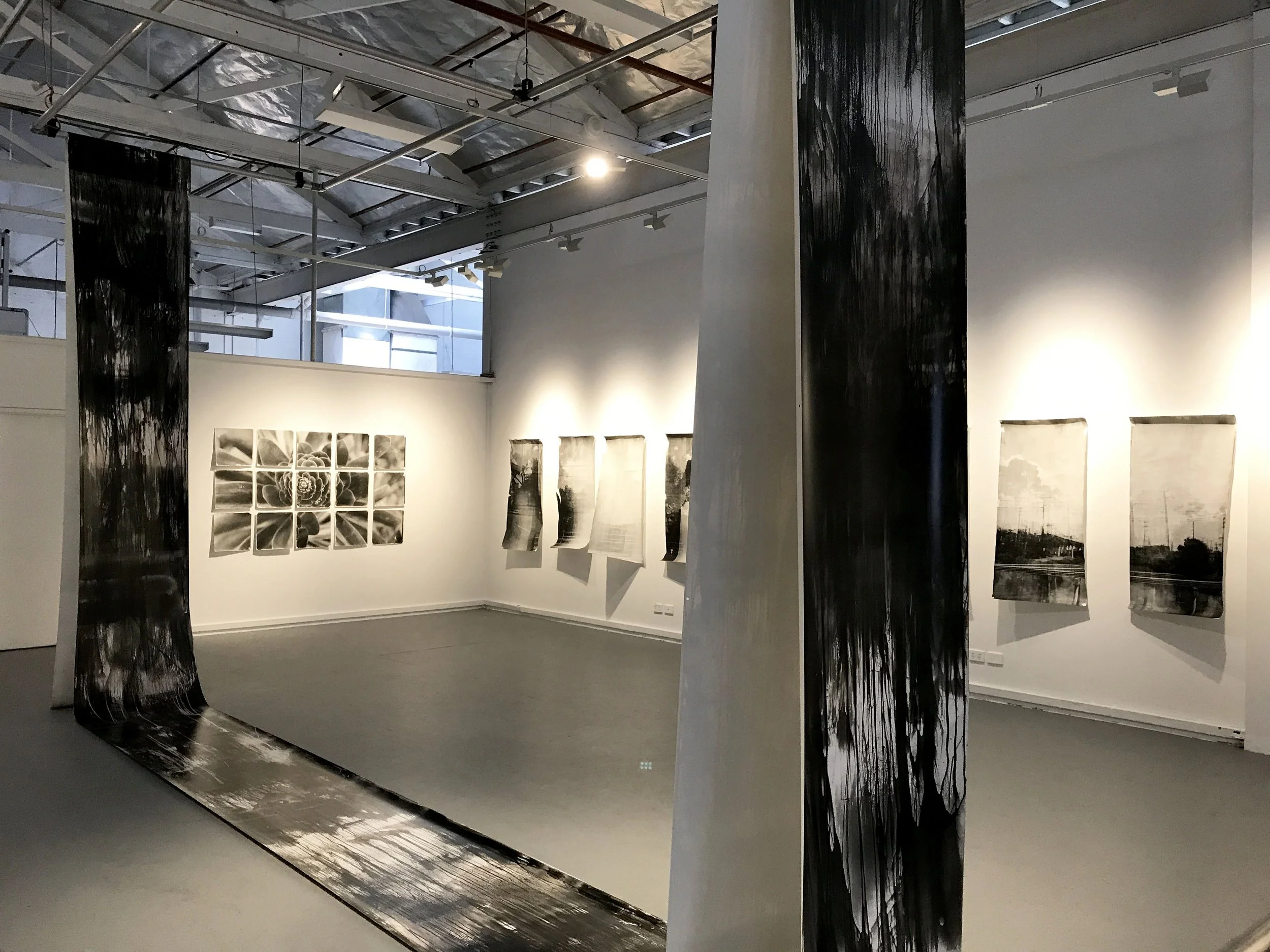
Flow, Master of Fine Art final folio presentation, 2023: Truth (front), Respite (back left), Possibilities (back right)
Respite
Respite explores the immediacy and uncensored material experience of making as a meaningful element of my creative process.
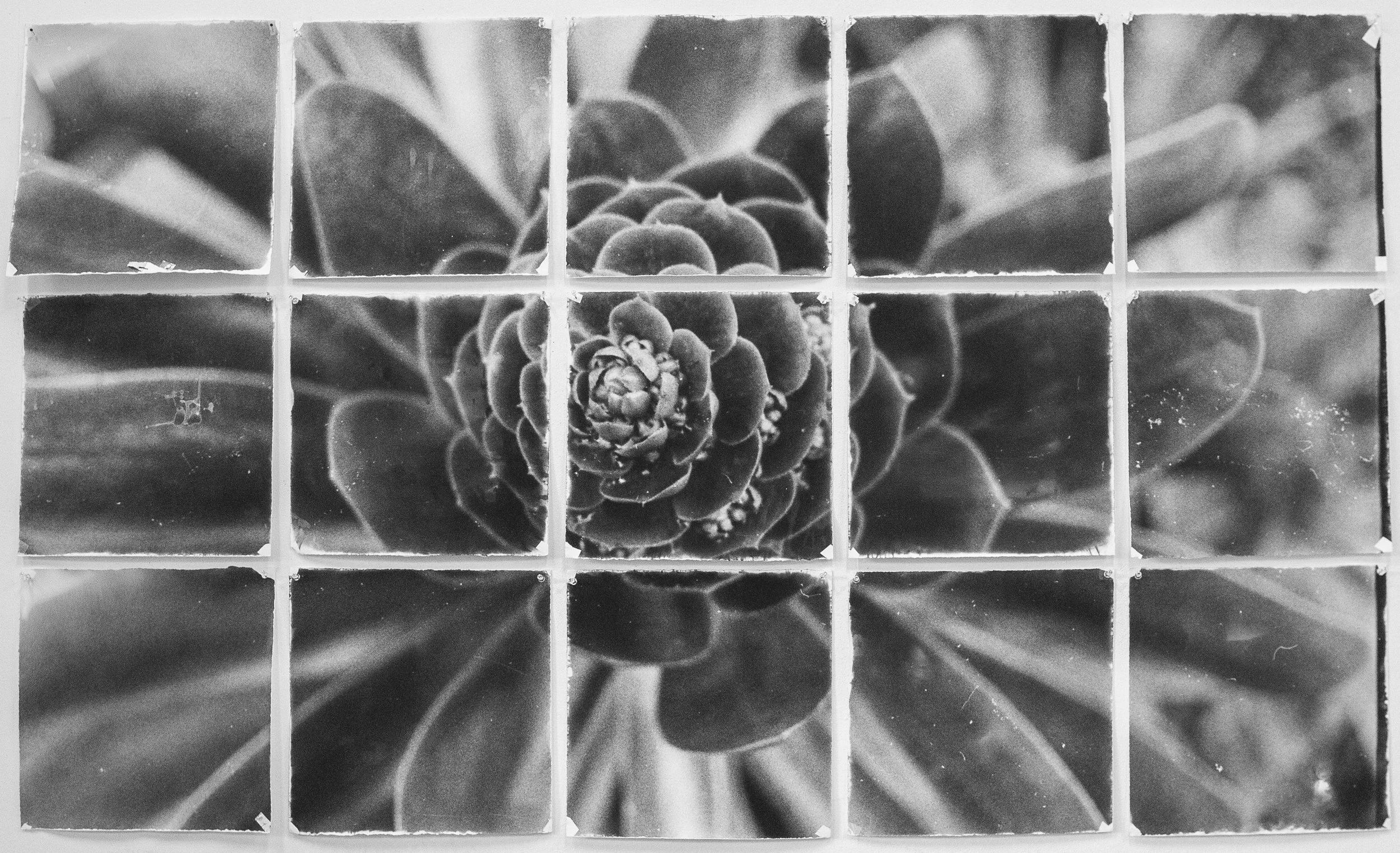
Respite, 2022, multi-panel gelatin silver print, nails, hand-torn paper/single 35mm exposure/hand brushed to develop, 190x120cm. Installation view, RMIT University, Melbourne, 2022
Trust
Trust cultivates novelty and chance to elicit the uncensored and unrepeatable occurrence of my aesthetic responses to my life experiences in real-time. Due to the artwork being on show at the Museum of Australian Photography as a shortlisted work for the Bowness Prize 2023, it was not presented in my final folio presentation
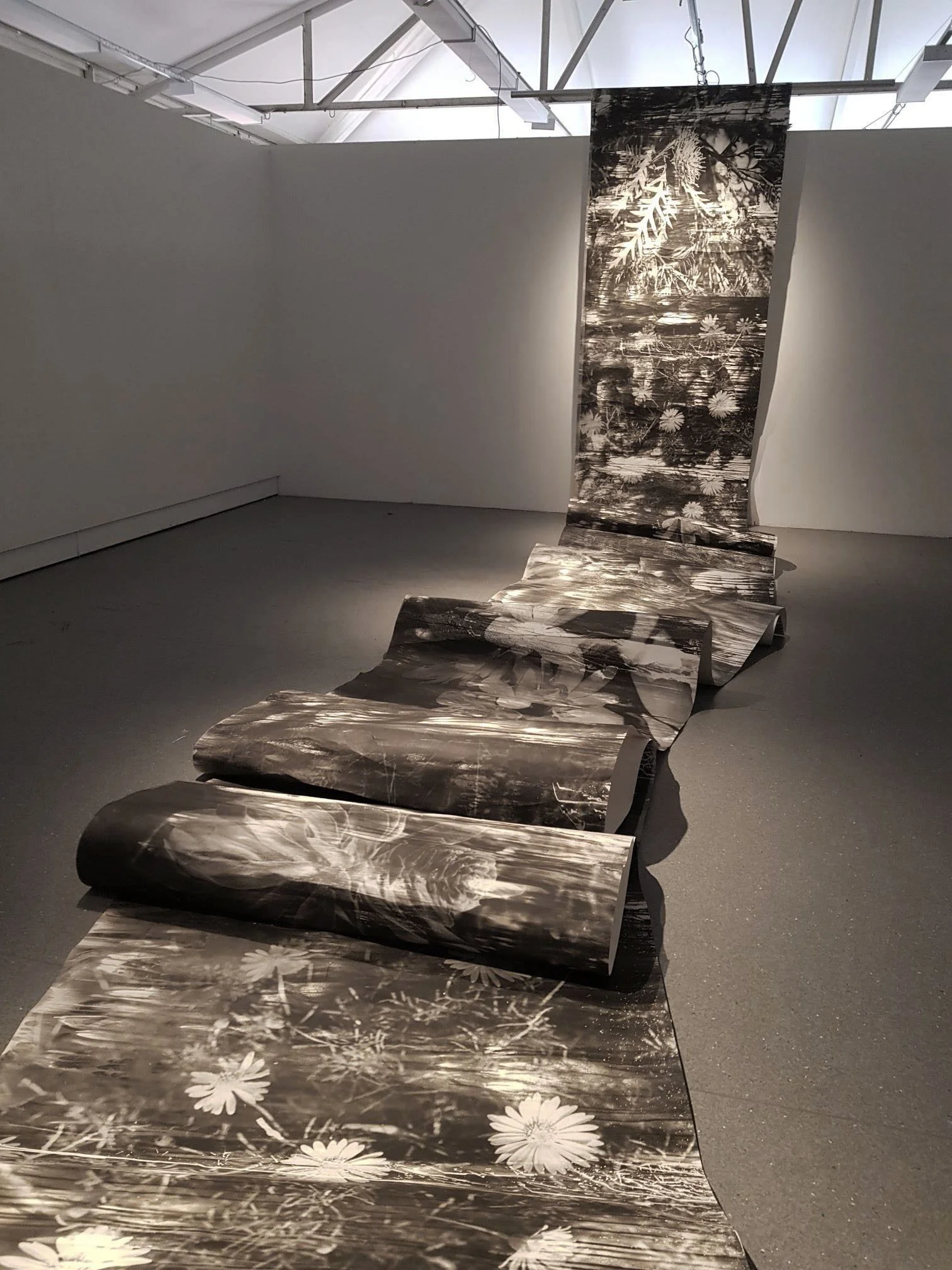
Trust, 2022-2023, unique gelatin silver print, bubble wrap/string, 110cmx15M, continuous roll/hand-brushed to develop. Installation view, RMIT University Melbourne, 2023. Photo courtesy Jessica Curry, 2023
Possibilities
Possibilities combines the methods of methodologies deployed in the making of Respite and Trust to explore the phenomenology of ‘doing’ and notions of embodied knowledge through material agency and the act of ‘being’.
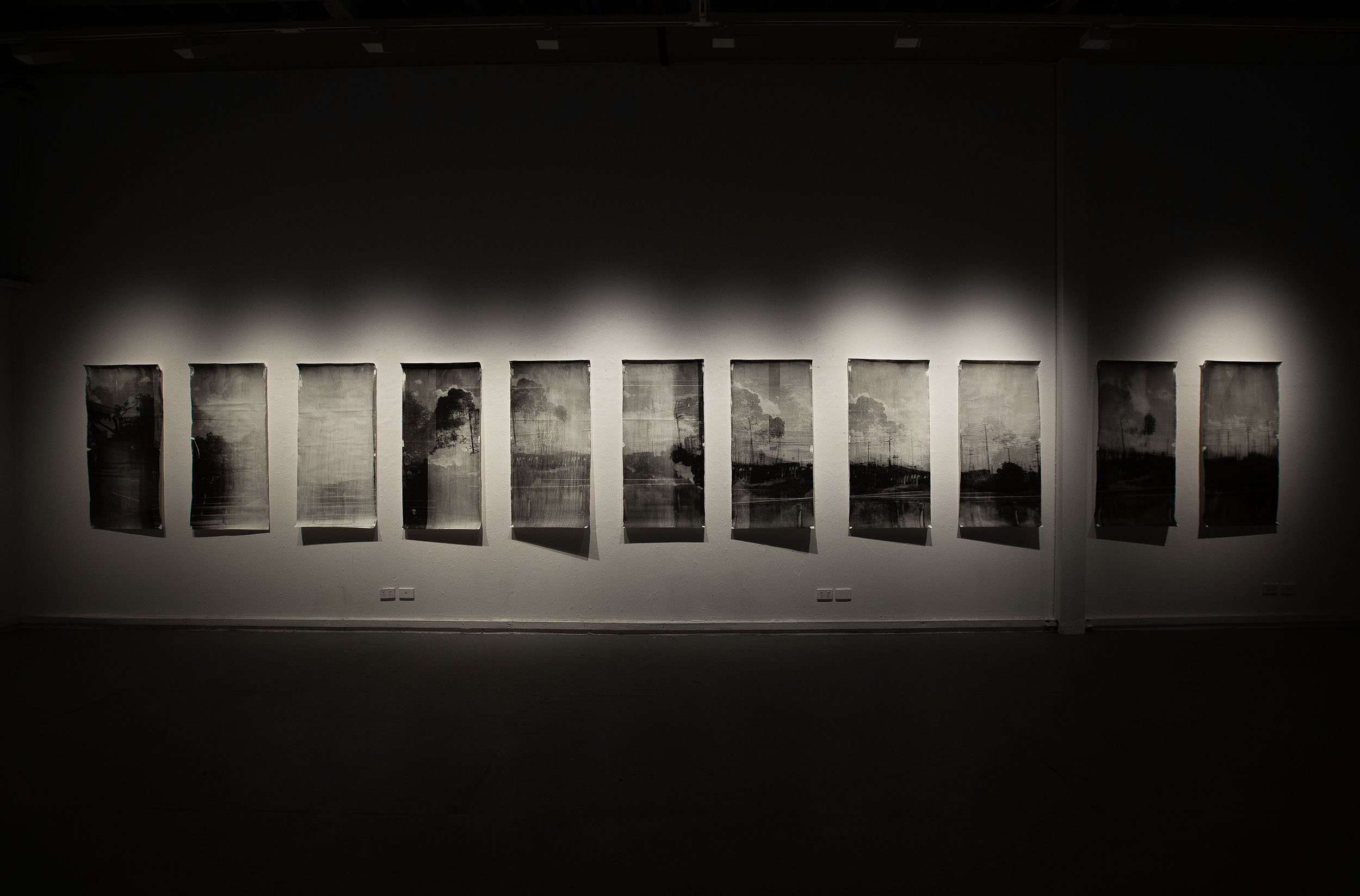
Possibilities, 2023, multi-panel gelatin silver print on paper, hand-torn from continous roll/hand-brushed to develop, 127cm x 7M. Installation view, RMIT University, Melbourne, 2023
Truth
Truth is a new work created in place of Trust, which, at the time of my Master of Fine Art presentation, was on display as a Bowness Prize finalist at the Museum of Australian Photography group exhibition 2023. Created by exposing one 35mm negative sequentially across a continuous roll of panchromatic gelatin silver black and white paper, the artwork challenges the illusion of representational truth in photography. What emerges from beneath the emulsion is not a conventional image, as the exposure would suggest, but rather the embodiment of my skewed vision of the world. Find out more here.
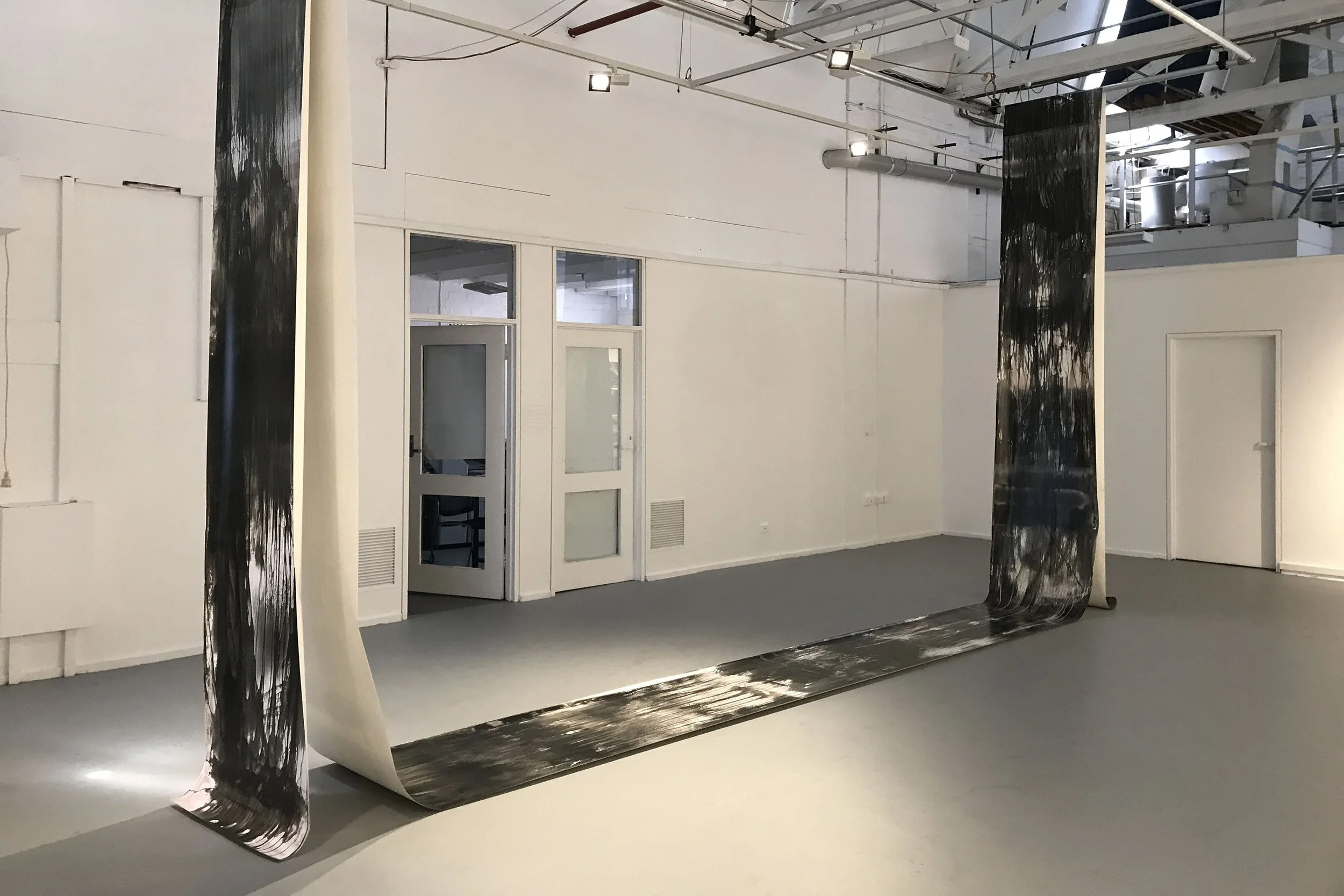
Truth, 2023, (foreground) unique gelatin silver print on panchromatic paper, continuous roll/hand-brushed to develop, 70cm x 16M. Installation view, RMIT University, Melbourne, 2023
Footnotes
A heuristic learning method applies discovery and problem-solving grounded in reasoning and experience (Sultan 2019).
Lifeworld is a phenomenological term that “refer[s] to the idea that ‘individuals’ realities are invariably influenced by the world in which they live” (Neubauer, Witkop, and Varpio 2019, 94).
Bibliography
Banfield, Janet, and Mark Burgess. 2013. “A Phenomenology of Artistic Doing: Flow as Embodied Knowing in 2D and 3D Professional Artists.” Journal of Phenomenological Psychology 44 (1): 60–91. https://doi.org/10.1163/15691624-12341245.
Houlgate, Stephen. 2020. “Hegel’s Aesthetics.” Edited by Edward N. Zalta. Stanford Encyclopedia of Philosophy. Metaphysics Research Lab, Stanford University. 2021. https://plato.stanford.edu/entries/hegel-aesthetics/#:~:text=Art.
Schuldberg, David. 2011. “Chaos Theory and Creativity.” In Encyclopedia of Creativity, edited by Mark A. Runco and Steven R. Pritzker, 183–91. London: Elsevier BV. https://doi.org/10.1016/b978-0-12-375038-9.00037-6.
MFA S3 A2
Zo Damage
S9753760
Studio 3
Combined methodology report and folio of works
Studio 3
Assignment 2
Combined methodology report and folio of works
This research is an introspective heuristic investigation that uses black and white experimental analogue photography and alternative darkroom processes (henceforth analogue photography) to foster and visually iterate physical and psychological responses (henceforth aesthetic responses) to lived experience.
MFA S3 A1
Studio 3
Assignment 1
Reflective feedback report
Introduction
This introspective heuristic[1] investigation questions how analogue photography[2] can be explored to foster and visually iterate aesthetic responses to lived experience. Informed by theoretical disciplines, including neuroscience and philosophy, the practice-led study aims to (a) exploit analogue photography as a generative or process-based creative practice, where the confluence between artist, materials and process manifest in part or entirely as the artwork, (b) investigate how the interactions between artist, materials and processes may approximate, in real-time, aesthetic responses that lived experience can induce, and (c) push the medium’s boundaries to create unique photographic works of art that reflect and emanate metaphors of my existence.
MFA S2 A2
Studio 2
Assignment 2
Methodology report and folio of works
This report is informed by creative and theoretical disciplines, including neuroscience, philosophy and Zen aesthetics. The research uses experimental analogue photography and alternative darkroom processes to foster and visually iterate physical and psychological responses (hence aesthetic responses) to mental health, wellbeing and lived experience. Notably, the study investigates how engagement in creative practice, in the case of this Studio 2 methodology report, can be used to develop a toolkit to provide critical means of creative narration and self-expression, thereby contributing to improved mental and physical health and quality of life (Stuckey and Nobel 2010, 254).
MFA S1 A2
Studio 1
Assignment 2
Methodology report and folio of works
This report is informed by academic disciplines, including neuroscience, phenomenology, ethnomethodology and Wabi Sabi and Kintsugi aesthetics. The report aims to a) explore how unpredictable modes of experimental analogue photography can be used to cultivate alternative means of perception and observation, b) explore creative means of interpreting physical and psychological to the world I inhabit, and c) seek unfamiliar modes within the mediums discussed above that allow suspension of presumptions and judgments about, and expand upon, my existing practice.
MFA S1 A1
Studio 1
Assignment 1
Reflective feedback report
Introduction
To contextualise my aims for the Master of Fine Art program, I will first briefly outline the underpinning motivations for my research and discuss two projects created in the final semester of my Master of Photography program – Frisson (Figure 1) (Gay 2021) and All dressed up and nowhere to go (Figure 2) (ibid 2021). Next, I will provide documentation of a selection of experiments undertaken this semester and select readings and artists informing my practice and methods and methodologies related to my current study. To conclude, I will reflect on the work undertaken and the advice I have received from my lecturers and supervisor.
Motivation
Like many people, I experience physical and psychological sensations when listening to music and making and viewing art, while my research of neuroscience, phenomenology, and psychophysics (psychoacoustics) informs my creative investigation into the visual iteration of frissons. [1] Furthermore, I have worked in the live music industry for decades primarily as a social documentary and concert photographer, and to a lesser degree, as a magazine publisher and online editor and in event management.
Past projects and research
My Master of Photography capstone project, Frisson, uses experimental analogue photography, printmaking and installation to visually iterate physical and psychological sensations experienced when listening to music. The project addresses the phenomenology of mental and bodily sensations experienced when listening to music and making and consuming art [2], otherwise known as frissons. I researched fields of neuroscience and phenomenology to develop an understanding of how the human body responds to and interprets rhythm, energy and auditory and visual stimuli. The objective of the folio presentation was to foster interaction between observer, artworks and space to create visual and spatial interplays that unfold as a real-time event, reflecting the real-time occurrence of frissons.
Figure 1. Zo Gay, Frisson installation view, 2021
Presented as a street poster campaign comprising seven double A0 prints, my project All dressed up and nowhere to go depicts the facades of Melbourne live music venues impacted by the pandemic. The project aims to interpret Melbourne music performance, communities, and creativity in a pre- and post-pandemic era. The baron streetscapes depicted in the photographs aim to reflect the challenges of the pandemic on the live music community and culture. For example, due to restrictions such as capacity quotients and social distancing, many venues were not able to trade, which in turn saw bands without a space to perform [3], prompting me to further investigate the complex interconnections between artists and fandom, exploring the significance of traditional (face-to-face) gatherings compared to digital delivery of real-time performances [4] also reflected in the empty streetscapes.
Figure 2. Zo Gay, All dressed up and nowhere to go installation view, 2021
Selected experiments [5]
Projects undertaken for the Master of Fine Art program included introducing unfamiliar elements into my practice, such as painting (Figures 3–4), which produced unsatisfactory results that did not reflect or iterate mental and bodily responses to musically and visually induced frisson but more my frustration in working with the medium.
Figure 3. Zo Gay, Untitled 2022, mixed media on cardboard, 420x590mm (approx)
Figure 4. Zo Gay, Untitled, 2022, acrylic on foam-core, 297x420mm
Printmaking artefacts (Figure 5) and abstract film photography (Figure 6) were also used to make photogravure prints on various substrates. Although the traces and movement in the artefacts and abstract photography were captivating, offering a potential representation of physical and psychological networks that receive and interpret auditory and visual stimuli, which manifest tangibly as frissons. As with the painting, I was not satisfied with the print’s outcomes, representation, or overall aesthetic and have chosen not to work with these visual concepts as they feel forced and cliche.
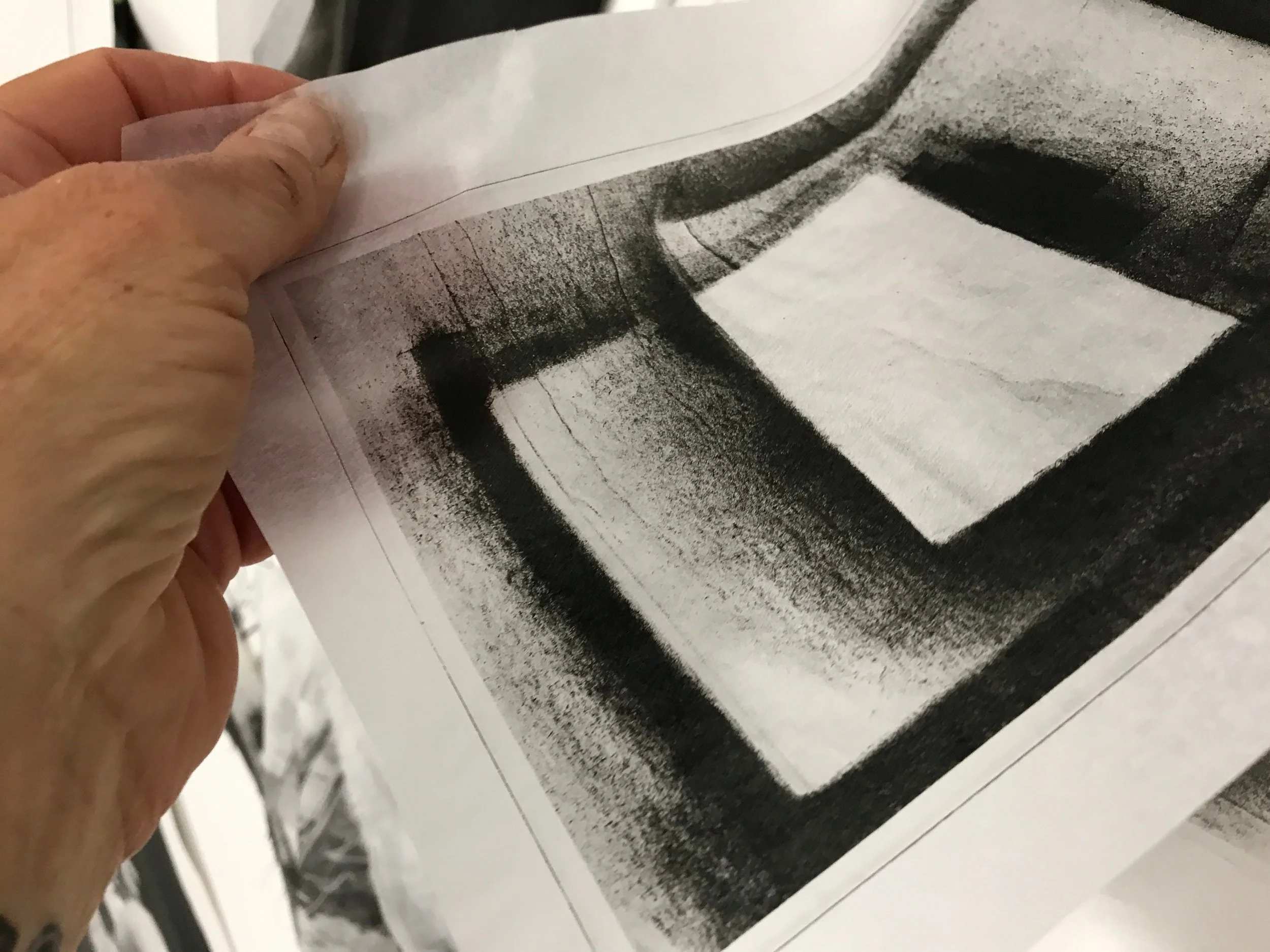
Figure 5. Zo Gay, Untitled, 2022, photogravure on linen
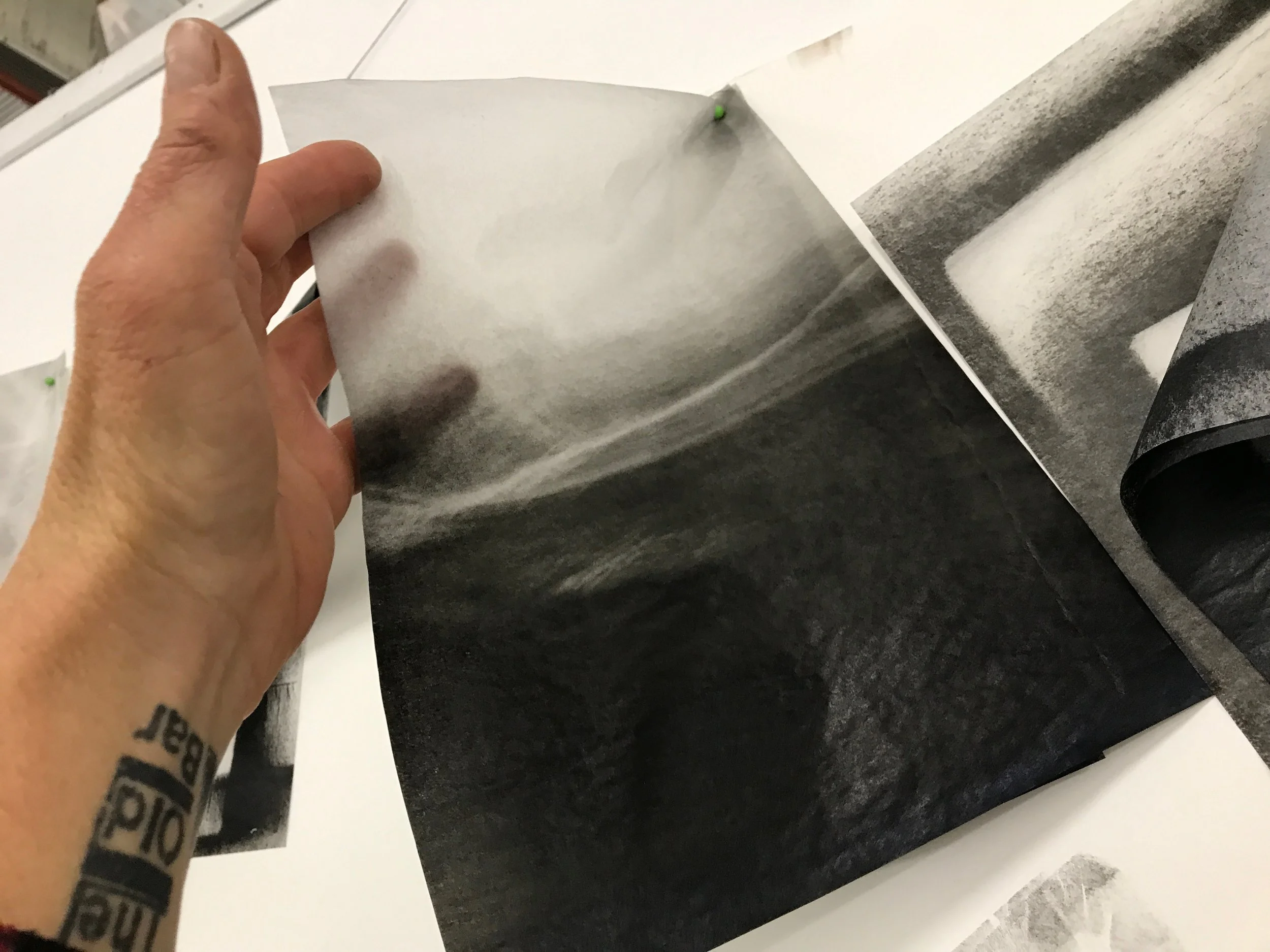
Figure 6. Zo Gay, Untitled, 2022, photogravure on tissue paper
Additional experiments using ink on tracing paper (Figure 7) for making silk screens and making mixed media montages were made, but as with the methods outlined above, did not result in successful outcomes and have thus not been pursued.
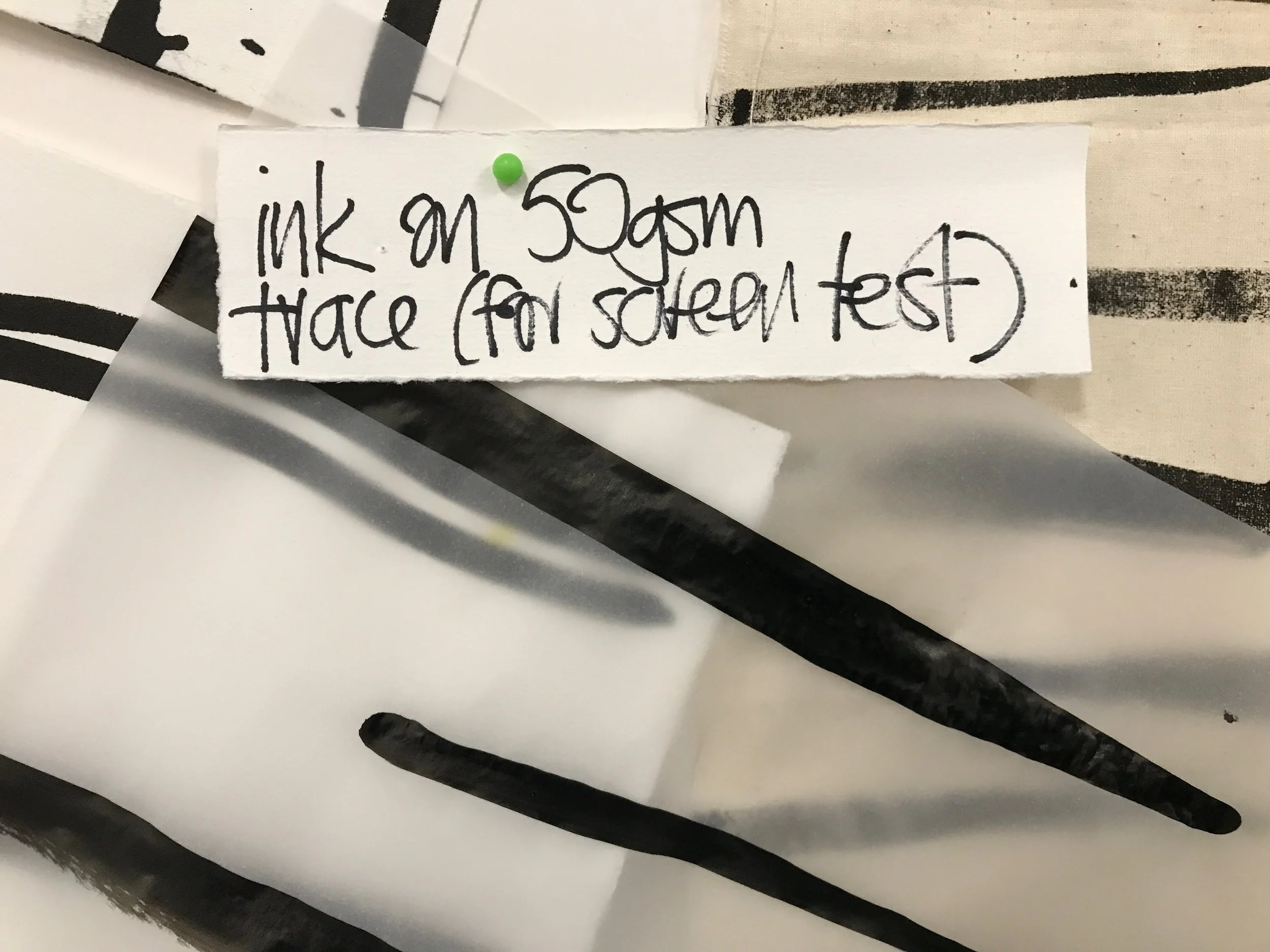
Figure 7. Zo Gay, Auditory perception, 2022, ink on 50gsm tracing paper
Conclusion
My research in neuroscience, phenomenology, physics and urban culture reveals new knowledge that promises to inform a comprehensive studio-based study to visually iterate musically induced frisson. Although I am still experimenting with the methods I will use for the project, my initial creative investigations in Studio 1 for the MFA have not produced outcomes worth pursuing. However, the process has reminded me of the adage, “Love what you make and make what you love”, leading me back to photography, where I am photographing my day-to-day life (Figures 8–12) while continuing to investigate studio-based research. My field of references includes Modernist and Contemporary artists such as Laszlo Moholy-Nagy, Man Ray, Floris Neusüss, Eileen Quinlan and Mariah Robertson.
I read daily and watch documentaries about art theory, philosophy (although I struggle to stay focused on that) and music. The music documentaries are informative as the musicians talk freely about “feel” and how music connects with energy in their songwriting, performing and collaborations, all of which relate to my research.
Pinhole photography may be interesting, while another avenue to explore is distortion. All the effects would be achieved in-camera/capture, reflecting, and iterating my own experience. The challenge and the constraints would also serve me well for keeping on an even keel without spinning into a creative hot mess. I am hesitant to continue with photogravure. The prints can be made on the etching presses at RMIT, but the plates can only be made at Baldessin Press, which is prohibitive. The darkroom is good, although the scale of work is small, and I would need to hire space to print, while photo screen printing is accessible and cost-effective.
It would be fascinating to investigate digital imaging of human responses to visual and auditory stimuli and learn from researchers currently working in the fields of neuroscience and physics.
To share that I have no idea what I am making and am at a complete creative loss is daunting and terrifying. Without a clear plan and outcome to work towards, I flounder without focus. That does not mean I need to know what I will make, but more what I am making for. My supervisor has provided me with exercises that prompt creative focus and direction. They have also scheduled an additional meeting to discuss my approach and project ideas moving forward, for which I am grateful.
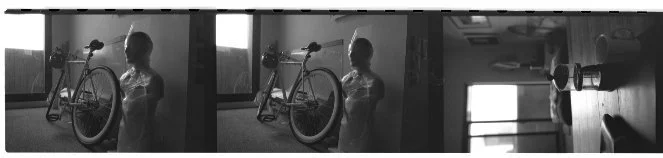
Figure 8. Zo Gay, Home (1), 2022, scan of 35mm negative
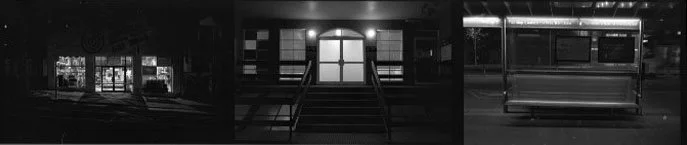
Figure 9. Zo Gay, Home (2), 2022, scan of 35mm negative
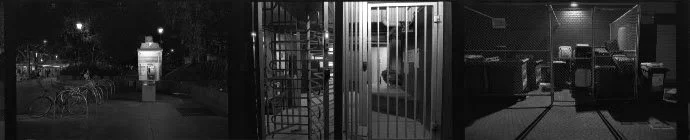
Figure 10. Zo Gay, Home (3), 2022, scan of 35mm negative
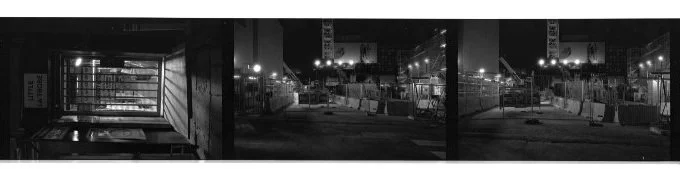
Figure 11. Zo Gay, Home (4), 2022, scan of 35mm negative
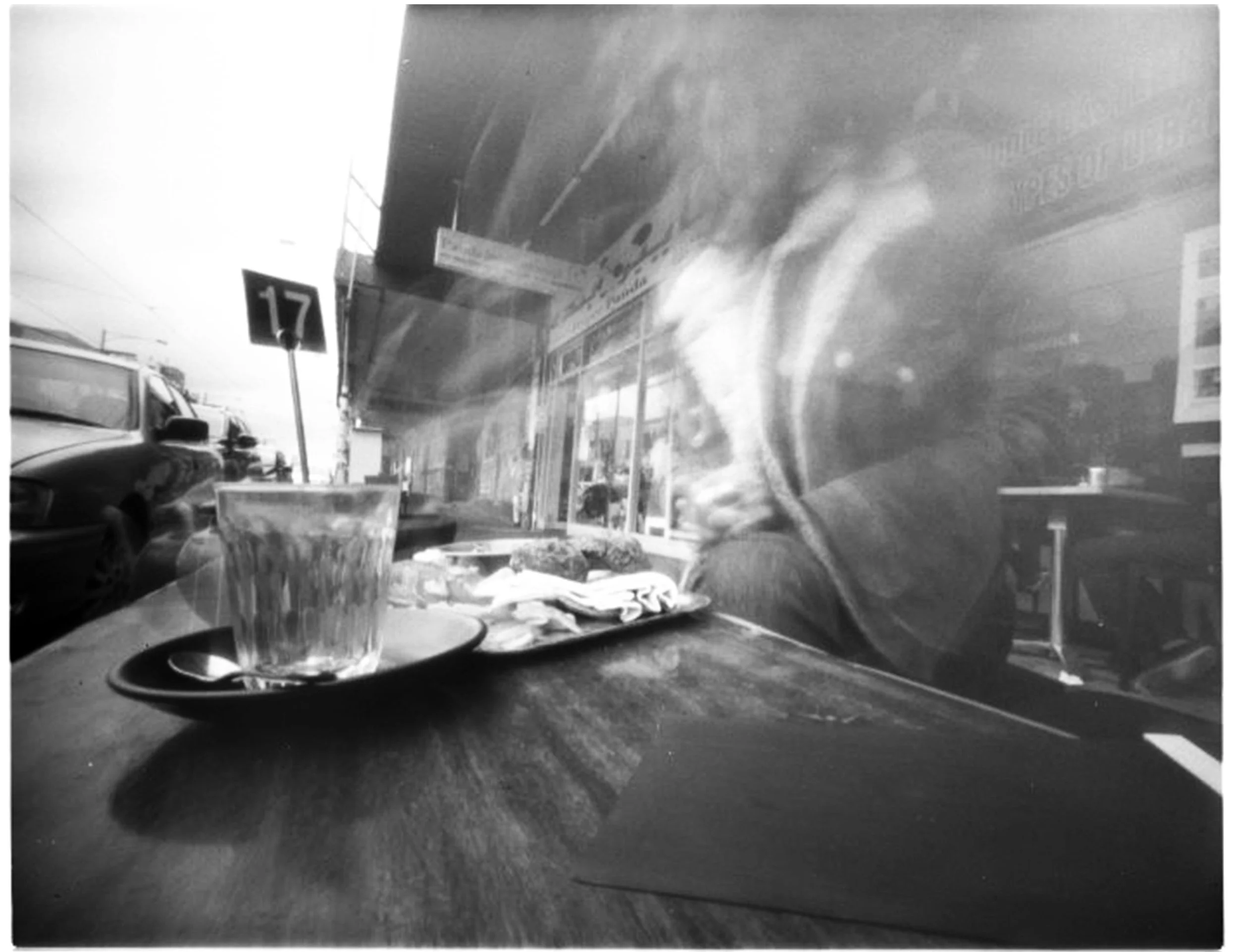
Figure 12. Zo Gay, Tea and falafel (self-portrait), 2022, scan of 4x5” negative
Footnotes
Frissons are sudden, intense emotional and/or physical responses to something (Juslin and Västfjäll 2018). Many people experience frissons when listening to music, which manifests as tingles, chills and goosebumps (Gay 2021).
The term “making and consuming art” applies to composing, performing and listening to music and making and viewing 2D art such as photographic prints and paintings.
Social distancing restrictions prevented bands from performing live and prohibited them from rehearsing and creating as a collaborative group.
Creswell Jones and Bennet (2015, 14) assert, “The live concert as an unrepeatable, exclusive event, grounded in time and space”.
Additional creative investigations I have undertaken in the Master of Fine Art program may be viewed online at https://zed-oh.com.
Bibliography
ABC Science. 2016. Power of Music on the Brain | Dementia & Parkinson’s. YouTube video, 00:29:17. https://www.youtube.com/watch?v=rnUSNbqtVJI&t=943s.
Amyl and the Sniffers. “Guided by Angels”. Directed by John Angus Stewart. July 8, 2021. Music video. 04:00. https://youtu.be/Z--D1flPLnk.
Bennett, Andy, and Susanne Janssen. 2015. “Popular Music, Cultural Memory, And Heritage”. Popular Music and Society 39 (1): 1-7. doi:10.1080/03007766.2015.1061332.
Bruscia, Kenneth E. 2013. Defining Music Therapy. eBook. University Park: Barcelona. ProQuest Ebook Central. https://ebookcentral.proquest.com/lib/rmit/reader.action?docID=3117673&ppg=28.
Cotton, Charlotte. 2015. Photography is Magic. 1st ed. New York: Aperture.
Cresswell Jones, Angela, and Rebecca Jane Bennett. 2015. The Digital Evolution Of Live Music. Waltham, MA: Chandos Publishing an imprint of Elsevier.
Crum, Lawrence, and Kullervo Hynynen. 1996. “Sound Therapy”. Physics World 9 (8): 28-34. doi:10.1088/2058-7058/9/8/22.
Dickerman, Leah, and Brigid Doherty. 2005. Dada. Washington, DC: National Gallery of Art in association with D.A.P. / Distributed Art Publishers.
Eisele, Petra, Isabel Naegele, and Michael Lailach. 2019. Moholy-Nagy and the New Typography. Berlin: Verlag Kettler.
Foucault, Michael. 2020. Power: Essential Works of Foucault 1954–84: Volume Three. 3rd ed. Great Britten: Penguin Books.
Gay, Zo. 2021. All dressed up and nowhere to go: A photographic essay interpreting Melbourne music performance, communities, and creativity in a pre- and post-pandemic era. PFD. https://zed-oh.com/mop-assignments/tccp-project
Gay, Zo. 2021. Frisson: A sculptural photographic installation investigating physical and psychological sensations experienced when listening to music. Master of Photography (by Coursework) exegesis, RMIT. PDF. https://zed-oh.com/mop-assignments/studio-4-adr.
Grohl, Dave. 2013. Sound City. Film, 01:48:00. Gravitas Ventures. https://rmit.kanopy.com/video/sound-city.
Halbreich, Kathy, Mark Godfrey, Lanka Tattersall, and Magnus Schaefer. 2014. Alibis: Sigmar Polke 1963–2010. London: Tate Publishing.
Heaney, Conor. 2019. “Tragic Rhythms: Nietzsche and Agamben on Rhythm and Art.” PDF. la Deleuziana 10: 61–78. http://www.ladeleuziana.org/wp-content/uploads/2020/01/Heaney.pdf.
Heroux, Erick. 2001. “Power. Vol. 3 Of The Essential Works Of Foucault, 1954-1984”. Substance 30 (3): 143-150. doi:10.1353/sub.2001.0025.
Jarmusch, Jim. 2016. Gimme Danger. Film. Low Mind Films and New Element Media. https://rmit.kanopy.com/video/gimme-danger-0.
Juslin, Patrik N., and Daniel Västfjäll. 2008. “Emotional Responses To Music: The Need To Consider Underlying Mechanisms.” Behavioral And Brain Sciences 31 (5): 559-575. doi:10.1017/s0140525x08005293.
Kuenzli, Rudolf E. 2015. Dada. London: Phaidon.
Lamb, Robert. 2021. “The Stoned Ape Hypothesis: Did Magic Mushrooms Influence Human Evolution?”. Howstuffworks. https://science.howstuffworks.com/life/evolution/stoned-ape-hypothesis.htm.
Gay, Zo. 2021. Gillick, Liam. 1995. “Interview: I Will Not make any More Boring Art.” Art Monthly (Archive : 1976-2005) (187): 3-4, 6-7. https://login.ezproxy.lib.rmit.edu.au/login?url=https://www.proquest.com/scholarly-journals/interview-i-will-not-make-any-more-boring-art/docview/1366938379/se-2?accountid=13552.
Miguel Abreu Gallery. 2014. “Eileen Quinlan: Selected Press.” Miguel Abreu Gallery. PDF. https://miguelabreugallery.com/wp-content/uploads/2014/07/EQuinlan_SelectedPress_opt-2.pdf.
Minissale, Gregory. 2021. Rhythm in Art, Psychology and New Materialism. Cambridge: University of Cambridge ESOL Examinations. https://ebookcentral.proquest.com/lib/rmit/detail.action?docID=6499776.
Moholy-Nagy, Laszlo. 1925. Bauhausbucher 8: Painting Photography Film. Zurich: Lars Müller Publishers, 2019.
Ræbild, Ulla & Piper, Anna & Nimkulrat, Nithikul. 2018. Soft Landing.
Roederer, Juan G. 1973. Introduction to the Physics and Psychophysics of Music. London: English Universities Press.
Sartori, Andreza, Dubravko Culibrk, Yan Yan, and Nicu Sebe. 2015. “Who’s Afraid of Itten: Using the Art Theory of Color Combination to Analyze Emotions in Abstract Paintings.” In Proceedings of the 23rd ACM International Conference on Multimedia, 311–320. ACM. https://rmit.primo.exlibrisgroup.com/permalink/61RMIT_INST/4t5l5f/cdi_acm_primary_2806250.
Sakai, Katsuyuki, Okihide Hikosaka, Satoru Miyauchi, Ryousuke Takino, Tomoe Tamada, Nobue Kobayashi Iwata, and Mathew Nielsen. 1999. “Neural Representation of a Rhythm Depends On Its Interval Ratio”. The Journal or Neuroscience 19 (22): 10074-10081. doi:10.1523/jneurosci.19-22-10074.1999.
Schirmer, Annett, Maria Wijaya, Man Hey Chiu, Burkhard Maess, and Thomas C Gunter. 2020. “Musical Rhythm Effects on Visual Attention Are Non-Rhythmical: Evidence Against Metrical Entrainment”. Social Cognitive and Affective Neuroscience 16 (1-2): 58-71. doi:10.1093/scan/nsaa077.
Snoad, Laura. 2022. “8 Makers Using Biodesign To Grow Their Work”. Crafts Council. https://www.craftscouncil.org.uk/stories/8-makers-using-biodesign-grow-their-work.
Thacker, Eugene. 2003. “Data Made Flesh: Biotechnology and the Discourse of the Posthuman.” Cultural Critique, no. 53: 72–97. http://www.jstor.org/stable/1354625.
Thaut, Michael. 2008. Rhythm, Music, and the Brain: Scientific Foundations and Clinical Applications. London: Taylor & Francis Group. ProQuest Ebook Central. DOI:10.4324/9780203958827