
Tenesh Webber
Tenesh Webber applies photographic techniques to manipulate the image in the darkroom and in-camera in the negative, extending her investigation of photographic mediums through the photogram [1]. Webber's process involves first making sketches to develop her concepts and ideas. The artist then composes the image by arranging objects such as sewing thread and drawing directly on a sheet of clear, transparent acetate akin to a pane of glass to create a film negative-like 'exposure plate'. The 'exposure plate' is then positioned on or over a light-sensitive substrate from which Webber creates 'cameraless' photographic images. Although I have made several photograms in the traditional sense of placing objects directly onto light-sensitive surfaces, I had not considered using acetate sheets to create ‘exposure plates’ and look forward to exploring how to incorporate these methods into my practice moving forward.
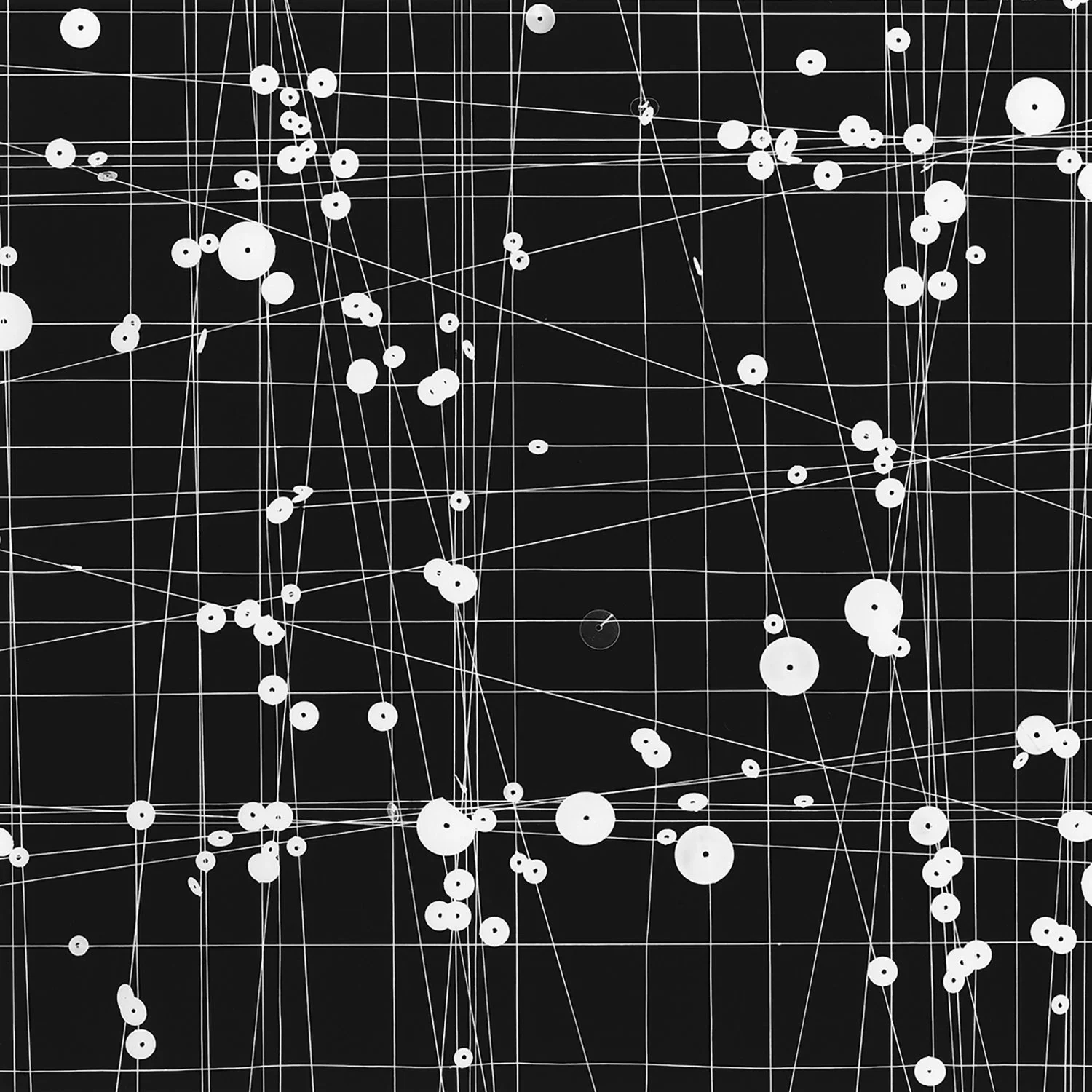
Tenesh Webber, Midpoint 3, 2015, photogram on paper, 280x280mm
Keywords
Tenesh Webber, Photogram, Contemporary photography
Bibliography
"Tenesh Webber". 2022. IdeelArt. Accessed May 28. https://www.ideelart.com/artist/tenesh-webber.
Webber, Tenesh. 2022. Midpoint 3. Image. https://www.widewalls.ch/artwork/tenesh-webber/mid-point-3.
Francis Bacon
In the early years of his career, Francis Bacon[1] was best known as an interior designer. However, attending an exhibition in Paris in the early 1930s, Bacon was inspired to become a painter after viewing the work of Pablo Picasso.
In 1933 Herbert Reed featured Bacon’s “Crucifixion 1933” in the highly regarded and influential publication “Art Now”. However, his first solo exhibition was not a success.
Despite the acknowledgement of Reed, Bacon’s submission to the “International Surrealist Exhibition” in 1936 was rejected for being insufficiently surreal. In the years to follow, disheartened, Bacon destroyed nearly all of his paintings. (Photographer Brian Duffy also destroyed most of his negatives in the 1960s out of frustration).
Bacon aims to make concentrations of images – to deconstruct and reconstruct reality in his own vision, stating that his aim is not “to create an illustration of reality, but to create images that are a concentration of reality and a shorthand of sensation”.
Figure 1. Untitled self-portrait by Zo Damage, 2021. Photogram (unique print) on gelatin silver paper (600x1200mm). Click to open in light box view.
Relevance to practice
Bacon asserts that he aims to make concentrations of images – to deconstruct and reconstruct reality in his own vision, stating that his aim is not “to create an illustration of reality, but to create images that are a concentration of reality and a shorthand of sensation”. This resonates strongly in my own work, particularly with the photograms and in-camera multi-exposures.
Despite my not liking the colour of the fibre-based paper, my photograms are particularly relevant as they are unique prints – artifacts, which relates directly to Bacon as the artist asserts “Art is artefact”. Streaks and textures have been created purposefully and with performative gestures during the development process, representing agency, impermanence, movement and emotion in my photograms (Figure 1) may be compared with many of Bacon’s paintings (Figure 2).
Figure 2. Study from the human body by Francis Bacon, 1953
I strongly identify with Bacon’s passion for chaos in his painting. I began exploring chaos through film photography using in-camera multi-exposure in 2018, further developing my practice at university (Figure 3).
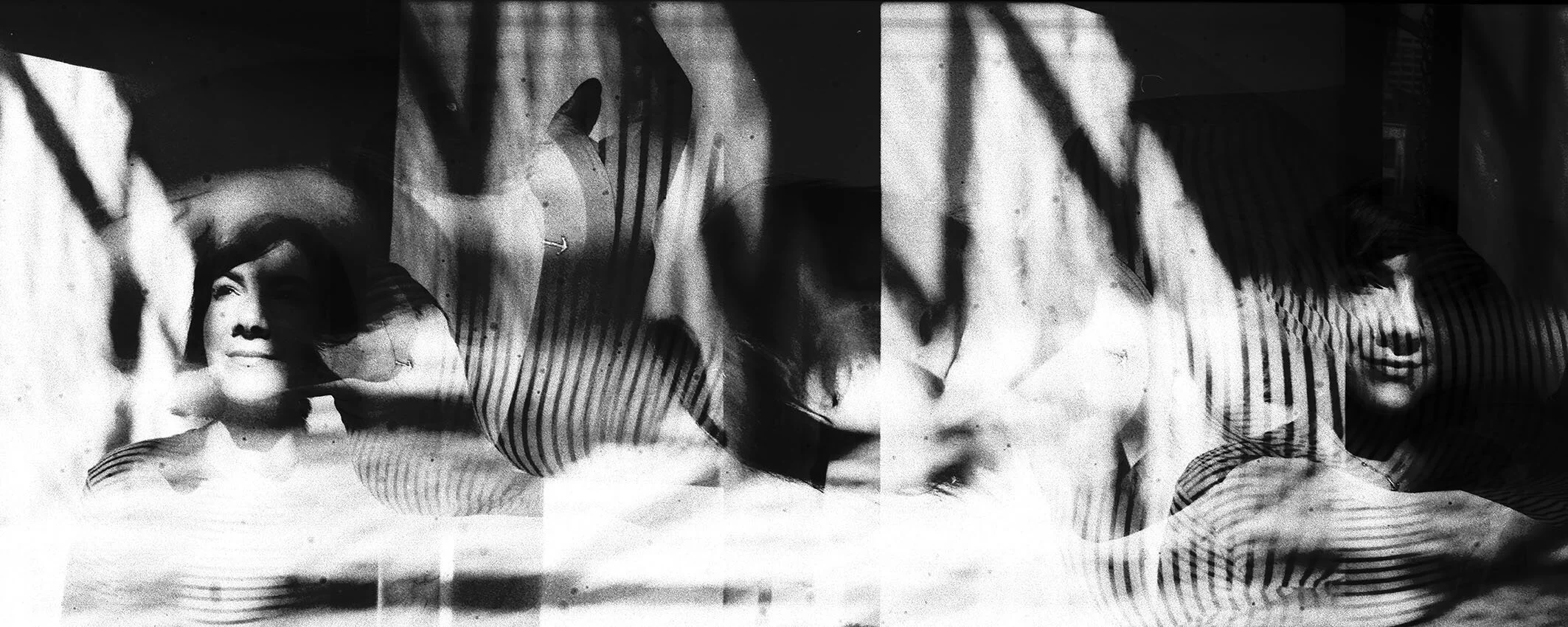
Figure 3. Hanamax. In-camera multi-exposure on 35mm film by Zo Damage, 2021
Quotes
“Chaos for me breathes images.” — Francis Bacon.
“I believe in deeply ordered chaos.” — Francis Bacon. (I love this guy!)
Keywords
Community of practice, Francis Bacon, Agency, Epherial, Surrealism, Photogram, Painting
Footnotes
Francis Bacon. David Hinton. et. al. 2013.
Bibliography
Hinton, David. et.al. Francis Bacon. Australia: ABC1 [broadcaster], 2013. https://rmit.primo.exlibrisgroup.com/permalink/61RMIT_INST/tcai14/alma9921628248001341.
Bacon, Francis. 1953. Study From The Human Body. Image. Accessed June 3, 2021. https://www.ngv.vic.gov.au/explore/collection/work/3761/.
Damage, Zo. 2021. Hanamax. Image.
Damage, Zo. 2021. Untitled self-portrait. Image.
Adam Fuss
Adam Fuss creates a visual language of beauty and strength, exploring and redefining notions of what constitutes a photograph or an image. Fuss is less interested in the meaning of the picture than the making of it (Kellein 2013), depending on the rudimentary infrastructure of pinhole cameras, photograms and other commonly considered ‘redundant’ processes to create spectacular conceptual deconstructions of the transforming medium (Lundström 2005) (Jolly et al. 2015, 6).
I am officially in love … and not sure how to approach writing about Fuss or the relationship to practice.
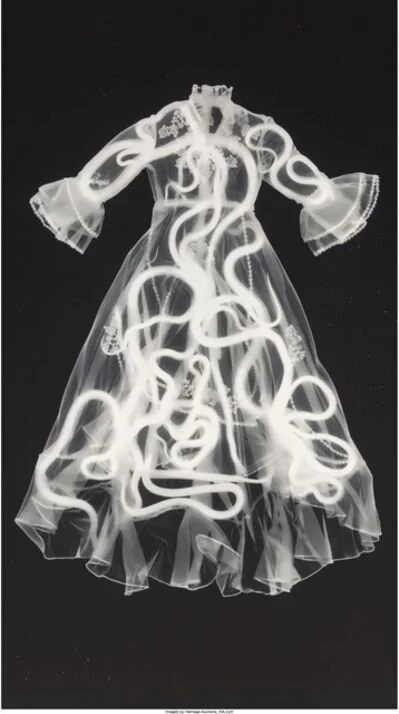
Adam Fuss, Medusa, 2010
Quotes
I’m not interested in the meaning of the picture, I’m interested in the making of it. — Adam Fuss (2013)
Keywords
“Adam Fuss.” n.d. Fraenkel Gallery. Accessed September 11, 2022. https://fraenkelgallery.com/artists/adam-fuss.
Adam Fuss, Camera-less photography, Photogram, Water, Chemigram, Contemporary, Energy, Movement Rebel, Focused, Narratives, Alternative printing, Abstraction, Obscure, Texture, Contrast, Emotive, Community of practice
References
123marketstreet 2011, A&A Portrait – Adam Fuss, online video, YouTube, viewed 3 May 2020, <https://www.youtube.com/watch?v=QxpeNIN0iRA>
Cheim & Read 2013, Adam Fuss Documentary, online video, YouTube, viewed 3 May 2020, <https://youtu.be/LHvByy7950Q>
Douglas Udell Gallery 2013, Adam Fuss in Conversation with Thomas Kellein, online video, YouTube, viewed 3 May 2020, <https://youtu.be/HrgvCngcf40>
Fuss, A 2010, Medusa, photograph, viewed 3 May 2020, <https://www.artsy.net/artwork/adam-fuss-medusa-from-the-series-home-and-the-world>
Fuss, Adam. 2013. "Adam Fuss in Conversation with Thomas Kellein." February 10, 2013, 26:07. YouTube video. DouglasUdelGalery. https://youtu.be/HrgvCngcf40.
Jolly, Martin, Cherine Fahd, and Suzanne Buljan. 2015. The Alchemists: Rediscovering Photography In The Age Of The Jpeg. Sydney: The University of Sydney. PDF. https://martynjolly.files.wordpress.com/2015/10/
thealchemistscatalogue.pdf.Lundström, Jan-Erik. "Fuss, Adam." In The Oxford Companion to the Photograph. : Oxford University Press, 2005. https://www-oxfordreference-com.ezproxy.lib.rmit.edu.au/view/10.1093/acref/9780198662716.001.0001/acref-9780198662716-e-601.
Rafferty, E 2013, Art Movements Through Photography, online video, YouTube, B&H Photo Video, viewed 2 May 2020, <https://www.youtube.com/watch?v=r-Bx5krtLZY&t=3444s>
Victoria and Albert Museum 2018, Camera-less photography: Adam Fuss, online video, YouTube, viewed 2 May 2020, <https://www.youtube.com/watch?v=RHNvVm0Rp_4>
László Moholy-Nagy
László Moholy-Nagy
Hungary
1895–1946
Practice: Painting; Photography; Sculpture; Film
Movement/Style: Dada, Constructivism, Expressionism, Bauhaus style, Modern art
The complexity, depth and structure of Moholy-Nagy’s work are deceiving. ‘Photogram’ by László Moholy-Nagy (1926) has had a significant impact on me and how I look at photography. Although simple at first glance, the layers, exposure and the opacity of the objects are complex and highly technical.
László Moholy-Nagy, a teacher of the Bauhaus (Staatliches Bauhaus), authored Bauhausbücher 8: Painting Photography Film (1925). As represented by the title, the first half of the book finds Moholy-Nagy discussing various styles of art with a focus on painting, photography and film and theory. Curated by Moholy-Nagy, the second half of Bauhausbücher 8: Painting Photography Film presents a collection of works – ranging from sheet music to photograms – by artists of the Bauhaus.
In the introduction, author Moholy-Nagy states that “This book is in defence of photography, which many people still think of as an inferior mechanical operation of recording.” The books are as magnificent to look at as it is to read. Typography is as much as a graphic element as a means of communication. One hundred years down the track, Moholy-Nagy was a profound thinker and creative. His art and writing continue to be a powerful influence on contemporary artists, particularly in the field of photography.
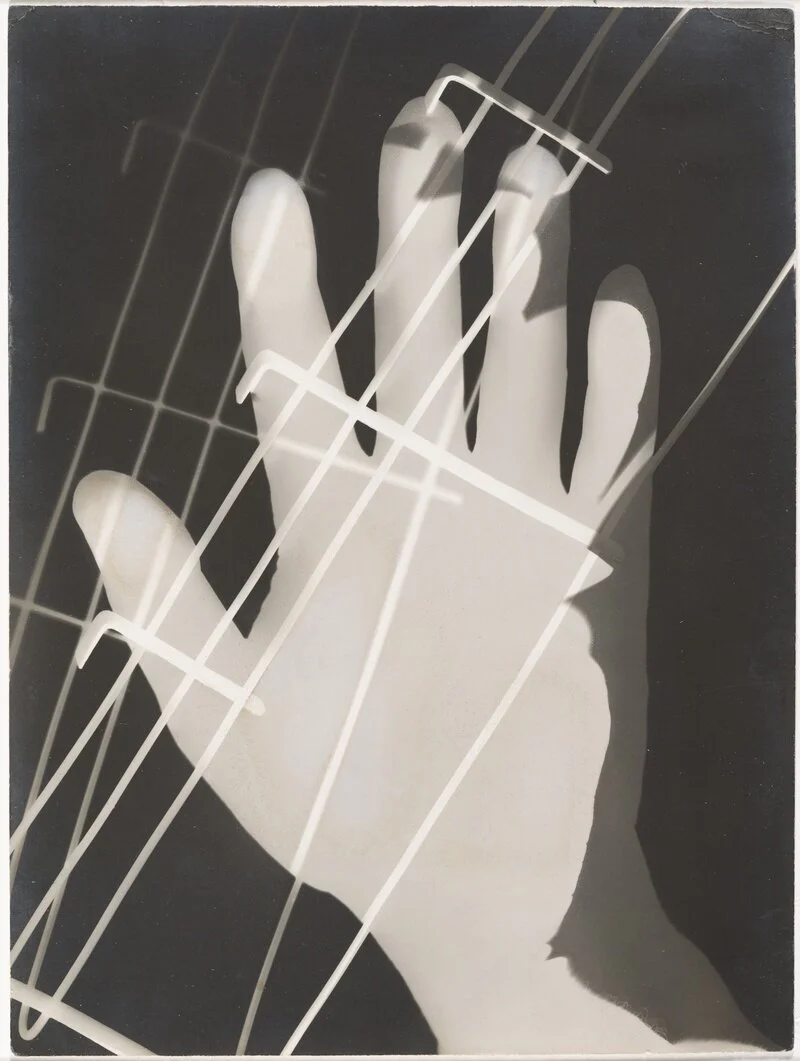
Laszlo Moholy-Nagy, Photogram, 1926
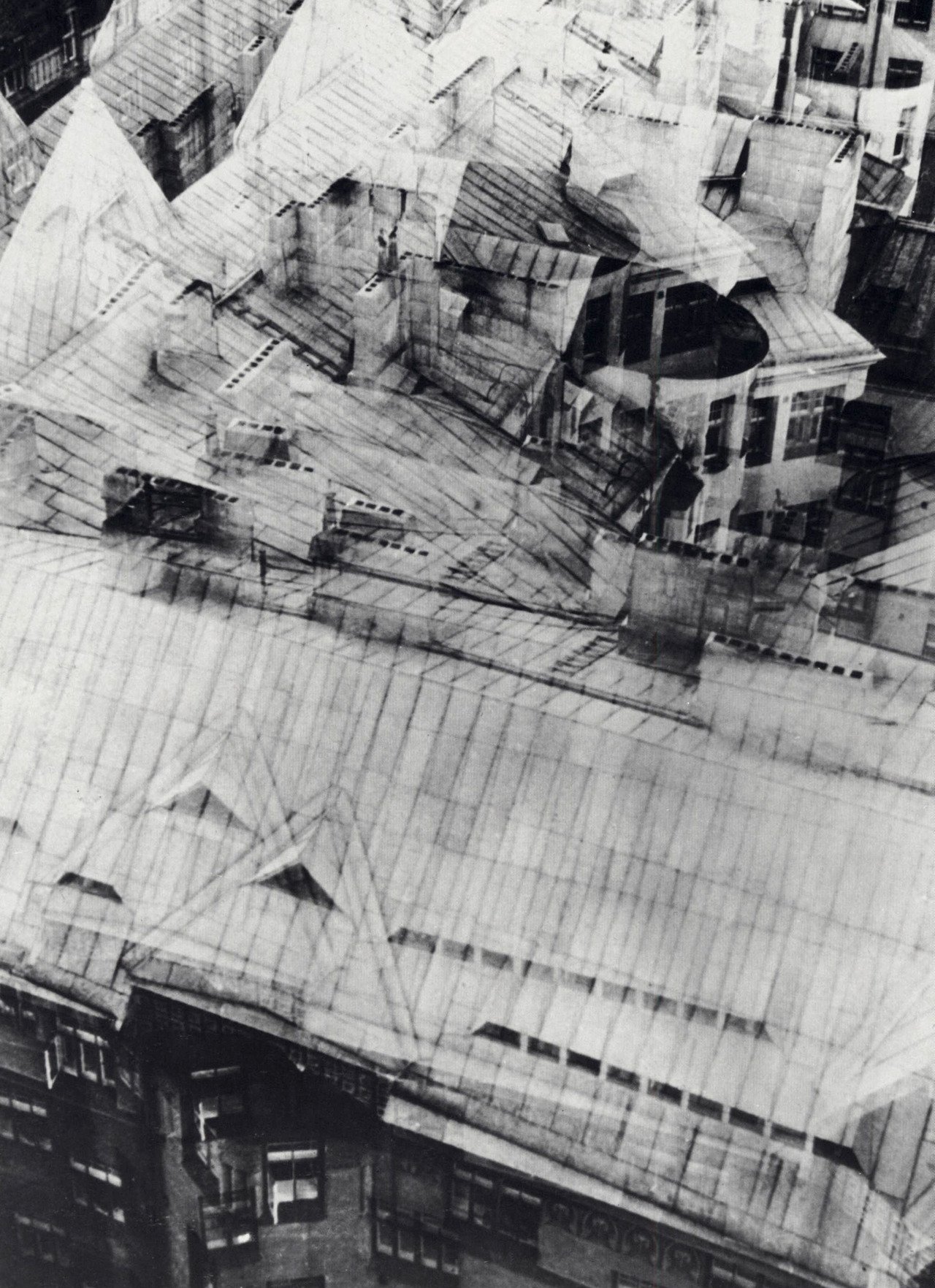
László Moholy-Nagy, Helskini, 1930, gelatin silver print, 394×292mm
Keywords
Dada, Modernism, Photogram, Experimental, Art, Community of practice
References
Laszlo Moholy-Nagy. 1926. Photogram. Image. https://moholy-nagy.org/.
Laszlo Moholy-Nagy. 1930. Helsinki. Image. https://www.sfmoma.org/artwork/98.243/.
Tate n.d. “Laszlo Moholy-Nagy”. TATE. Accessed March 11, 2020. https://www.tate.org.uk/art/artists/laszlo-moholy-nagy-1649.