
Sigmar Polke
First published 14 April 2020
Similarly, lens-based German artist Sigmar Polke (Figure 9) applies radical techniques, such as creating in-camera multi-exposures and omitting, bypassing and reversing steps in the darkroom to subvert traditional ideals of the medium.[1] The artist documents his life and surroundings, “altering the aesthetic heredity of his mediums by debasing the integrity of each, cultivating crossovers of material and meaning” (Halbreich 2016, 69). Like myself, Polke is as self-taught photographer, considers “the darkroom as an arena for exploration” and displays a recklessness for “the conventions of photography [which] often resulted in scratched negatives, under- and overexposures, and prints that further obscured details to create visually disorienting compositions” (The J. Paul Getty Museum 2007).
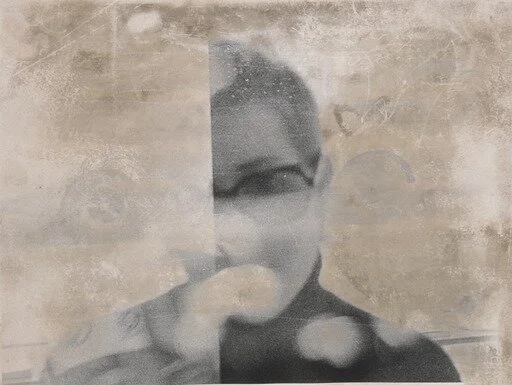
Sigmar Polke, Untitled (Mariette Althaus), c. 1973, unique gelatin silver print, 180x240mm
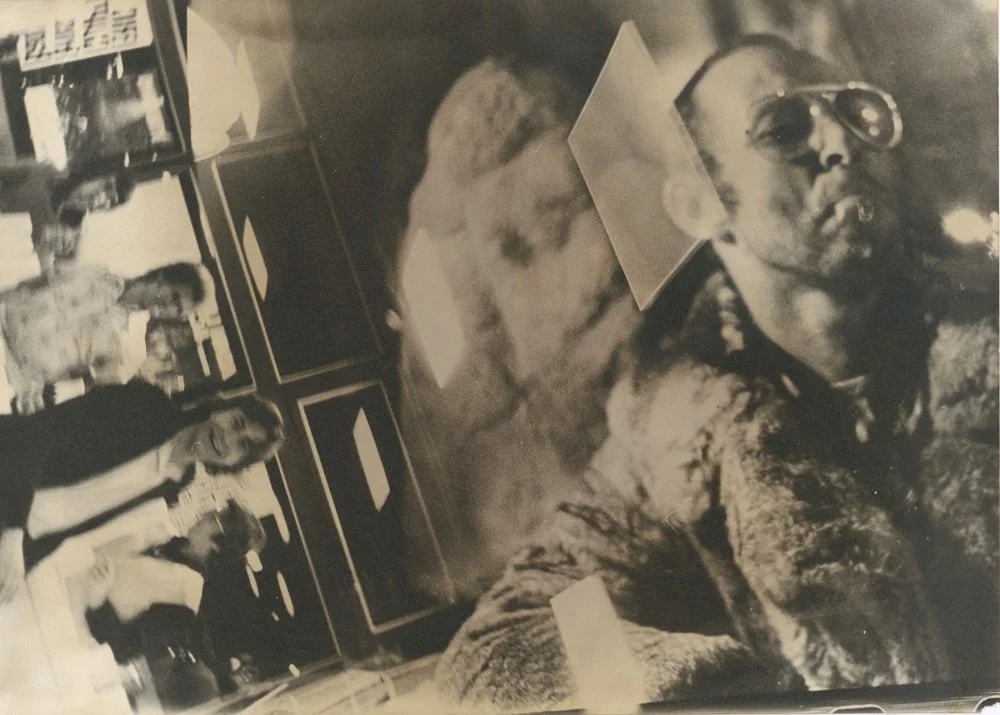
Sigmar Polke, Untitled (Sigmar Polke), c. 1975, photograph on AGFA C90 paper, 210x296mm
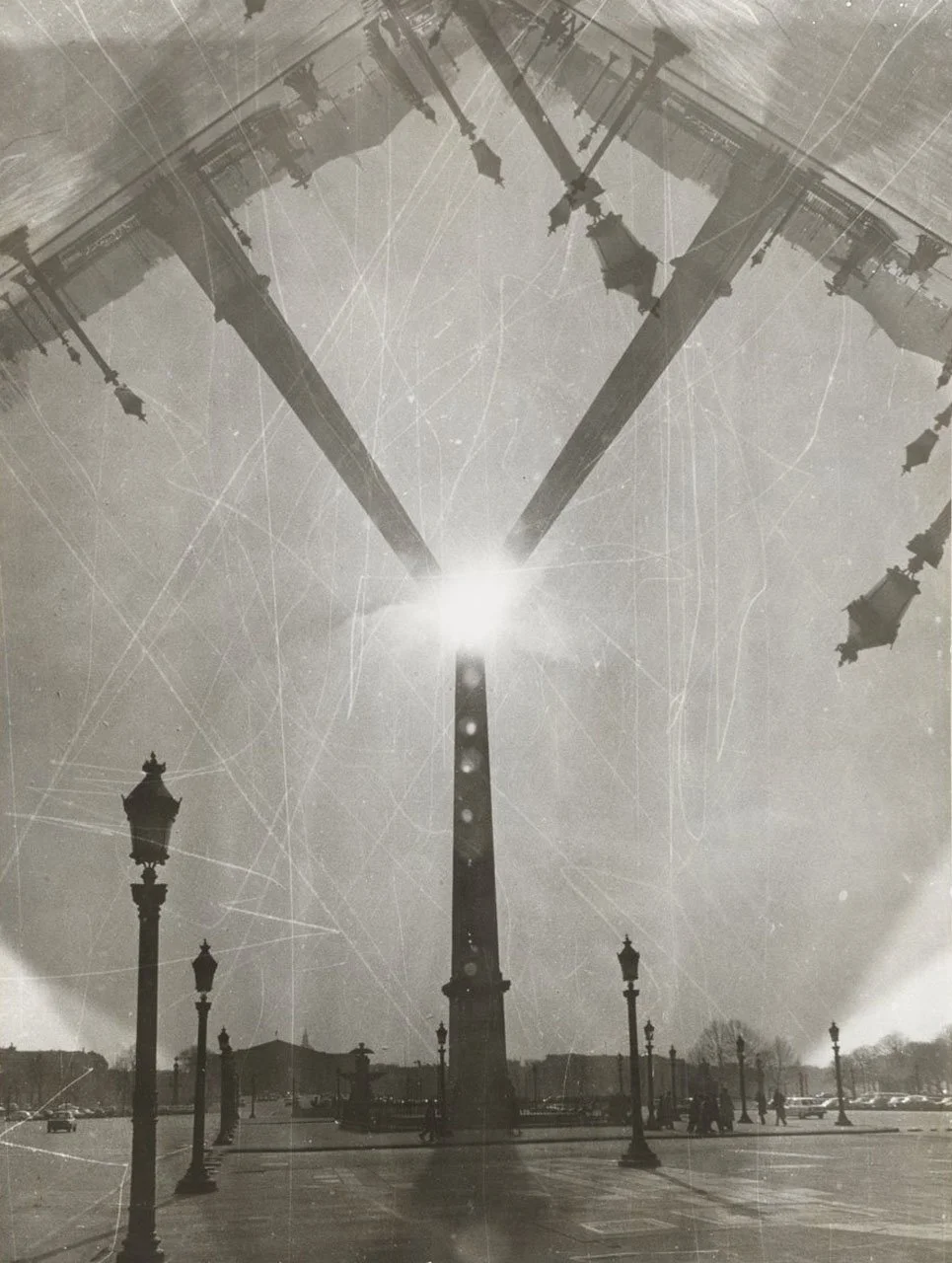
Sigmar Polke, Untitled (Obelisk, Paris), c. 1970. Courtesy Kicken Berlin, Berlin & Sies + Höke, Düsseldorf
Footnotes
An in-camera multi-exposure is when the film is rewound in the camera and repeatedly exposed, resulting in montage-like images embedded directly into the negative.
Keywords
Sigmar Polke, Painting, Photography, Capitalist realism, Abstract, Art, Community of practice, Expressionism, Contemporary, Alternative, Film, Darkroom, Courage, Pushing boundaries
References
Polke, Sigmar. c. 1975. Untitled (Obelisk, Paris). Image. https://news.artnet.com/market/sigmar-polke-at-paris-photo-11451237.
Polke, Sigmar. c. 1973, Untitled (Mariette Althaus). Image. https://www.moma.org/collection/works/149078.
Polke, Sigmar. c. 1975. Untitled (Sigmar Polke). Image. https://www.maxhetzler.com/zh/exhibitions/sigmar-polke-zeitreise-photographs-1966-1986collection-georg-polke-2020/works/#img27.
Rowell, Margit, Michael Semff, and Bice Curiger. 1999. Sigmar Polke WORKS on PAPER 1963-1974. New York: Museum Of Modern Art. PDF. https://www.moma.org/documents/moma_catalogue_187_300100396.pdf.
Squires, Carol and George Baker 2013. What Is a Photograph?. New York: International Center for Photography and DelMonico Books.
Thistlewood, David. 1996. Sigmar Polke: Back to Postmodernity. Liverpool: Liverpool University Press And Tate Gallery Liverpool.
Williams, Gregory. 2016. "Gregory H. Williams. Review of 'Alibis: Sigmar Polke, 1963–2010' by Kathy Halbreich". caa.reviews. http://www.caareviews.org/reviews/2337#.Yq2CS-xBzUI.
Halbreich, Kathy, Mark Godfrey, Lanka Tattersall, and Magnus Schaefer. 2014. Alibis: Sigmar Polke 1963–2010. London: Tate Publishing.
Francis Bacon
In the early years of his career, Francis Bacon[1] was best known as an interior designer. However, attending an exhibition in Paris in the early 1930s, Bacon was inspired to become a painter after viewing the work of Pablo Picasso.
In 1933 Herbert Reed featured Bacon’s “Crucifixion 1933” in the highly regarded and influential publication “Art Now”. However, his first solo exhibition was not a success.
Despite the acknowledgement of Reed, Bacon’s submission to the “International Surrealist Exhibition” in 1936 was rejected for being insufficiently surreal. In the years to follow, disheartened, Bacon destroyed nearly all of his paintings. (Photographer Brian Duffy also destroyed most of his negatives in the 1960s out of frustration).
Bacon aims to make concentrations of images – to deconstruct and reconstruct reality in his own vision, stating that his aim is not “to create an illustration of reality, but to create images that are a concentration of reality and a shorthand of sensation”.
Figure 1. Untitled self-portrait by Zo Damage, 2021. Photogram (unique print) on gelatin silver paper (600x1200mm). Click to open in light box view.
Relevance to practice
Bacon asserts that he aims to make concentrations of images – to deconstruct and reconstruct reality in his own vision, stating that his aim is not “to create an illustration of reality, but to create images that are a concentration of reality and a shorthand of sensation”. This resonates strongly in my own work, particularly with the photograms and in-camera multi-exposures.
Despite my not liking the colour of the fibre-based paper, my photograms are particularly relevant as they are unique prints – artifacts, which relates directly to Bacon as the artist asserts “Art is artefact”. Streaks and textures have been created purposefully and with performative gestures during the development process, representing agency, impermanence, movement and emotion in my photograms (Figure 1) may be compared with many of Bacon’s paintings (Figure 2).
Figure 2. Study from the human body by Francis Bacon, 1953
I strongly identify with Bacon’s passion for chaos in his painting. I began exploring chaos through film photography using in-camera multi-exposure in 2018, further developing my practice at university (Figure 3).
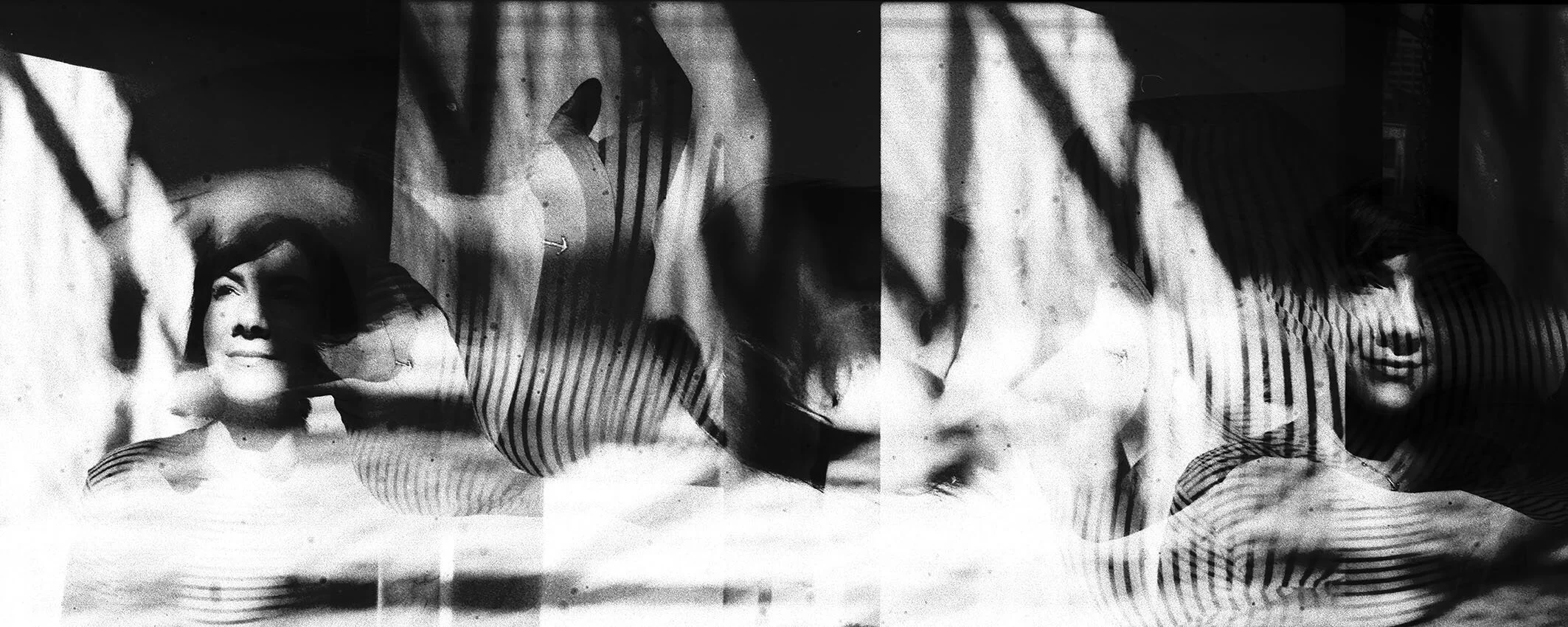
Figure 3. Hanamax. In-camera multi-exposure on 35mm film by Zo Damage, 2021
Quotes
“Chaos for me breathes images.” — Francis Bacon.
“I believe in deeply ordered chaos.” — Francis Bacon. (I love this guy!)
Keywords
Community of practice, Francis Bacon, Agency, Epherial, Surrealism, Photogram, Painting
Footnotes
Francis Bacon. David Hinton. et. al. 2013.
Bibliography
Hinton, David. et.al. Francis Bacon. Australia: ABC1 [broadcaster], 2013. https://rmit.primo.exlibrisgroup.com/permalink/61RMIT_INST/tcai14/alma9921628248001341.
Bacon, Francis. 1953. Study From The Human Body. Image. Accessed June 3, 2021. https://www.ngv.vic.gov.au/explore/collection/work/3761/.
Damage, Zo. 2021. Hanamax. Image.
Damage, Zo. 2021. Untitled self-portrait. Image.
Wassily Kandinsky
Wassily Kandinsky
Russia
1866–1944
Practice: Painting, Graphic art
Movement/Style: Expressionism, Abstract art, The Bauhaus
Russian painter, printmaker and graphic artist Wassily Kandinsky is credited for creating the first purely abstract works, and as the forefather or pioneer of Abstract art. Considered to be one of the great Modernists, Kandinsky was also a teacher at the Bauhaus school. Kandinsky’s use of colour is the opposite of my use of black and white, while at the same time having notable similarities.
I use monotone/black and white to encourage in the viewing a very personal interpretation and free emotional connection with the work – I believe that by applying colour is to imply a pre-determined emotional state. Kandinsky, on the other hand, uses abstract form, applying many colours to the work, my personal interpretation of this is that there is such an abundance of shape, texture and colour that it removes any given, or predetermined, emotional state thus, as in my own work, enabling the viewer freedom of interpretation and emotional connection.
As a live music photographer, my primary goal is to photograph energy, sound and emotion over and above any given subject.
Discovering that Kandinsky referred to colour as sound and music as art was an added bonus.
The Kandinsky website quotes the Modernist master: “With few exceptions, music has been for some centuries the art which has devoted itself not to the reproduction of natural phenomena, but rather to the expression of the artist's soul, in musical sound.” (Kandinsky n.d.)
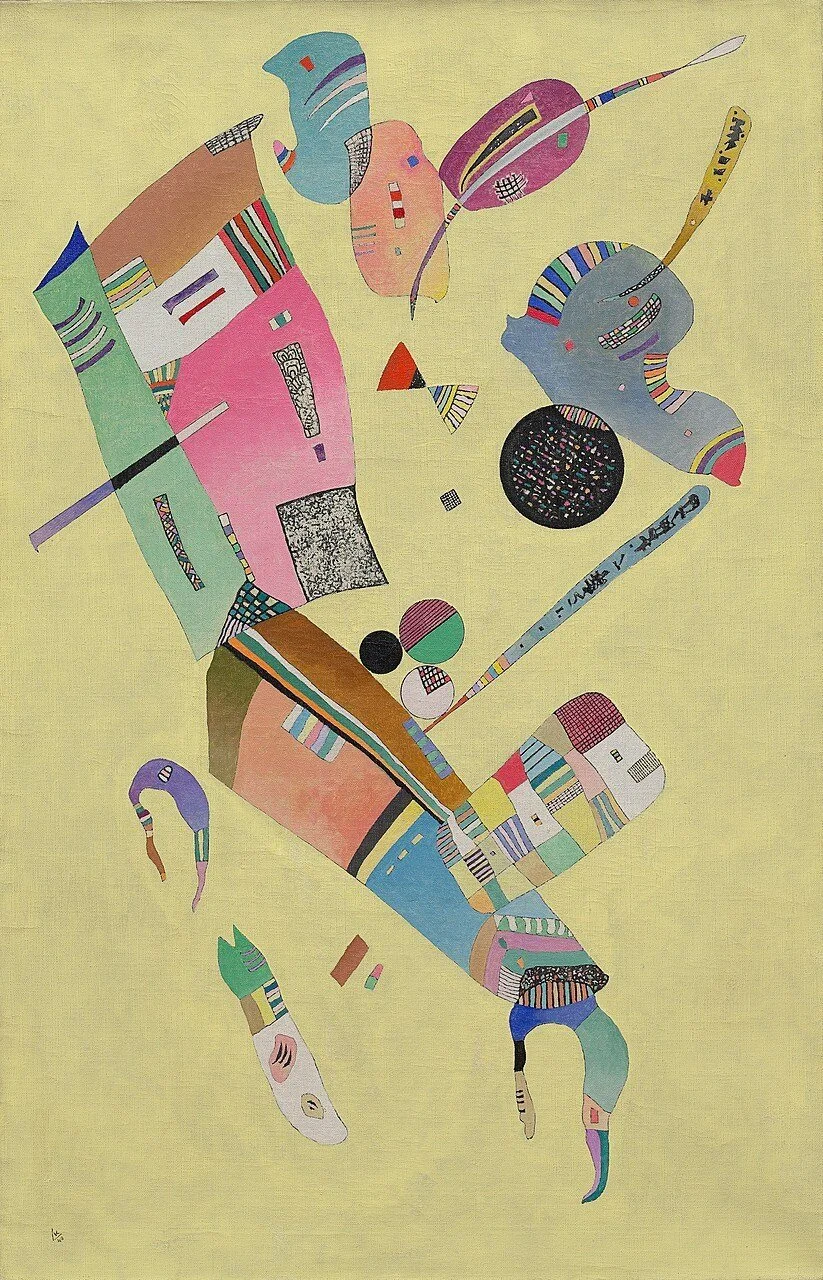
Wassily Kandinsky, Moderation, 1940
Keywords
Wassily Kandinsky, Bauhaus, Painting, Graphic art, Abstract, Expressionism, Colour, Form, Music, Sound, Community of practice, Abstraction, Emotive, Sound, Energy, Music, Tone, Energy, Kinetics, Obscurity, 2-dimensional, Organised chaos, Structure
References
Kandinsky, W n.d., Quotes, viewed 14 April 2020, <https://www.wassilykandinsky.net/quotes.php>
Kandinsky, W 1940, Moderation, painting, viewed 14 April 2020, <https://www.guggenheim.org/artwork/artist/vasily-kandinsky>
Manhattan Arts International n.d., Wassily Kandinsky, viewed 14 April 2020, <https://manhattanarts.com/wassily-kandinsky/>
Tate n.d., Wassily Kandinsky, viewed 14 April 2020, < https://www.tate.org.uk/art/artists/wassily-kandinsky-1382>