
Dada Japan
Although Dada strongholds were located in Zurich, Berlin, Hannover, Cologne, New York and Paris the movement reached as far as Japan. This is mind blowing and must be researched.
Bibliography
“Dada and Surrealism in Japan.” 2016. Blackwell Companions to Art History: A Companion to Dada and Surrealism. https://rmit.primo.exlibrisgroup.com/permalink/61RMIT_INST/4t5l5f/cdi_credo_entries_26969661.
Dickerman, Leah, and Brigid Doherty. 2006. Dada. Washington: National Gallery of Art.
Gopnik, Blake. 2016. "Was Japanese Dada Tougher Than Its European Versions?". Artnet News. https://news.artnet.com/opinion/japanese-dada-new-york-public-library-622340.
William. 2016. "Tokyo Goes Dada For Art Anniversary". Japan Trends. https://www.japantrends.com/tokyo-dada-art-anniversary-festival/.
Man Ray
Man Ray was a significant contributor to the Dada and Surrealist movements, although his ties to each were informal. Man Ray worked in a wide range of mediums and considered himself a painter. Best known for his photography, Man Ray was a renowned fashion and portrait photographer. Man Ray is also known for his work with photograms, which he called "rayographs", a reference to himself.
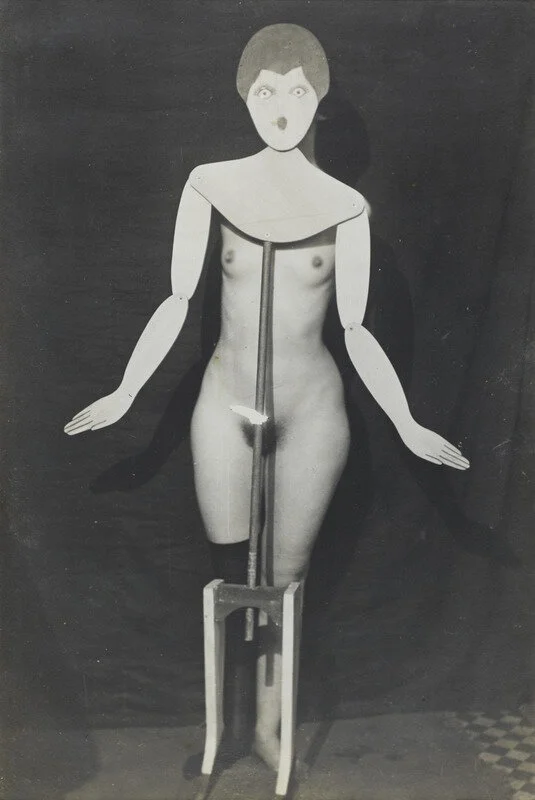
Man Ray, The Coat-Stand (Porte manteau), 1920
Keywords
Experimental, Sculpture, Photography, Modernism, Community of practice
References
Dupêcher, N 2017, ‘Man Ray (Emmanuel Radnitzky)’ , MoMA, viewed 31 March 2020, <https://www.moma.org/artists/3716>
Ray M 1920, The Coat-Stand (Porte manteau), photograph, viewed 31 March 2020, <https://www.centrepompidou.fr/cpv/resource/czzAepB/rXKKqz>
László Moholy-Nagy
László Moholy-Nagy
Hungary
1895–1946
Practice: Painting; Photography; Sculpture; Film
Movement/Style: Dada, Constructivism, Expressionism, Bauhaus style, Modern art
The complexity, depth and structure of Moholy-Nagy’s work are deceiving. ‘Photogram’ by László Moholy-Nagy (1926) has had a significant impact on me and how I look at photography. Although simple at first glance, the layers, exposure and the opacity of the objects are complex and highly technical.
László Moholy-Nagy, a teacher of the Bauhaus (Staatliches Bauhaus), authored Bauhausbücher 8: Painting Photography Film (1925). As represented by the title, the first half of the book finds Moholy-Nagy discussing various styles of art with a focus on painting, photography and film and theory. Curated by Moholy-Nagy, the second half of Bauhausbücher 8: Painting Photography Film presents a collection of works – ranging from sheet music to photograms – by artists of the Bauhaus.
In the introduction, author Moholy-Nagy states that “This book is in defence of photography, which many people still think of as an inferior mechanical operation of recording.” The books are as magnificent to look at as it is to read. Typography is as much as a graphic element as a means of communication. One hundred years down the track, Moholy-Nagy was a profound thinker and creative. His art and writing continue to be a powerful influence on contemporary artists, particularly in the field of photography.
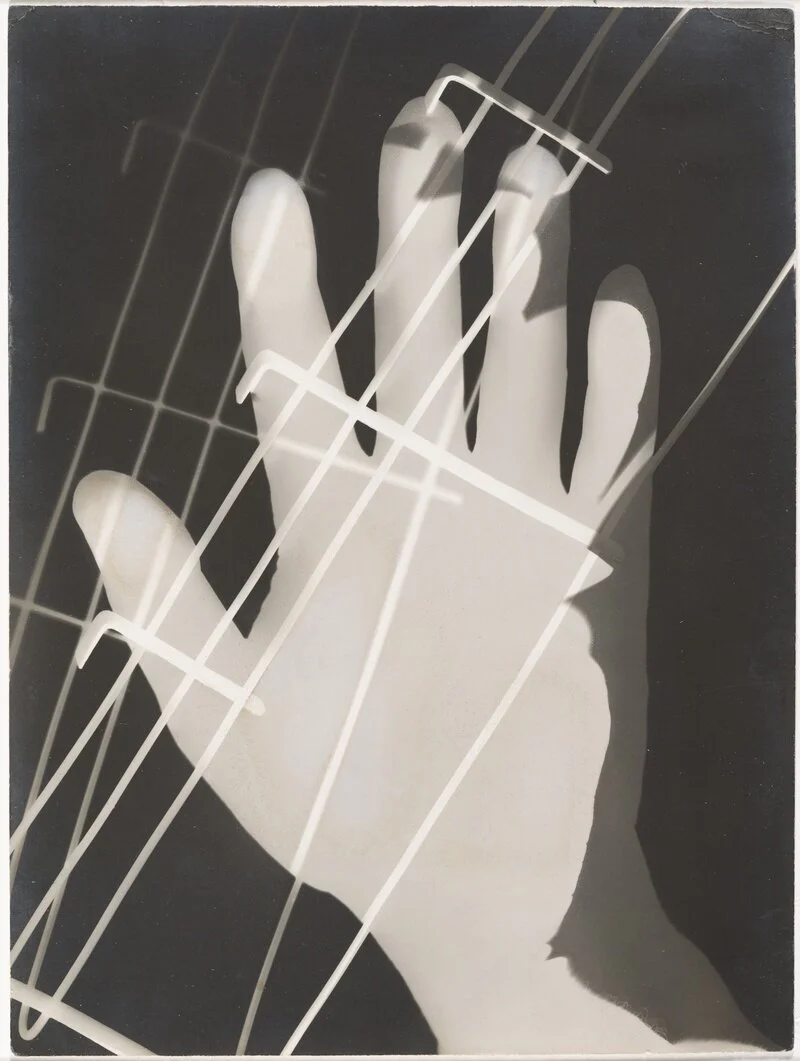
Laszlo Moholy-Nagy, Photogram, 1926
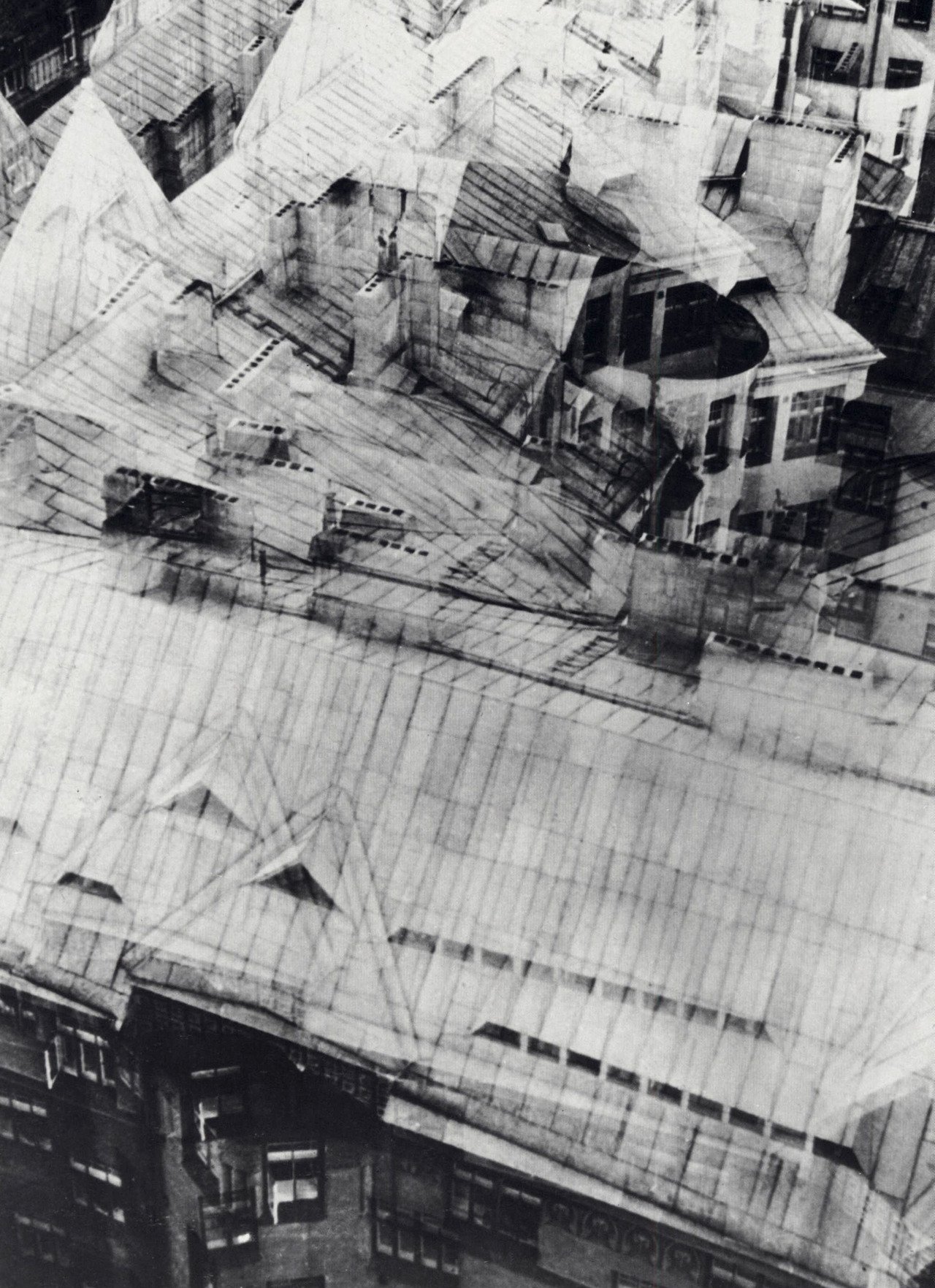
László Moholy-Nagy, Helskini, 1930, gelatin silver print, 394×292mm
Keywords
Dada, Modernism, Photogram, Experimental, Art, Community of practice
References
Laszlo Moholy-Nagy. 1926. Photogram. Image. https://moholy-nagy.org/.
Laszlo Moholy-Nagy. 1930. Helsinki. Image. https://www.sfmoma.org/artwork/98.243/.
Tate n.d. “Laszlo Moholy-Nagy”. TATE. Accessed March 11, 2020. https://www.tate.org.uk/art/artists/laszlo-moholy-nagy-1649.