
Uta Barth
First published 15 August 2020
Uta Barth
Germany
1958–
Practice: Photography
Movement/Style: Contemporary
Uta Barth is best known for her alternative use of light, colour and focus, producing abstraction and distortion, resulting in an elusive and ethereal discourse of her images and subject matter. Barth considers her work never directly addresses the literal subject matter of the photograph but attempts to ask questions about vision itself, photographing sound, non-space and in-betweens. In her presentation for The Modern Art Museum of Fort Worth (2011), Uta Barth discusses her work over the past 20 years. Barth shares her influences and inspirations as she questions the interpretation of visual perception. Describing her work as visceral, Barth continues, explaining the application of psychological theories, including phenomenology, to her practice.
“The discussion of these photographs, or anything that lacks focus for that matter, as being ‘painterly’ or ‘pictorialist’, drives me crazy. It assumes that a photograph would secretly–or overtly–aspire to the attributes of painting in order to justify itself as an artwork” (Higgins 2013).
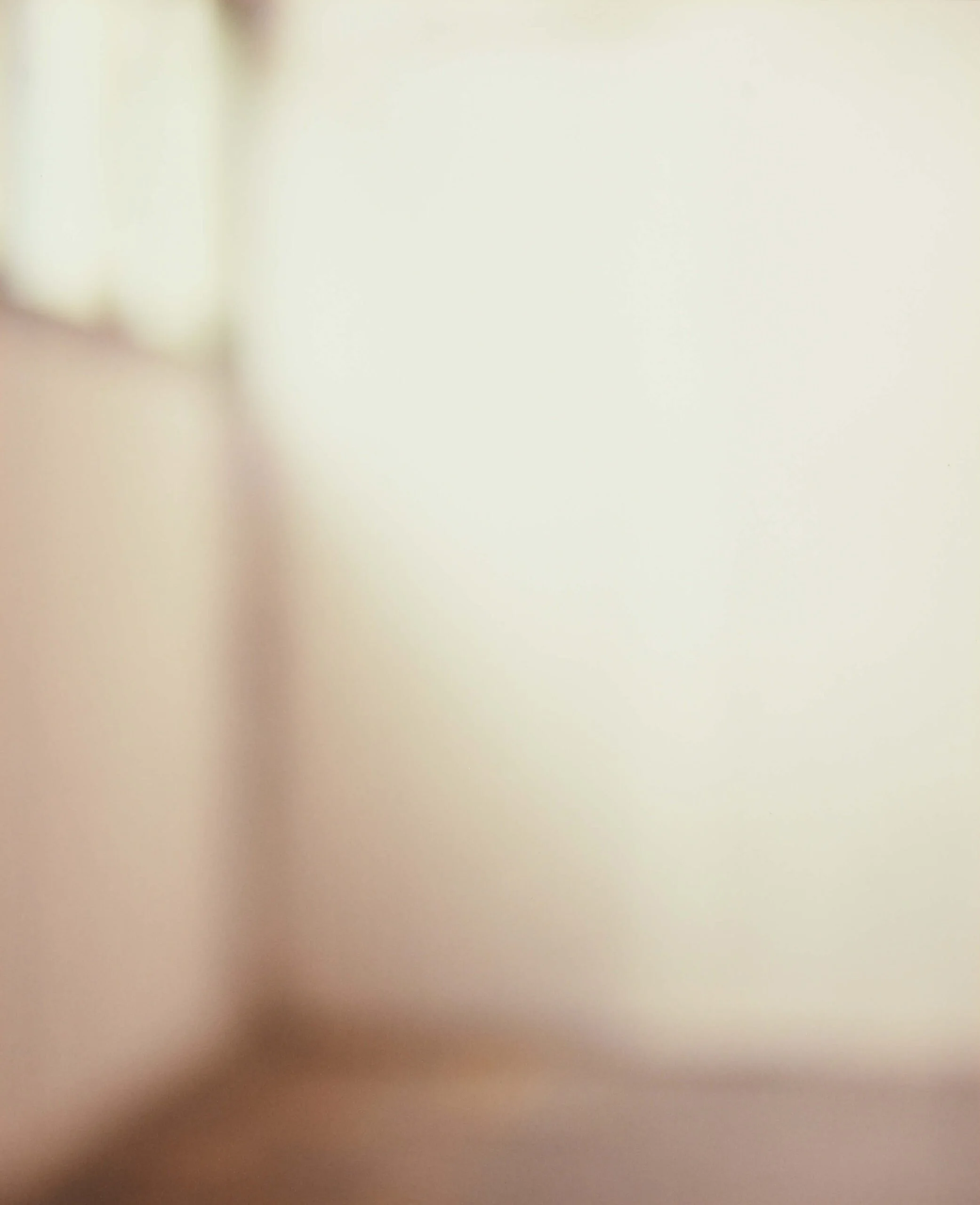
Uta Barth, Ground #56, 1995
Bibliography
Barth, Uta. 1994. Ground #30. Image. https://utabarth.net/work/ground/#image-3.
Barth, Uta. 2011. "Uta Barth 2.8.11". Podcast. Modern Art Museum Of Fort Worth. https://soundcloud.com/themodernpodcast/uta-barth-2811.
Barth, Uta. 2012. "Conceptual Photographer Uta Barth: 2012 MacArthur Fellow | MacArthur Foundation". macfound. October 2, 2012. YouTube video, 03:10. https://youtu.be/xxYcpPDq5iQ.
Christine Cornish
Australian contemporary artist Christine Cornish combines painting and drawing with photography. Cornish investigates "the self-consciousness of individual perception", particularly interested in the relationship "between perception, memory and knowledge". Cornish relates "subjective vision" as being restricted by governance and principles that stem from cultural and scientific rhetoric than from an "understanding of perception itself. Merging physical and faux space with "objects that suggest ephemeral cultural phenomena", Cornish aims to unpack "the inextricable yet abstruse materiality of things that make up our ordinary daily experiences". Moreover, Cornish "modulates the images through layering and drawing before photographing to distancing materiality from the material and objects from their origins and their objections" (Cornish 2006).
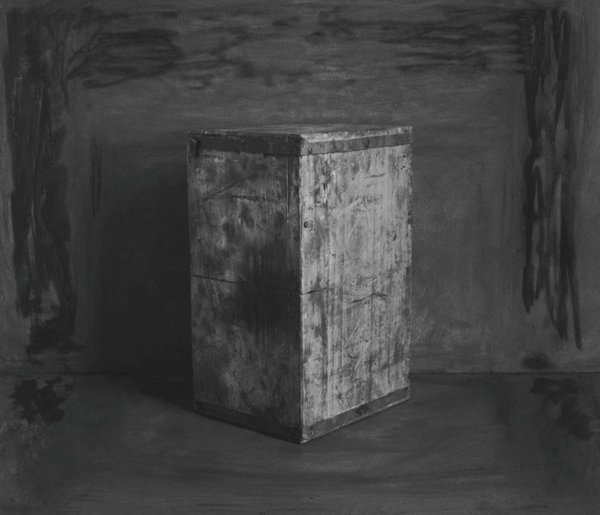
Figure 1. Christine Cornish, Natura Morta V, 1987, gelatin silver print, 377x414mm
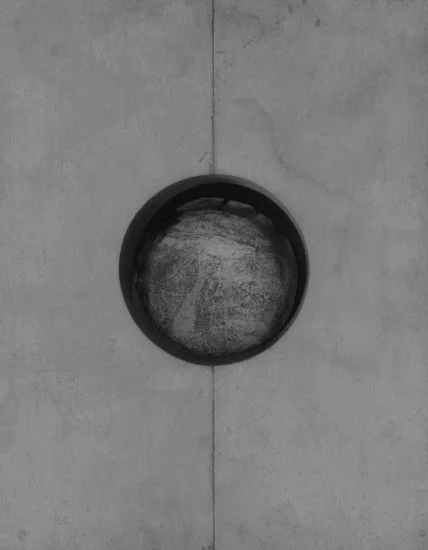
Figure 2. Christine Cornish, Datum 17 , 2001, gelatin silver print, 495x408mm
Keywords
Christine Cornish, Analogue photography, Contemporary photography, Australia
Bibliography
Cornish, Christine. 1987. Natura Morta V . Image. http://www.australianphotographers.org/artists/christine-cornish/photos#301.
Cornish, Christine. 2001. Datum 17. Image. http://www.australianphotographers.org/artists/christine-cornish/photos#313.
Cornish, Christine. 2006. "Christine Cornish". Australian Photographers. http://www.australianphotographers.org/artists/christine-cornish.
Tenesh Webber
Tenesh Webber applies photographic techniques to manipulate the image in the darkroom and in-camera in the negative, extending her investigation of photographic mediums through the photogram [1]. Webber's process involves first making sketches to develop her concepts and ideas. The artist then composes the image by arranging objects such as sewing thread and drawing directly on a sheet of clear, transparent acetate akin to a pane of glass to create a film negative-like 'exposure plate'. The 'exposure plate' is then positioned on or over a light-sensitive substrate from which Webber creates 'cameraless' photographic images. Although I have made several photograms in the traditional sense of placing objects directly onto light-sensitive surfaces, I had not considered using acetate sheets to create ‘exposure plates’ and look forward to exploring how to incorporate these methods into my practice moving forward.
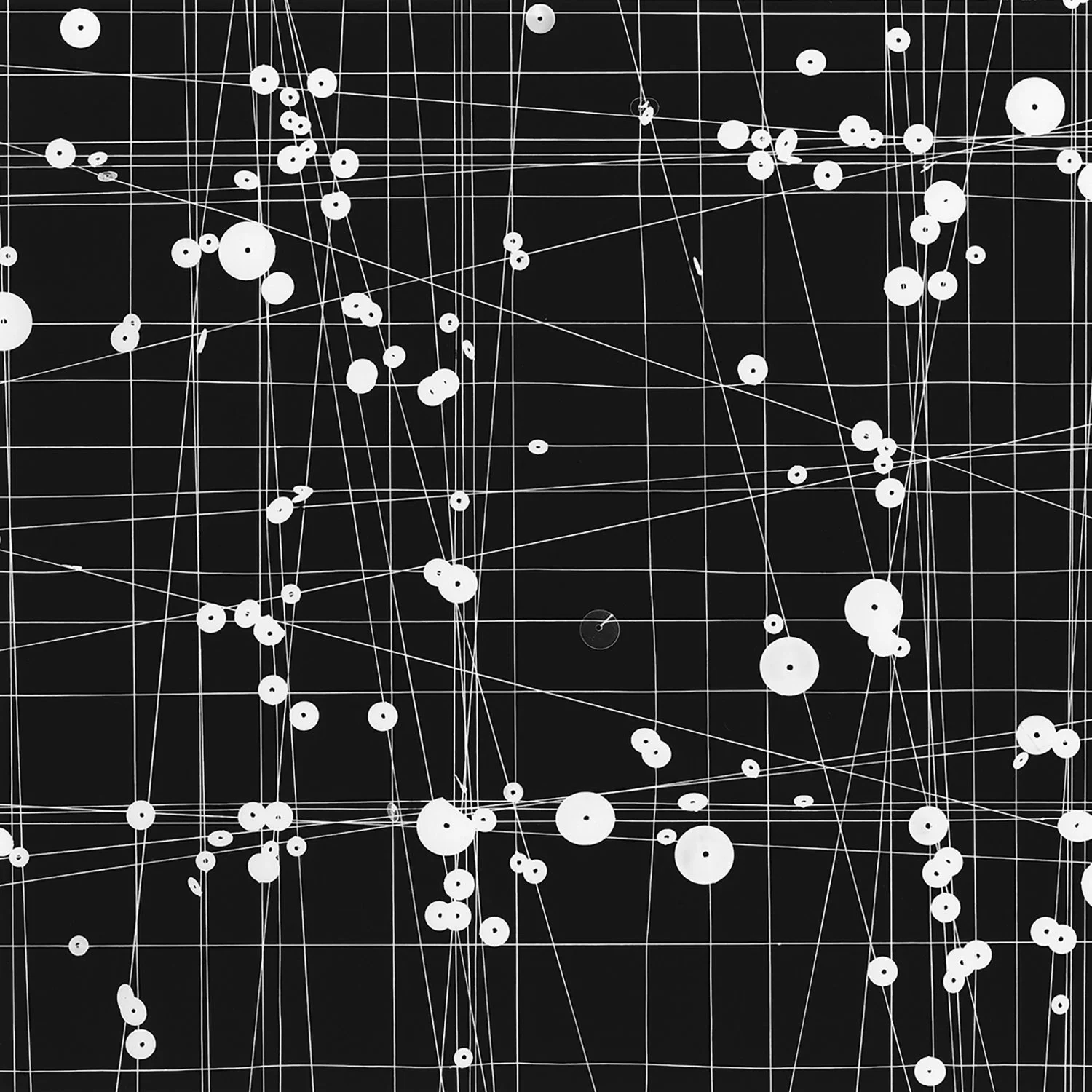
Tenesh Webber, Midpoint 3, 2015, photogram on paper, 280x280mm
Keywords
Tenesh Webber, Photogram, Contemporary photography
Bibliography
"Tenesh Webber". 2022. IdeelArt. Accessed May 28. https://www.ideelart.com/artist/tenesh-webber.
Webber, Tenesh. 2022. Midpoint 3. Image. https://www.widewalls.ch/artwork/tenesh-webber/mid-point-3.
Christian Marclay
American multimedia artist Christian Marclay creates unique cyanotype contact prints of unravelled cassette tapes to investigate "visual abstraction to capture the old soundtracks" (Bunyan 2016). Marclay titled his work acknowledging the cassette and "media technology that is rapidly approaching extinction" (Higgins 2013, 212). Marclay further applies the "cyanotype process to portray their demise and simultaneously summon beauty from banality" (ibid)
To create Memento, Marclay first coated the substrate with cyanotype solution, commonly applied by hand using brushes, sponges or spray bottles. Next, the treated substrate must be laid out to dry. After drying, the prepared substrate must be arranged, and the desired objects placed on the surface and exposed to light to create the photographic impression. Finally, the substrate must be developed, dried and prepared for installation.
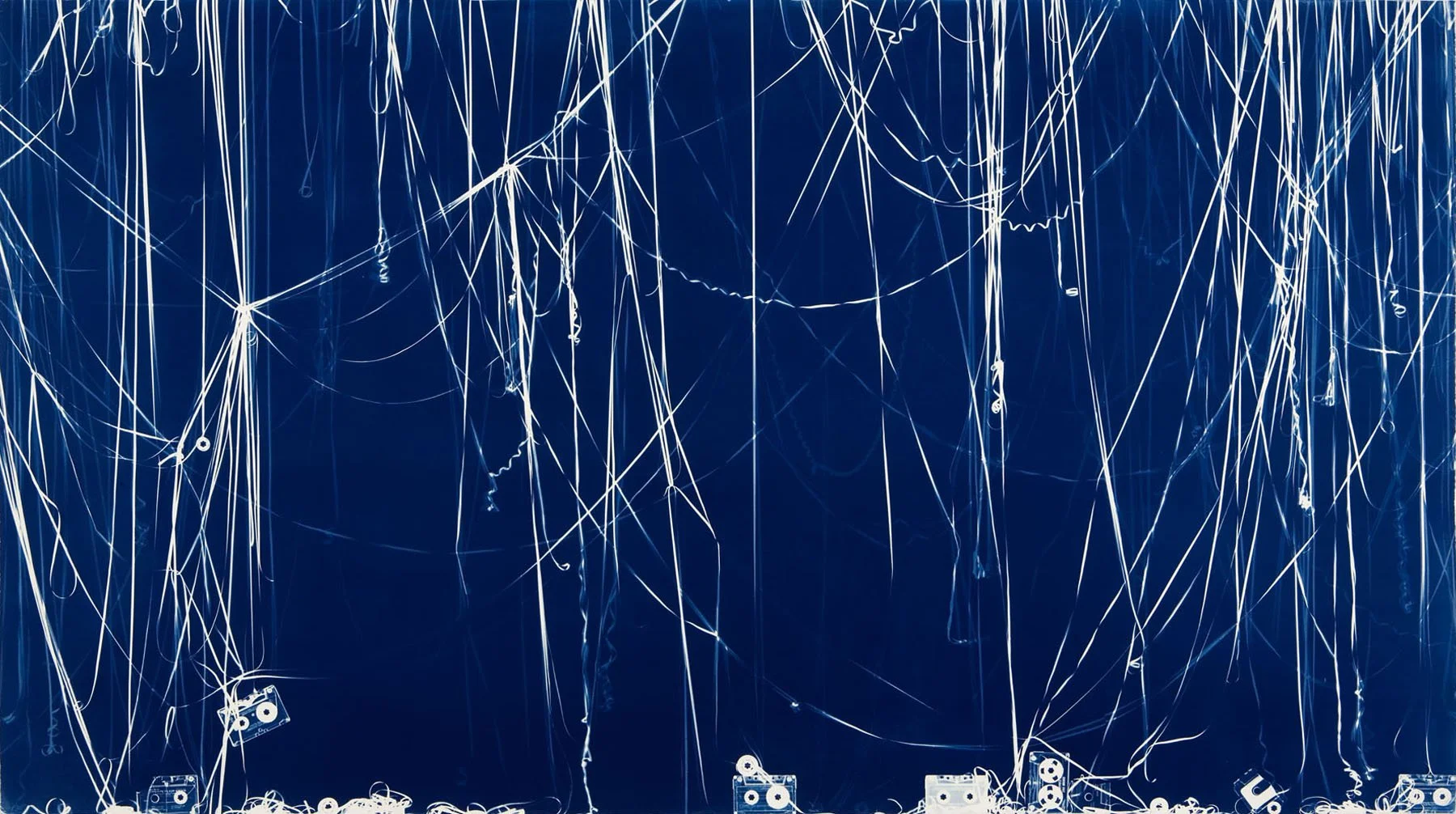
Christian Marclay 2008, Memento (Survival of the Fittest), unique cyanotype print on paper, 1310x2340mm
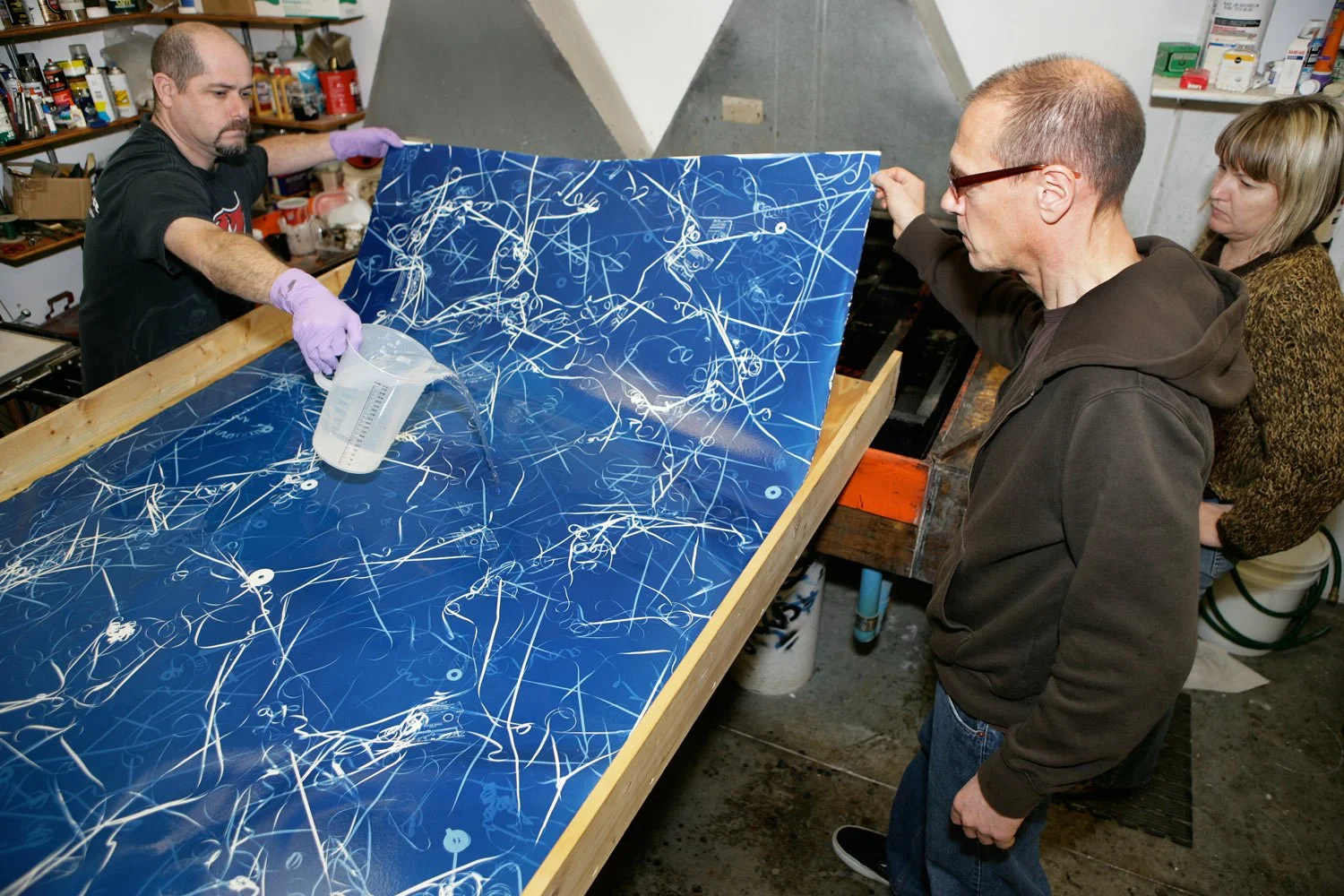
Christian Marclay (center) producing a unique cyanotype at Graphicstudio, University of South Florida, Tampa. Image courtesy of USF Graphicstudio. Photo: Will Lytch.
Keywords
Christian Marclay, Cyanotype, Contemporary photography
Bibliography
Bunyan, Marcus. 2016. "Christian Marclay Memento (Survival Of The Fittest)". Art Blart. https://artblart.com/tag/christian-marclay-memento-survival-of-the-fittest/.
Higgins, Jackie. 2013. Why It Does Not Have To Be In Focus. London: Thames & Hudson.
Lytch, Will. n.d.. “Christian Marclay (center) producing a unique cyanotype at Graphicstudio, University of South Florida, Tampa”. Image. https://artinprint.org/2014/wp-content/uploads/2016/10/6.4_Marclay_01.jpg.
Marclay, Christian. 2008. Memento (Survival Of The Fittest). Image. https://artblart.com/tag/christian-marclay-memento-survival-of-the-fittest/.
Tallman, Susan. 2016. "To The Last Syllable Of Recorded Time: Christian Marclay". Art In Print 6 (4). https://www.jstor.org/stable/26408703.
Minor White
Minor White
1908–1976
USA
Practice: Photography
Movement/Style: Contemporary art, Photography
Although many consider White to be an abstract photographer, the environmentalist and Buddhist was primarily a landscape photographer. White blurred the lines of reality while combining his emotional and spiritual connections with nature and environment with his unique vision and approach in his work. Thought-provoking with vast scope for interpretation, I am attracted to the beauty, serenity and textures of White’s exposures and the courage and conviction of the artist as he pushes against boundaries in his expression and image-making. Relationship to practice is in White’s persistence to push boundaries and think outside the box in the narrative of his work. Bold and hauntingly beautiful with seemingly endless possibilities for interpretation, White is fearless and unapologetic in the images he makes.
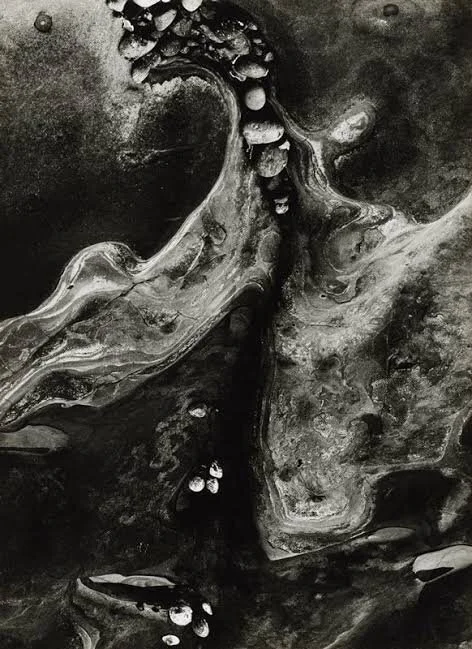
Minor White, Nature Abstract, 1963
Quotes
If all your life means to you is water running over rocks, then photograph it, but I want to create something that would not have existed without me. — Minor White (Graf, M 2016)
Relevance to practice
Large format, Abstraction, Black and white, Contemporary, Texture, Tone, Composition
Keywords
Minor White, Contemporary art, Photography, Texture, Tone, Abstraction, Alternative view, Composition, Film, Analogue, Black and white, Community of practice
References
Artnet n.d., Minor White, viewed 11 May 2020, <http://www.artnet.com/artists/minor-white/>
Graf, M 2016, ‘Art from the Moment’, Notes from the Woods, blog post, 20 March, viewed 2 June 2020, <https://www.grafphoto.com/2016/03/20/art-from-the-moment/>
White, M 1963, Nature Abstract, photograph, viewed 2 June 2020, <https://collections.artsmia.org/art/115964/nature-abstract-minor-white>
Adam Fuss
Adam Fuss creates a visual language of beauty and strength, exploring and redefining notions of what constitutes a photograph or an image. Fuss is less interested in the meaning of the picture than the making of it (Kellein 2013), depending on the rudimentary infrastructure of pinhole cameras, photograms and other commonly considered ‘redundant’ processes to create spectacular conceptual deconstructions of the transforming medium (Lundström 2005) (Jolly et al. 2015, 6).
I am officially in love … and not sure how to approach writing about Fuss or the relationship to practice.
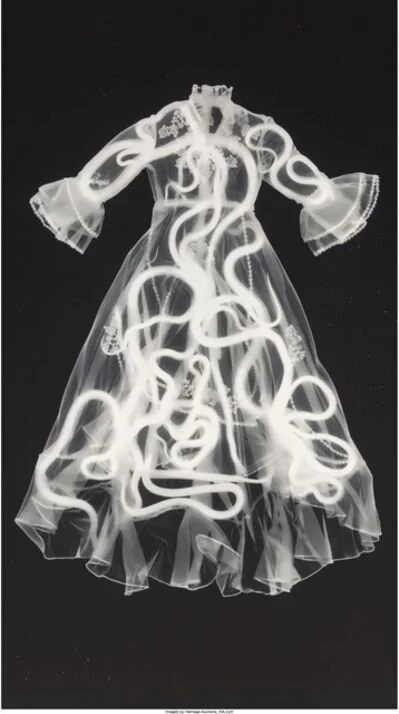
Adam Fuss, Medusa, 2010
Quotes
I’m not interested in the meaning of the picture, I’m interested in the making of it. — Adam Fuss (2013)
Keywords
“Adam Fuss.” n.d. Fraenkel Gallery. Accessed September 11, 2022. https://fraenkelgallery.com/artists/adam-fuss.
Adam Fuss, Camera-less photography, Photogram, Water, Chemigram, Contemporary, Energy, Movement Rebel, Focused, Narratives, Alternative printing, Abstraction, Obscure, Texture, Contrast, Emotive, Community of practice
References
123marketstreet 2011, A&A Portrait – Adam Fuss, online video, YouTube, viewed 3 May 2020, <https://www.youtube.com/watch?v=QxpeNIN0iRA>
Cheim & Read 2013, Adam Fuss Documentary, online video, YouTube, viewed 3 May 2020, <https://youtu.be/LHvByy7950Q>
Douglas Udell Gallery 2013, Adam Fuss in Conversation with Thomas Kellein, online video, YouTube, viewed 3 May 2020, <https://youtu.be/HrgvCngcf40>
Fuss, A 2010, Medusa, photograph, viewed 3 May 2020, <https://www.artsy.net/artwork/adam-fuss-medusa-from-the-series-home-and-the-world>
Fuss, Adam. 2013. "Adam Fuss in Conversation with Thomas Kellein." February 10, 2013, 26:07. YouTube video. DouglasUdelGalery. https://youtu.be/HrgvCngcf40.
Jolly, Martin, Cherine Fahd, and Suzanne Buljan. 2015. The Alchemists: Rediscovering Photography In The Age Of The Jpeg. Sydney: The University of Sydney. PDF. https://martynjolly.files.wordpress.com/2015/10/
thealchemistscatalogue.pdf.Lundström, Jan-Erik. "Fuss, Adam." In The Oxford Companion to the Photograph. : Oxford University Press, 2005. https://www-oxfordreference-com.ezproxy.lib.rmit.edu.au/view/10.1093/acref/9780198662716.001.0001/acref-9780198662716-e-601.
Rafferty, E 2013, Art Movements Through Photography, online video, YouTube, B&H Photo Video, viewed 2 May 2020, <https://www.youtube.com/watch?v=r-Bx5krtLZY&t=3444s>
Victoria and Albert Museum 2018, Camera-less photography: Adam Fuss, online video, YouTube, viewed 2 May 2020, <https://www.youtube.com/watch?v=RHNvVm0Rp_4>