
Wolfgang Tillmans
First published 18 April 2020
Last updated 6 June 2023
Wolfgang Tillmans’ Frieschwimmer series was created using dry, cameraless analogue photographic processes. The artist used his hands to manipulate light to create the patterns on the paper during development. The colour was introduced into the images by way of Tillmans’ use of a colour head enlarger and C-type paper. Many art critics regard Tillmans’ work to be situated between observational and abstract photography, creating new narratives while offering a significant contribution to the overarching field of contemporary photography.
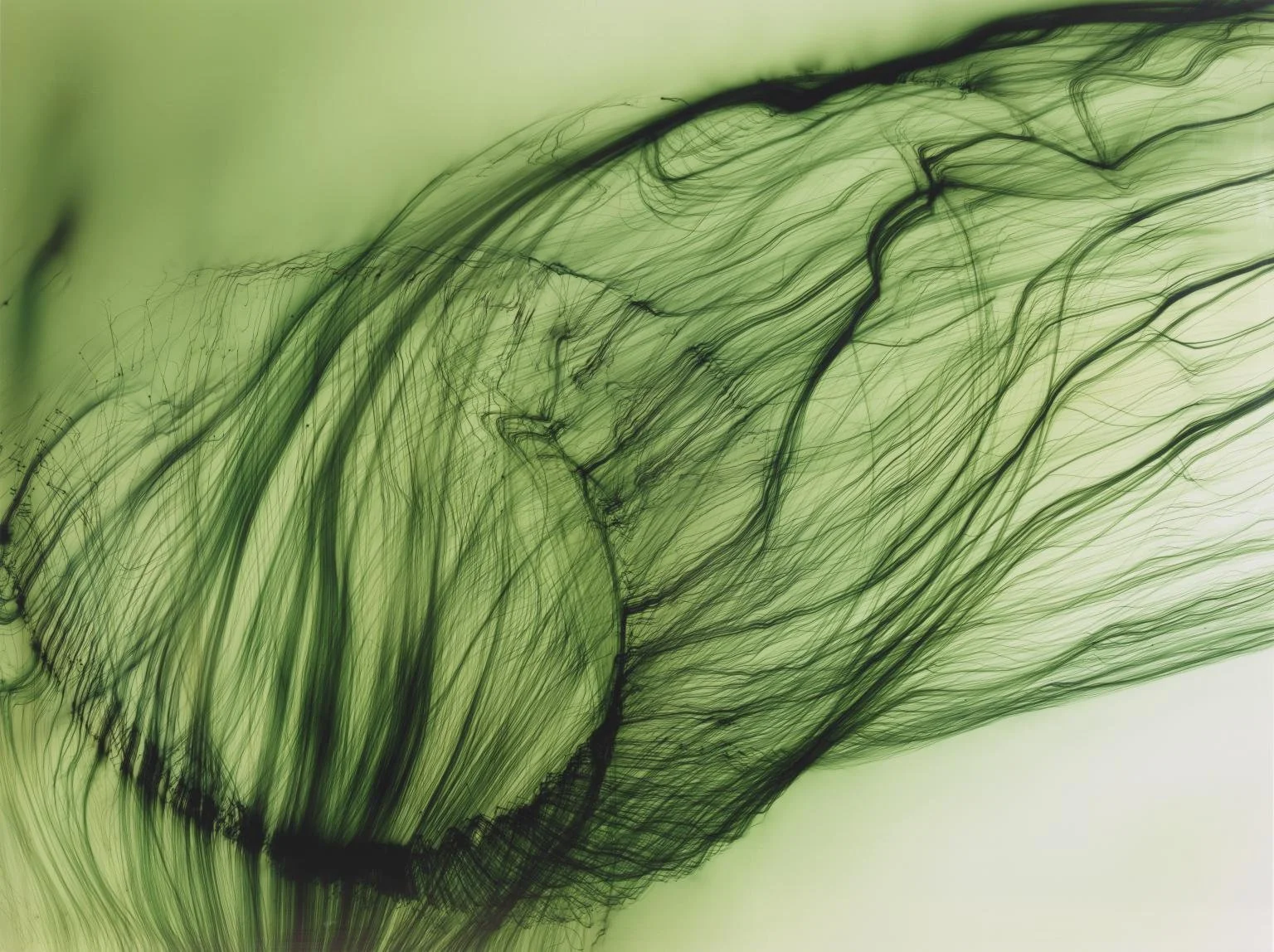
Wolfgang Tillmans, Freischwimmer 16, 2003, c-type print on paper, 2395×1797mm
Relevance to practice
Alternative printing, Abstraction, Darkroom, Analogue, Experimentation, Technical, Paradoxical
Keywords
21st century, Art, Photography, Technology, Digital, Perspective, Arrangement, Exploration, Contemporary
References
Artspace Editors. 2016. “8 New Classics of 21st-Century Photography You Need to Know Now.” Artspace. 2016. https://www.artspace.com/magazine/art_101/book_report/phaidon-photography-21st-century-list-53466.
Tillmans, Wolfgang. 2003. Freischwimmer 16. Image. https://www.tate.org.uk/art/artworks/tillmans-freischwimmer-16-p20284.
Floris Neusüss
Adventurous and innovative, Contemporary artist Floris Nuesüss has a great impact on my work practice, particularly in exploring shape, texture and methodology. Best known for his photograms, I am drawn to Neusüss’ willingness to think outside the box, push boundaries and explore the craft of photography.
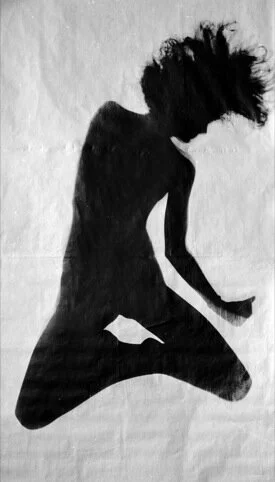
Floris Neusüss, Nudogrammm, 1964
Floris Neusüss is a contemporary experimental German photographer known for his use of camera-less photography (photograms) … “Photograms don’t show us what’s beyond the visible, but they give us a hint of it,” Neusüss has said. “It is true that the subject resting on the photo-sensitive paper presents its reverse side to be recorded, the side that is in shadow, the shadow cast by the object itself. This intimate physical connection inscribes into the paper, and this, if you are open to it, is the real fascination of photograms: the tension between the hidden and the revealed.” … Today, his works are held in the collections of the Victoria and Albert Museum in London, the San Francisco Museum of Modern Art, and the Art Institute of Chicago, among others. (artnet, nd)
Quotes
A true pioneer of photographic art, inspired by the camera-less photography of Làszló Moholy-Nagy and by Man Ray’s Surrealist photograms, Floris Neusüss has dedicated his whole career to the practice, study and teaching of the photogram, exploring its technical and visual possibilities and pushing the boundaries of the medium. — Twenty 6 Magazine
Relevance to practice
Alternative printing, Darkroom, Film, Contact printing, Obscure, Abstraction, Tone, Texture, Questioning, Experimentation
Keywords
Photograph, Monochrome, Photography, Camera-less, Abstract, Contemporary, 20th century, Community of practice
References
Artnet n.d., Floris Neusüss, viewed 15 April 2020, <http://www.artnet.com/artists/floris-neus%C3%BCss/>
Atlas Gallery n.d., Floris Neusüss, viewed 8 May 2020, <http://www.atlasgallery.com/artists/floris-neususs>
Gosling, Emily. 2012. “Floris Neusüss: Ancient and Modern.” Design Week. https://www.designweek.co.uk/issues/may-2012/floris-neususs-ancient-and-modern/.
Neusüss, Floris. 1964. Nudogramm. Image. https://www.designweek.co.uk/issues/may-2012/floris-neususs-ancient-and-modern/.
Squires, C, Batchen, G, Baker, G & Steyerl H 2013, What Is a Photograph?, International Center for Photography and DelMonico Books, New York, NY