
Beau Lotto
Beau Lotto is a neuroscientist and expert in perception. His research explores how we experience the world through personal versions of reality.
In his TED Talk "Optical illusions show how we see" (2009), Lotto discusses how music can be made with colour. Children were asked to create images while being encouraged to think about what pictures they see would sound like if they could be heard. Lotto then translated the children's artworks into sound. The sample presented was a collage created by a six-year-old translated into a musical composition of a 32-piece orchestra.
Although Lotto does not explain how the process is achieved, it instantly reminds me of Kandinsky's colour theory, where different colours co-relate to and represent emotional states.
The colours used by Lotto in many of the illusions were opposites on the colour spectrum, such as green/red and yellow/purple, which omit the same light frequency and are thus often used in such experiments and demonstrations.
Thinking about this, I wonder if Lotto uses light spectrum frequencies are used to generate sound.
Shane suggested I research Lotto in response to an email I had sent him asking for advice on applying for a PhD Candidature, in which I also provided a basic outline of my research topic.
Lotto, as with many other scientists, turns toward art to define and broaden their research.
My research turns to neuroscience, exploring how the brain interprets rhythm and energy. Does the brain perceive rhythm and energy as physical? Do rhythm and energy affect the making and consumption of art? If so, how? To what means can scientific knowledge be utilised from the perspective of the artist?
Keywords
Beau Lotto, Neuroscience, TED, Illusions, Colour, Colour spectrum, Sound
Bibliography
Lotto, Beau. 2009. "Optical Illusions Show How We See". Ted.Com. https://www.ted.com/talks/beau_lotto_optical_illusions_show_how_we_see?utm_campaign=tedspread&utm_medium=referral&utm_source=tedcomshare.
Clyde Butcher
Butcher is best known for his black and white, large format landscapes of the Florida everglades and country surrounds. An environmentalist, the veteran photographer, raises awareness through his photographs of the natural environment which he loves.
In an interview with Steven Crandell (2014), Butcher talks about his relationship with the environment and how both nature and photography restored his soul after a drunk driver killed his teenage son. Butcher explains, "Wilderness, to me, is a spiritual necessity. The mysterious spiritual experience of being close to natural restored my soul. My experience reinforced my dedication to use the art of photography as an inspiration for others to work together to save nature's places of spiritual sanctuary for future generations."
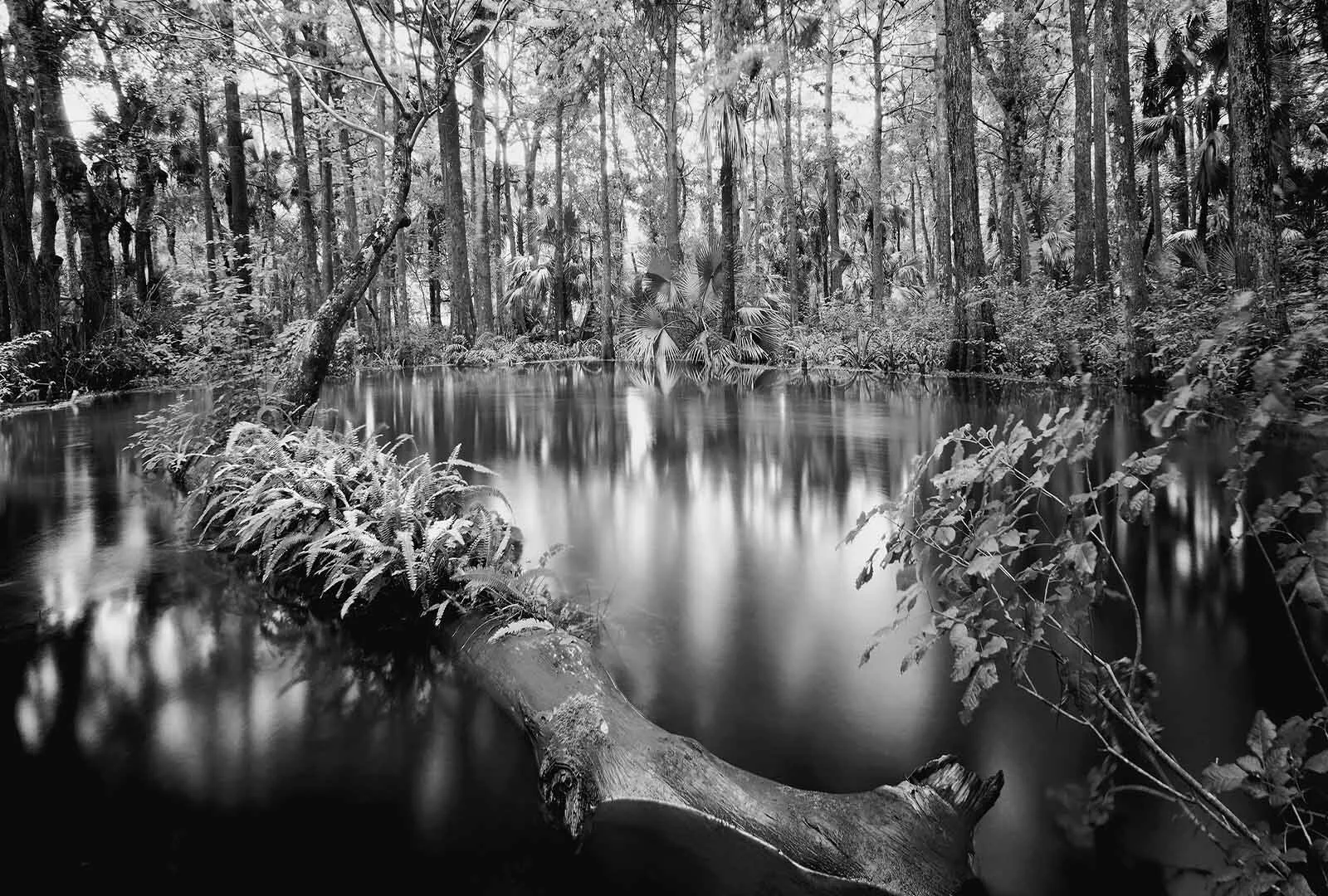
Clyde Butcher, LOXAHATCHEE RIVER 1, 1991
Relevance to practice
Film photography, Large format, Black and white, Colour is overrated, Composition, Courage, Commitment
Keywords
Clyde Butcher, Drive, Vision, Self-promotion, Salvador Dali, Black and white, Large format, Landscape, Florida, Photography, Colour, B&H
References
Butcher, C 1991, LOXAHATCHEE RIVER 1, photograph, viewed 20 June 2020, <https://clydebutcher.com/s/photographs/florida-collection/state-parks/jonathan-dickinson-state-park/loxahatchee-river-1-south-east-fl/>
Crandell, S 2011, ‘Extreme Exposure: Everglades — Clyde Butcher's Wilderness Intuition’, Huffington Post, viewed 8 August 2020, <https://www.huffpost.com/entry/clyde-butcher_b_810107>
B&H Photography Podcast 2020, Clyde Butcher - Photographing the Everglades and Selling Clocks, podcast, B&H Photo Video, viewed 20 June 2020, <https://soundcloud.com/bh-photography-podcast/clyde-butcher-photographing-the-everglades-and-selling-clocks>
Wassily Kandinsky
Wassily Kandinsky
Russia
1866–1944
Practice: Painting, Graphic art
Movement/Style: Expressionism, Abstract art, The Bauhaus
Russian painter, printmaker and graphic artist Wassily Kandinsky is credited for creating the first purely abstract works, and as the forefather or pioneer of Abstract art. Considered to be one of the great Modernists, Kandinsky was also a teacher at the Bauhaus school. Kandinsky’s use of colour is the opposite of my use of black and white, while at the same time having notable similarities.
I use monotone/black and white to encourage in the viewing a very personal interpretation and free emotional connection with the work – I believe that by applying colour is to imply a pre-determined emotional state. Kandinsky, on the other hand, uses abstract form, applying many colours to the work, my personal interpretation of this is that there is such an abundance of shape, texture and colour that it removes any given, or predetermined, emotional state thus, as in my own work, enabling the viewer freedom of interpretation and emotional connection.
As a live music photographer, my primary goal is to photograph energy, sound and emotion over and above any given subject.
Discovering that Kandinsky referred to colour as sound and music as art was an added bonus.
The Kandinsky website quotes the Modernist master: “With few exceptions, music has been for some centuries the art which has devoted itself not to the reproduction of natural phenomena, but rather to the expression of the artist's soul, in musical sound.” (Kandinsky n.d.)
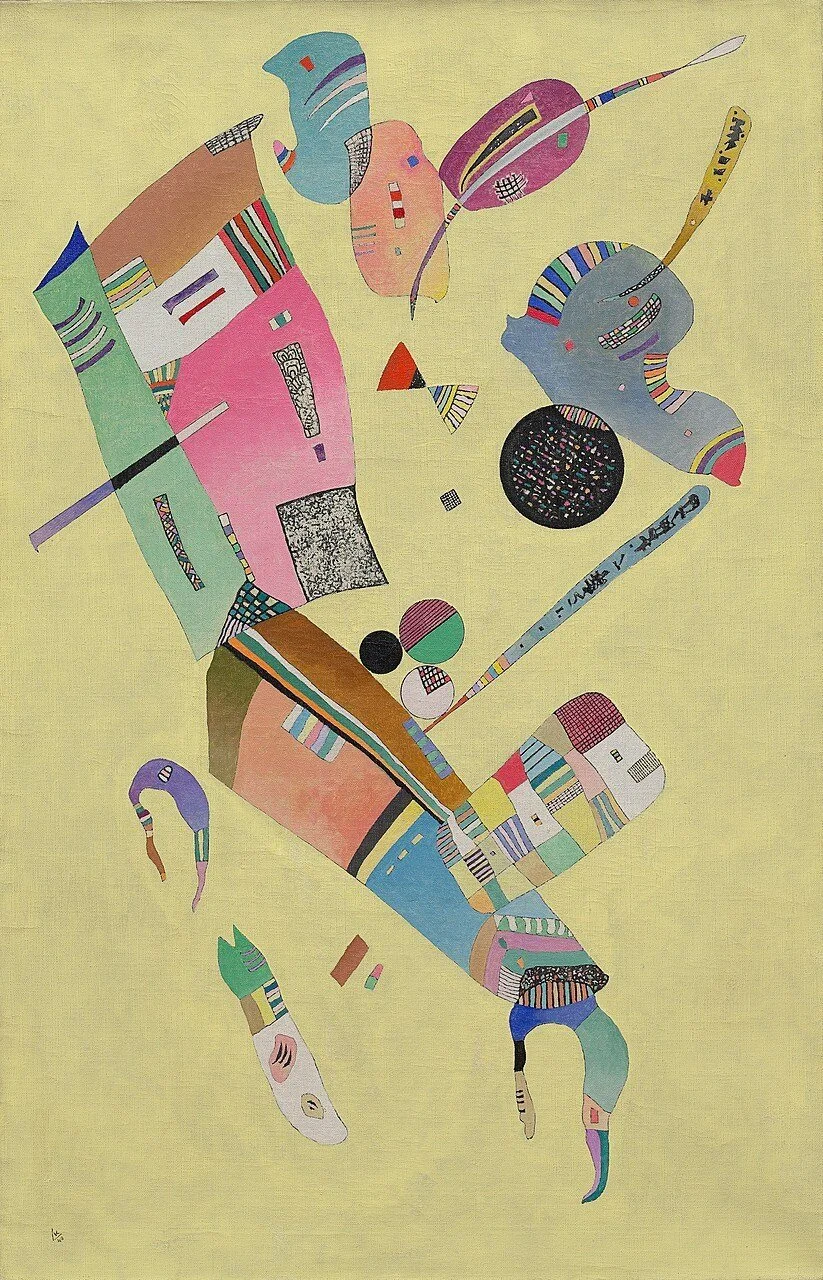
Wassily Kandinsky, Moderation, 1940
Keywords
Wassily Kandinsky, Bauhaus, Painting, Graphic art, Abstract, Expressionism, Colour, Form, Music, Sound, Community of practice, Abstraction, Emotive, Sound, Energy, Music, Tone, Energy, Kinetics, Obscurity, 2-dimensional, Organised chaos, Structure
References
Kandinsky, W n.d., Quotes, viewed 14 April 2020, <https://www.wassilykandinsky.net/quotes.php>
Kandinsky, W 1940, Moderation, painting, viewed 14 April 2020, <https://www.guggenheim.org/artwork/artist/vasily-kandinsky>
Manhattan Arts International n.d., Wassily Kandinsky, viewed 14 April 2020, <https://manhattanarts.com/wassily-kandinsky/>
Tate n.d., Wassily Kandinsky, viewed 14 April 2020, < https://www.tate.org.uk/art/artists/wassily-kandinsky-1382>