
Chronophotography
“Similar to what we know today as ‘time-lapse’ photography, the Chronophotography technique is where a sequence of still images are captured over a pre-determined period, then arranged into a single photograph for analysis. A precursor to cinematography, chronophotography was used to study changes in movement” (Corbett 2008).
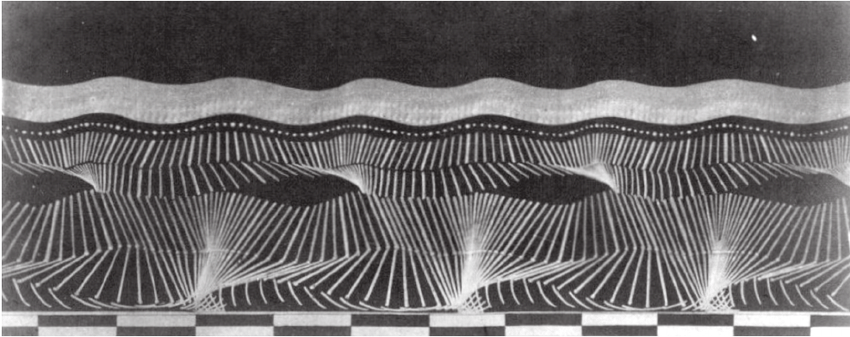
Étienne-Jules Marey, Walking Man, chronograph, 1884
Keywords
Marey, Chronography
Bibliography
Corbett, J. Martin. 2008. "Towards Neuroscientific Management? Geometric Chronophotography And The Thin-Slicing Of The Labouring Body". Management & Organizational History 3 (2): 107-125. doi:10.1177/1744935908092134.
Marey, Étienne-Jules. 1884. Walking Man. Image. https://www.researchgate.net/figure/Etienne-Jules-Marey-Walking-Man-chronophotography-1884-This-was-based-on-adding_fig2_252066643.Marey, Étienne-Jules, and Jackie McAllister. 1997. "Chronophotographs". Grand Street, no. 59: 174. doi:10.2307/25008135.
Marey, Étienne-Jules. 1902. The history of chronophotography. Smithsonian Institute Annual Report 1901. Washington, DC: Smithsonian Institute Publications.
Scharf, Aaron. 1976. "Marey And Chronophotography". Artforum.Com. https://www.artforum.com/print/197607/marey-and-chronophotography-37960.
Sipe, Daniel. 2020. "Aesthetics And The Methods Of Visual Enquiry In The Photography Of Étienne-Jules Marey". French Studies 74 (4): 554-571. doi:10.1093/fs/knaa170.