
Flashing and Fogging
Flashing and Fogging in Analogue Photography
Zo Damage, August 2026
Abstract
The practices of flashing and fogging represent two contrasting methodologies in the ecology of analogue printmaking, both of which impact the tonal qualities and contrast of photographic prints. This paper explores the mechanisms, applications, and outcomes of these techniques, elucidating their roles in achieving desired aesthetic results.
Flashing
Flashing is a pre-image-forming exposure method to mitigate the inertia of gelatin silver paper, thereby facilitating enhanced control over contrast manipulation. This technique involves pre-sensitising the light-sensitive material through exposure to white light, typically projected via an empty negative carrier. Notably, while this method does not involve tone development, its application yields several advantages in the realm of printmaking. These include (a) reduced shadow blocking and improved tonal separation, (b) enhanced highlight detail due to more effective exposure of the paper from the image-forming light, and (c) diminished contrast levels coupled with enhanced detail in the resulting prints.[1]
A preferred technique for achieving pre-flashing involves the insertion of an empty negative carrier into the enlarger, supplemented by the placement of diffusing material—such as transparency paper—beneath the lens. This method can be implemented by appropriately cutting transparency paper to fit within a below-the-lens filter, thus circumventing the necessity for specialised hardware like paper flasher units, which may be difficult to procure owing to the difficulties associated with sourcing historic photographic equipment. The transparency paper effectively diffuses the pure white light emitted through the empty negative carrier, thereby moderating the pre-flash process and allowing for greater control and adjustment over the final print.
Fogging
Conversely, fogging arises when ambient light inadvertently infiltrates the chemical processing phase of photographic print creation. Unlike flashing, which invokes controlled pre-exposure of the light-sensitive substrate, fogging impacts the entirety of the emulsion surface, resulting in a uniform grey tone that obscures the lighter areas of the final print. As with various photographic exposure techniques, an increase in exposure duration correlates with a darker overall tonal rendition.
Fogging typically occurs under sub-optimal light-safe conditions. It is distinguished from pre-flashing by its unpredictable nature, leading to unintended exposure of the emulsion-based paper or negatives, subsequently affecting the emulsion throughout the exposure period.
Although generally considered undesirable—due to its tendency to cause premature exposure, dull grey tones, reduced contrast, and diminished highlight detail—this study intentionally employs fogging as a methodology. By incorporating ambient light during the chemical development phase of printmaking, this approach facilitates the gradual accumulation of tonal variation across the entire surface throughout the exposure duration, albeit in a somewhat chaotic manner.
Summary
In summarising the contrasting methodologies of flashing and fogging, it is clear that both techniques hold significant implications for tonal control and contrast in analogue printmaking. By understanding and manipulating these processes, photographers can cultivate unique aesthetic outcomes, pushing the boundaries of traditional photographic practices. Further research and experimentation could elucidate the nuances of these techniques, expanding their potential applications in the field of photography.
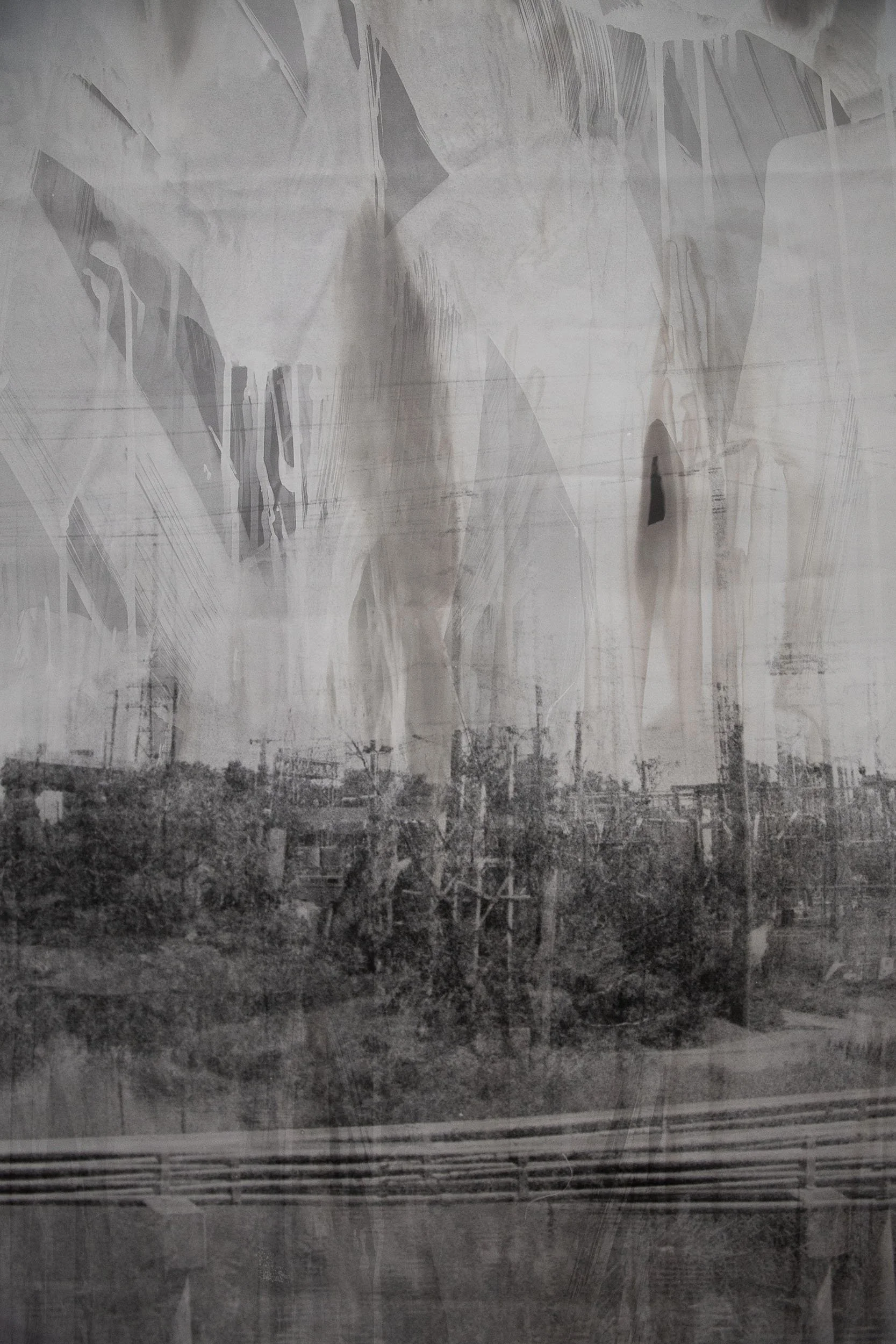
Zo Damage, 2022. Possibilities (AP), 127×70 cm, unique state gelatin silver print (detail), deliberately subjected to fogging via the introduction of ambient light throughout the chemical processing of the print
[1] Les McClean, “Flashing and Fogging,” Les McClean Photography, March 2005, https://www.lesmcleanphotography.com/articles.php?page=full&article=27
Bibliography
McClean, Les. “Flashing and Fogging.” Les McClean Photography. March 2005. https://www.lesmcleanphotography.com/articles.php?page=full&article=27